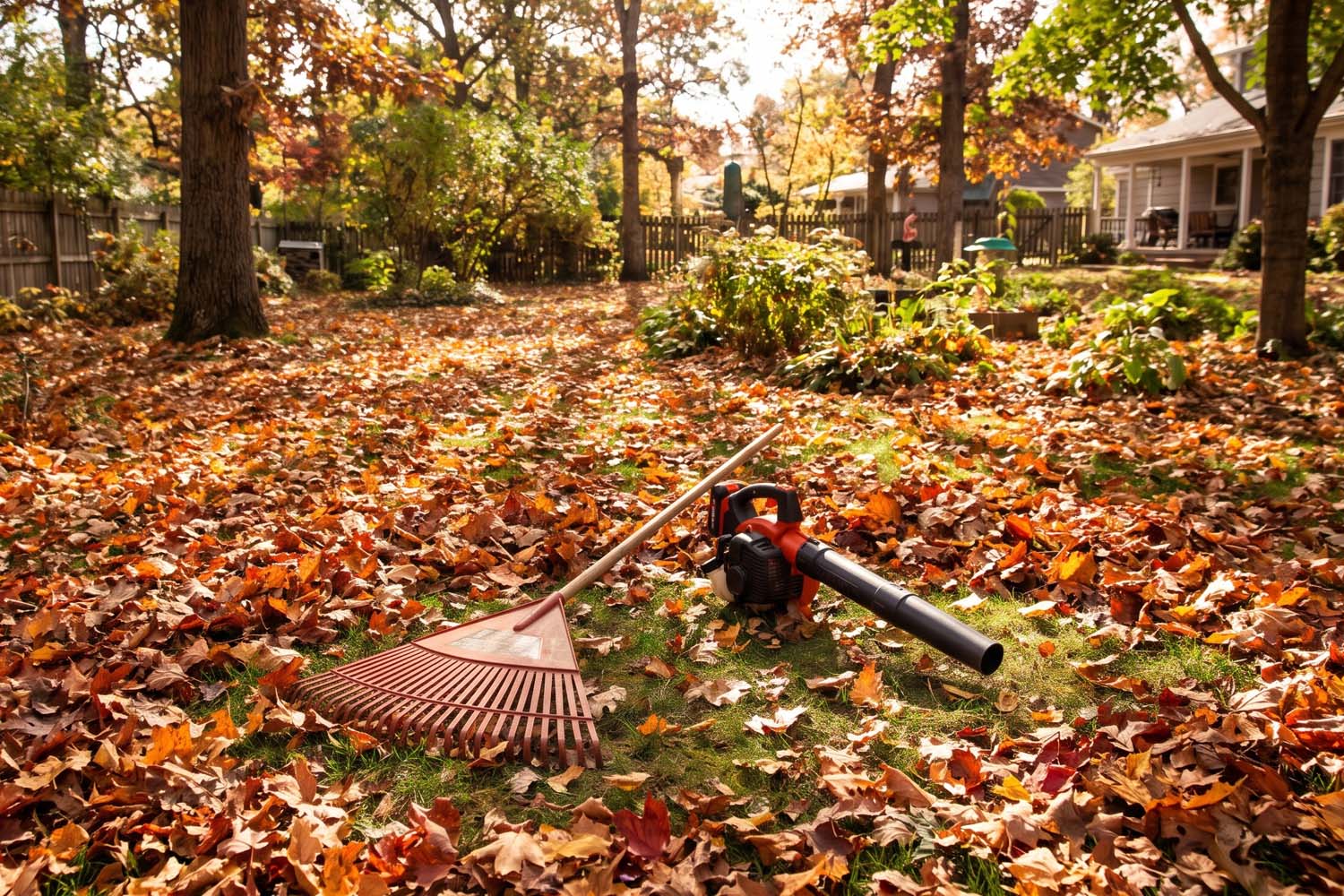

Leaf blower or rake? For a small yard with dry leaves, a rake is quieter, cheaper and easier on the ears. For a big yard, a blower saves a lot of effort. But you may not need to clear every leaf: several university Extension programs say mowing thin layers of leaves into the lawn works, while the Xerces Society says to leave leaves whole in beds for wildlife.
Many competing guides rely on the writers’ own views. Here is what the research and the experts say about hearing, injuries, lawn health, wildlife and storm drains, plus how to decide for your own yard.
The short answer: use a rake for small yards, wet leaves and tight spots, and a blower for large yards when you wear hearing protection and follow local rules. Before you remove everything, decide your goal: mowing thin layers of leaves into the turf suits the lawn, while whole leaves in beds suit wildlife.
Key takeaways
- Hearing protection is recommended with a blower. NIDCD says to wear protectors at or above 85 dBA, and Consumer Reports says the best blowers stay below 65 decibels while the worst exceed 85, so noise varies a lot by model.
- Gas versus battery noise is not settled. In one preliminary NIOSH field evaluation, the gas-blower operator’s projected exposure was much higher than the battery-blower operator’s, but those figures include surrounding noise and do not prove a universal difference.
- A Cleveland Clinic physician says lower-back injuries account for about a quarter of the raking-related injuries they see, and that blowers can lead to poor posture too.
- For the lawn, mow while the layer is thin. K-State says to mow when about an inch of leaves covers the turf, and Virginia Tech and Nebraska say a mower can handle up to 6 inches at a time. That is mower capacity, not a depth to leave.
- For wildlife, keep leaves whole. The Xerces Society says shredded leaves give less cover and mowing can destroy eggs, caterpillars and cocoons, so move leaves to beds instead.
- Keep leaves out of storm drains. USGS found leaves are a significant source of phosphorus in urban stormwater, so follow your town’s leaf collection rules.
Leaf blower or rake at a glance
| Question | Quick answer |
|---|---|
| Which is faster? | A blower, according to competing guides. We did not find an independent timing study. |
| Which is quieter? | A rake. Blowers vary by model: Consumer Reports says the best stay below 65 decibels and the worst exceed 85. |
| Do I need hearing protection? | It is recommended with a blower. NIDCD says to wear protectors at or above 85 dBA. |
| Which is cheaper? | A rake, with no fuel or charging costs. |
| Which works on wet leaves? | Usually a rake, per home-and-garden sites, though wet leaves are heavy. |
| Which is better for my back? | Neither is risk free. Cleveland Clinic says raking causes strains and overuse injuries, and blowers can encourage poor posture. |
| Is mulch-mowing suitable for my lawn? | Several Extension programs say yes for thin layers mowed regularly. Too many leaves can smother grass. |
| Can I leave the leaves? | In beds, yes, and whole leaves help wildlife. On turf, only a thin layer. |
| Are there laws? | Yes. Washington, DC bans gas-powered blowers, and many towns limit hours or types. Check your local code and HOA. |
Leaf blower vs rake vs mulch-mowing
| Factor | Leaf blower | Rake | Mulch-mowing |
|---|---|---|---|
| Speed | Faster on big, open areas (competing guides) | Slower on large yards | Done as you mow; K-State says mow when about an inch of leaves covers the turf |
| Noise | Varies by model (Consumer Reports) | Quiet | A mower is loud too |
| Hearing protection | Recommended (NIDCD) | Not needed | Depends on your mower |
| Air emissions | Gas models produce exhaust; battery models produce no direct exhaust when running | None | Exhaust if your mower is gas |
| Body strain | Heavy models can lead to poor posture (Cleveland Clinic) | Strains and overuse injuries are common (Cleveland Clinic) | Less lifting and bending (our reading) |
| Cost | Higher, plus fuel, charging or repairs | Low | No new tool if you own a mower |
| Wet leaves | Often struggles (home-and-garden sites) | Handles them better, though they are heavy | Not covered by the sources we read |
| Tight spots and beds | Reaches corners and between plants | Better control around delicate plants | Lawn only |
| Lawn health | Can benefit turf by removing excess cover; does not return leaf matter to the soil | Same | Extension programs call it effective for thin layers mowed regularly |
| Wildlife | Can move leaves whole, per Xerces | Can move leaves whole, per Xerces | Shreds leaves; Xerces says mowing can destroy insects sheltering in them |
Our reading: the cost, speed, wet-leaf and body-strain rows for mowing come from competing guides and general knowledge, not independent testing. We left dollar figures out because we found no current, independent price data.
Noise and hearing: the clearest difference
National Institute on Deafness and Other Communication Disorders (NIDCD) says sounds that average 70 dBA or lower over the day are currently considered safe for most people, and to wear hearing protectors when noise is at or above 85 dBA. It lists leaf blowers among loud noises that can put you at risk.
Consumer Reports (updated September 2026) measures blower noise at the operator’s ear and from 50 feet. It says the best models keep the volume below 65 decibels, while the worst exceed 85, and that at 85 decibels you need ear protection to avoid hearing damage even from very brief use. So there is no single answer: check a specific model’s tested noise level before you buy.
A preliminary NIOSH field evaluation of two landscaping crews offers one real-world example. It was measured in August 2018 and published in 2019. One battery blower, a Stihl BGA 85, read 85 dBA in the operator’s hearing zone in short readings of about 10 seconds. The gas-blower operator’s projected 8-hour exposure was 91 dBA by OSHA’s method and 97 dBA by NIOSH’s, compared with 69 and 79 dBA for the battery-blower operator. Those figures were projected from about five hours of monitoring and include surrounding noise, such as a nearby generator and mowing crew. The authors call the results preliminary and not statistically definitive, so they do not show a universal difference between gas and battery blowers. Our practical tip: wear ear protection even with a battery blower, and run it at reasonable hours for your neighbors.
Gas, battery or corded: what changes?
Exhaust is the clearer difference. Gas engines produce exhaust emissions during operation, while battery models produce no direct exhaust emissions when running. Battery manufacturing and electricity have their own environmental costs. In the NIOSH evaluation, management reported that battery blowers performed at least as well as gas ones and workers valued having no exhaust fumes. That is feedback from one site, not a controlled performance test.
Is a gas leaf blower worse than driving a car?
California Air Resources Board’s 2021 fact sheet says one hour of commercial leaf blower operation emits smog-forming pollution comparable to driving a new light-duty passenger car about 1,100 miles. That is a pollutant-specific comparison for commercial equipment, not a measure of greenhouse gases or all pollution, and it does not describe every blower. 11Alive Verify rated similar claims “kind of apples and oranges,” citing an analysis that found a pickup truck emits far more carbon monoxide and nitrogen oxides. The piece is undated and relies on figures from 2000 to 2015, so newer engines may differ.
Are gas leaf blowers banned anywhere?
Yes in some places. Washington, DC prohibits the use of gasoline-powered leaf blowers, with fines of up to $500 per offense, under a law that took effect January 1, 2022. The page lists exceptions, so check it for current rules. Other towns restrict hours or types, so check your town code and HOA rules before you buy.
Which is better for your back and body?
A Cleveland Clinic physician (October 2026) says raking leaves “is a full-body activity, so we see a lot of muscle strains and overuse injuries,” and that lower-back injuries account for about a quarter of the raking-related injuries they see. That is a clinic’s observation, not a national statistic. The advice: pick a dry, mild day, spread the work over several sessions, keep your back straight, bend your knees, avoid twisting, lift bags with your legs, and drink water. It also says blowers can be heavy and lead people to lean or use poor posture, and recommends proper eye and hearing protection.
Is mulch-mowing suitable for your lawn?
University Extension programs generally agree that thin layers of leaves can be mulched into established turf, but heavy accumulations can smother grass. How much a mower can handle depends on the mower, the leaves and how often you mow. The best approach is to mulch regularly rather than wait for a deep blanket of leaves.

| Source | What it says |
|---|---|
| Virginia Tech Extension (reviewed August 2025) | Research indicates up to 6 inches of leaves can be mulched at a time depending on mower size and performance, with multiple passes. A thick layer blocks sunlight and traps moisture, which raises disease risk. Removal is essential where turf use demands it. |
| University of Nebraska-Lincoln (2023) | Up to 6 inches can be mulched at a time depending on your mower. Leaves too deep can smother the lawn and raise snow mold risk. Use a mulching mower or make 2 to 3 passes with a regular mower, and consider alternating between bagging and mulching. |
| K-State Research and Extension (updated 2025) | Mow each time an inch or so of leaves covers the turf. The 6 inches or more is the total processed through a series of frequent mows, not a blanket to wait for. Bagging after chopping decreases the volume two- to four-fold. |
Our reading: all three describe frequent mowing. The 6-inch figure is what a mower can handle, not a depth to leave on the lawn, so the safe approach is to mow while the layer is thin and rake or bag if the grass is disappearing under the leaves.
What about wildlife and the street?
The Xerces Society (September 2026) says many species rely on fallen leaves for cover and insulation, including overwintering bumble bee queens, and that leaf litter shelters spiders, snails, worms and beetles that feed birds and other wildlife. It adds a catch for mowers: shredded leaves will not provide the same cover as whole leaves, and mowing may destroy eggs, caterpillars and cocoons along with the leaves. Its advice is to use a rake or blower to keep leaves intact, move them to out-of-the-way spots or beds, and keep only a thin layer on turf.
Our reading: mulch-mowing is a lawn-management option, not the best choice for insects already sheltering in the leaves. A practical split is to mulch-mow the lawn when the layer gets thick and leave whole leaves in beds, under shrubs and along fence lines.
Our editor’s note: when leaves get thick on our lawn, we run the mower over them to mulch them, and we leave the rest in the beds for birds and small animals. Our guide to feeding backyard birds covers another way to help wildlife through winter.
Where the leaves go also matters. U.S. Geological Survey (USGS) reports that leaves are a significant source of phosphorus in urban stormwater, because rain washes through leaves on streets into storm drains. In a Madison, Wisconsin study that excluded winter, fall leaf litter made up 56% of annual total phosphorus yield without leaf removal, versus 16% in a best-case treatment in which crews also cleared the streets with high-powered blowers before rain. USGS says that exceeds what most municipal programs can do, so ordinary programs may see smaller benefits. It is still a reason not to let leaves wash into storm drains. Our practical tip: compost leaves, mulch them into beds, or use your town’s leaf collection program, and follow its rules on curbside piles.
How to choose for your yard
| Your situation | Typical practical fit |
|---|---|
| Small yard, dry leaves, you want quiet | Rake, or mulch-mow if the layer is thin |
| Large yard with many trees | Blower for piles, plus mulch-mowing where the lawn can take it |
| Wet leaves | Rake, or wait for a dry day, which Cleveland Clinic also suggests |
| Leaves in beds and around plants | Rake or hand-gather, and keep whole leaves in beds for wildlife |
| Wildlife habitat is the priority | Move whole leaves with a rake or blower instead of shredding them |
| Back pain or limited strength | Match the method to your strength and limits, and ask your doctor if you have back problems |
| Neighbors close by or noise rules | Rake, or a quieter tested blower at reasonable hours |
Our reading: this table is our synthesis of the sources above, not a rule from any one of them.
How to use a blower, rake and mower together
- Mulch-mow the lawn when the layer gets thick. K-State says to mow when about an inch of leaves covers the turf.
- Leave beds and edges alone. Xerces says whole leaves in beds shelter wildlife.
- Blow or rake leaves into loose piles where you do need them moved. Our practical tip: work with the wind and keep leaves on your own property.
- Rake the piles. Keep your knees bent and your back straight, per Cleveland Clinic.
- Move leaves somewhere useful. Put them on beds, in a compost pile, or in your town’s collection, following its rules on curbside piles.
- Wear protection. Cleveland Clinic recommends eye and hearing protection for blowers.
Reading the specs: CFM and MPH
Most manufacturers explain the numbers on the box: CFM is the volume of air a blower moves, MPH is the speed of the air, and newtons measure the force on debris. It says higher MPH helps most with dry leaves on hard surfaces, while higher CFM and newtons help with wet or heavy leaves. Compare CFM and MPH together instead of relying on either number alone. This is manufacturer marketing with unsourced figures, so look for independent testing before you buy.
Leaf blower or rake: your questions, answered
Is a leaf blower faster than a rake?
Competing guides say yes, often by a wide margin. We did not find an independent timing study, so treat the exact savings as a rule of thumb.
See also

Do I have to rake leaves at all?
Not always. Virginia Tech, Nebraska and K-State say leaves can be mulched into the turf with a mower, and Xerces says whole leaves can go to garden beds or out-of-the-way spots. You do need to prevent a thick layer from smothering the lawn.
Is mulching leaves bad for wildlife?
It can be. The Xerces Society says shredded leaves give less cover than whole ones and mowing may destroy eggs, caterpillars and cocoons. If wildlife is a priority, move whole leaves to beds instead of shredding them.
How loud is a leaf blower?
It depends on the model. Consumer Reports says the best stay below 65 decibels and the worst exceed 85, and that you need ear protection at 85 decibels even for brief use. In a preliminary NIOSH field evaluation, one battery blower read 85 dBA at the operator’s ear. NIDCD says to wear protection at or above 85 dBA.
Are battery leaf blowers quiet?
Some are, but not all. Quieter models exist, yet one battery blower in the NIOSH evaluation still read 85 dBA at the operator’s ear. Check a model’s tested noise level before you buy.
Is raking good exercise?
It is a full-body activity, according to a Cleveland Clinic physician, which is also why strains and overuse injuries are common. Pace yourself and use good posture.
Can I blow leaves into the street?
Check your town’s rules first. Some towns collect leaves raked to the curb and others restrict it. USGS found leaves left on streets are a significant source of phosphorus in stormwater, so keep them out of storm drains.
Do leaf blowers stir up dust?
A 2000 California Air Resources Board report called the estimated PM10 impact of dust “small, but probably significant” and said operators may be exposed to potentially hazardous concentrations of carbon monoxide and particulate matter. That report is old, and its figures predate newer equipment. Cleveland Clinic recommends eye and hearing protection. Our practical tip: consider a dust mask in dry, dusty conditions.
Are leaf blowers bad for the environment?
Gas blowers produce exhaust, and CARB’s comparison with cars is specific to smog-forming pollutants. Battery blowers produce no direct exhaust when running. Both can remove leaf litter that wildlife uses, per the Xerces Society.
What is the best way to get rid of leaves?
Mulch-mow thin layers into the lawn, compost leaves or use them on beds, and use your town’s collection for the rest. See our guide to improving the look of your yard and our home maintenance tips for more seasonal chores.
The bottom line
Pick the rake for small yards, wet leaves and quiet, and the blower for large yards when you wear hearing protection and follow local rules. Before you clear every leaf, mow thin layers into the lawn and keep whole leaves in the beds for wildlife. Whatever you use, keep leaves out of storm drains.

Better Living may earn commissions through affiliate links and may occasionally feature sponsored or partner content. If you make a purchase through our links, we may receive a small commission at no cost to you.