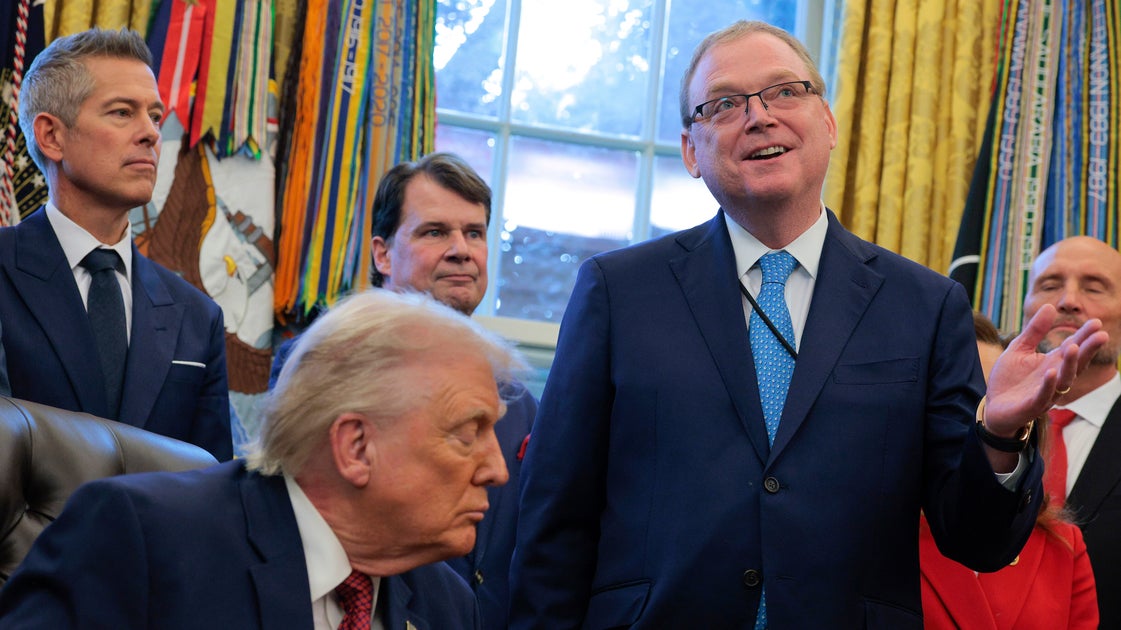

President Donald Trump’s top economic adviser displayed a rather brazen attempt to spin Americans’ struggles with affordability.
Kevin Hassett, director of the National Economic Council, made a dubious claim about rising costs during an appearance on “Fox News Sunday” ― namely, that the increased consumer spending of late is actually evidence of an “optimistic” public.
“People are spending more on gas, but they’re also spending more on everything else, not just groceries, but restaurants and so on,” Hassett said. “And I think that’s a sign that you would see when people are optimistic about the future.”
But an economist who studies food prices and consumer behavior said the interpretation is deeply misleading ― and potentially damaging to public trust.
“Those comments are very detached from reality,” David L. Ortega, a food economist and professor at Michigan State University, told HuffPost. “When we’re talking about things like food, groceries and gas, these are necessities. People have to eat. They need gas to get to work and move around. When we see more spending in those categories, it’s largely driven by higher prices ― not because people are optimistic about where we’re headed or where we currently are.”
Hassett’s remarks echo those of his boss. Trump has also questioned Americans’ concerns about affordability, calling the cost-of-living crisis a “hoax” and shrugging off rising prices as “peanuts.”
But the data tells a different story. Food prices are 3.2% higher today than they were a year ago, Ortega noted, which has a real impact on people’s wallets.
“What is more concerning is that food prices are more than 30% higher today than they were right before the COVID-19 pandemic,” Ortega said. “In 2022, we saw the sharpest year-over-year increase in food prices in about 40 years.”
Grocery costs surged faster in 2022 than any year since 1979 amid the Ukraine war, avian flu outbreak, supply chain disruptions and more challenges.
“What we’ve experienced over the past few years is certainly not within the normal balance of what we were looking at prior to the pandemic,” Ortega said. “And at this moment, food price inflation has moderated from those highs of 2022 when we were looking at double-digit increases, but we’re now seeing a resurgence in inflation. The month-over-month numbers for groceries, in particular this last month, was the fastest increase that we’ve seen since 2022.”
Although cost increases since the pandemic have had multiple causes, Ortega noted that the latest spikes seem to be largely the result of Trump administration policies and a new wave of global uncertainty.
“A lot of this is driven by the impacts of the tariffs and trade policy,” he explained. “And we’re starting to see signs of the Middle Eastern conflict show up in food prices because of higher gas and transportation costs. Immigration policy impacts the availability of labor in agriculture. There is just a tremendous amount of uncertainty at the moment. That’s what differentiates the current moment from other shocks that we’ve seen in the more recent past.”

Chip Somodevilla via Getty Images
Ortega also pointed to more concrete proof of how Americans actually feel about the economy, which seems quite at odds with Hassett’s optimism framing.

“The Consumer Sentiment Index ― which is a good measure of people’s level of optimism or pessimism regarding their financial situations and the broader health of the economy ― recently registered the lowest reading since they began tracking data,” he noted.
For Ortega, the disconnect between official messaging and lived experience has consequences beyond household budgets.
“People lose trust,” he said. “They lose trust in our elected officials; they lose trust in institutions. And it can have pretty significant consequences for how people view the economy. You don’t have to tell folks who are struggling to make ends meet what’s going on. And the messaging they’re getting isn’t aligned with their lived experiences, which leads to an erosion of trust that can be pretty problematic for economic policy going forward.”
For Americans feeling squeezed, there are some everyday ways to help ease the burden.
“Food prices are significantly higher today than they were just a few years ago, and costs are up all along the supply chain. But supermarkets and grocery stores are still competing for customers’ business,” Ortega explained. “So it pays off to shop around a little bit, to take advantage of deals and promotions that some grocery retailers may be able to provide.”
He also recommended considering substituting pricier food items for lower-cost options when possible.
“If there’s a type of protein right now that’s high, you can maybe substitute it for something else, and it also may pay off to consider private labels or store brands that sell at a much more affordable price point than some of the national brands,” Ortega said.
For non-food items, you can also track deals with price-monitoring tools and browser extensions that give you cash back on purchases. Make use of gift cards and rewards points, and avoid rushing into big spending decisions.
Be mindful of your gas consumption and consider exploring ways to make a tank last longer. Keep an eye out for hidden fees that tend to sneakily rise during times of economic uncertainty as well.
Still, individual budgeting strategies only go so far. Ortega was clear that the bigger solutions are political, not personal.
“Prices are high for American consumers right now, and we’ve seen policies and actions in the past year and a half that have really contributed to the resurgence in food price inflation,” he said. “Hold your elected officials accountable. We have elections coming up in November, and that’s an opportunity to hold public officials accountable.”