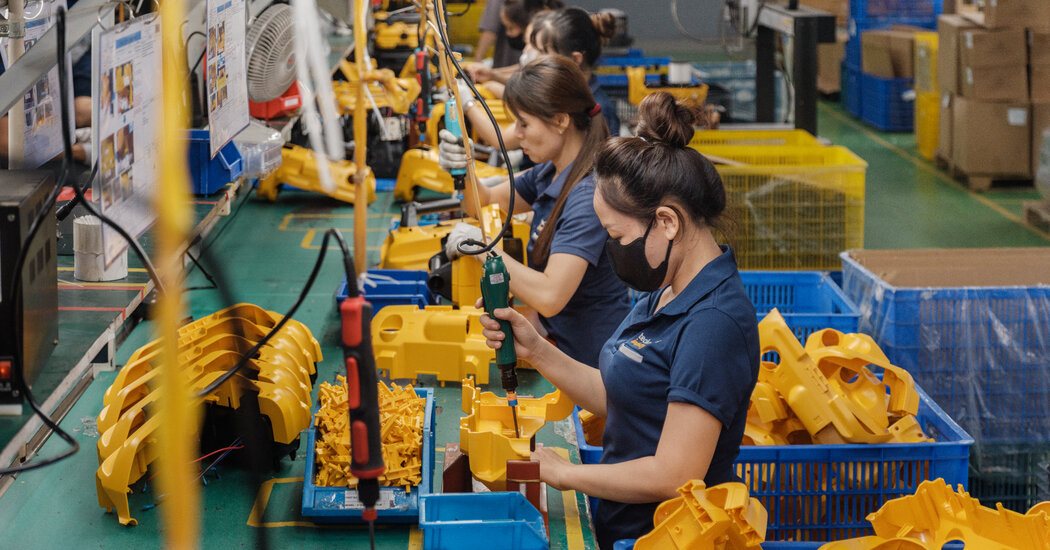

For chief executives and business owners around the world, the Iran war is hammering home an essential reality that they are operating in a world that is riskier and more unpredictable.
And that also means more expensive. Even if the attacks end, the increased cost of doing business will linger. Higher prices look to be a long-lasting side effect of the war in Iran.
Every business leader is saying, “I need to get myself options,” said Kevin O’Marah, chief research officer at Zero100, a firm that does research on supply chains. The urgency is felt by executives across sectors from pharmaceuticals to clothing to electronics.
That means having alternative manufacturers in other locales, stockpiling goods in case of unexpected stoppages and developing new supply chains.
“Flexibility is additional plant capacity, it’s additional pockets of inventory, it’s alternate routes,” he said. “But that flexibility costs money. And that’s inherently inflationary.”
Last week, the International Monetary Fund predicted a fresh bout of global inflation, forecasting a rise to 4.7 percent in 2026 from 4.1 percent in 2025 because of higher prices for basics like energy, metals, fertilizer and food.
And those calculations were made when oil prices had mostly returned to their prewar levels, before there was a sharp escalation in hostilities between Iran and the United States and oil prices shot up.
President Trump’s vow this week to extract a 20 percent fee on all cargo moved through the Strait of Hormuz, if it comes to pass, could double the cost of shipping, analysts say.
With disruptions in the strait, shipping companies such as Maersk have had to employ workarounds. As of June, Maersk had delivered 44,000 containers of goods such as furniture, electronics and food to Persian Gulf countries by rail and truck.
It’s a cumbersome and costly process. Cargo is unloaded from ships at the Red Sea port of Jeddah, Saudi Arabia. Then it is trucked to Kuwait, Qatar and Bahrain by drivers who have journeyed from Jordan, Iraq and Turkey to meet the increased demand.
“That is obviously not the most effective way to do it normally, but if the strait is closed, it is the most effective way to do it,” said Vincent Clerc, the chief executive of Maersk, adding that the alternative route costs the company about $1,000 extra per container.
If the disruptions continue, either the resulting higher costs will be passed on to consumers or retailers will see eroded profits, Mr. Clerc said.
The ripple effect has radiated far beyond the Gulf. The cost of sending a container from Shanghai has edged down from levels they hit in late June and early July.
But rates are high by historical standards, according to Rhenus, a global logistic company. “Despite the recent decline, freight rates still remain 84 percent higher than a year ago,” the company said in an email.

Southeast Asia has been particularly affected. Higher supply chain costs and delivery interruptions are interfering with manufacturing planning and schedules.
“Longer lead times, higher freight costs and elevated energy costs may add pressure to consumer prices,” Rhenus reported.
Longer routes aren’t the only reason delivery times increased by days or weeks during the crisis. When energy prices shot up, some shipping lines engaged in “slow steaming,” or reducing their speeds to save money on fuel, said Tobias Bartz, the chief executive of Rhenus.
Insurance costs will also stay at the highest risk levels until there is at least six months of stability, Mr. Bartz said. But every time there is an incident, as in recent days, the clock resets.
More important, higher costs won’t all disappear when the current crisis in the Gulf recedes.
The heads of companies like Maersk, based in Copenhagen, and the French shipper CGM CMA have already said they can no longer depend on a single pathway but must develop alternatives.
“This is the new operating environment,” Promixa, a global procurement and supply chain consultancy, concluded after surveying more than 500 chief executives of companies that generate income of more than $500 million a year.
The mind-set isn’t just about reacting quickly when a crisis occurs, but rather “creating and running functions that are permanently crisis-ready.” Almost three-quarters of those surveyed said they would accept a cost increase of more than 10 percent to guarantee the resilience of their supply chains.
Building that strength into oil and liquefied natural gas delivery routes is much more difficult, time-consuming and expensive. Some efforts, including pipeline expansions by the United Arab Emirates and Saudi Arabia, were already underway before the Iran war.
But the push has been turbocharged. Kuwait is so desperate to find alternatives to the Strait of Hormuz that it is looking at resurrecting a Saudi pipeline that runs through the Israeli-controlled portion of the Golan Heights and hasn’t been used in more than 35 years, said Jamie Ingram, senior editor at Middle East Economic Survey, a weekly newsletter and energy intelligence publication.
Oman is expanding ports that sit outside the strait; Iraq is studying pipeline proposals; Saudi Arabia and Turkey are exploring rail connections between Jordan to Syria.
As one analyst described it, a “spaghetti junction” will be taking shape in the Gulf as pipelines, roads, rails and ports sprout up to make sure that energy can get from producers to customers.
For some new projects, Mr. Ingram said, “we’re now entering a new era where the benefits of these investments have gone from being pretty abstract theoretical issues to very concrete tangible quantifiable benefits.”
Oil exporters like Saudi Arabia and importers like India are also investing in more storage capacity outside the Gulf region.
All of which means higher costs.
“We’re now in a world of not economizing for the most efficient option,” said David Goldwyn, a former U.S. diplomat and Energy Department official. “We’re in the world of investing in security and investing in resilience and redundancy.”
Jenny Gross contributed reporting from London.