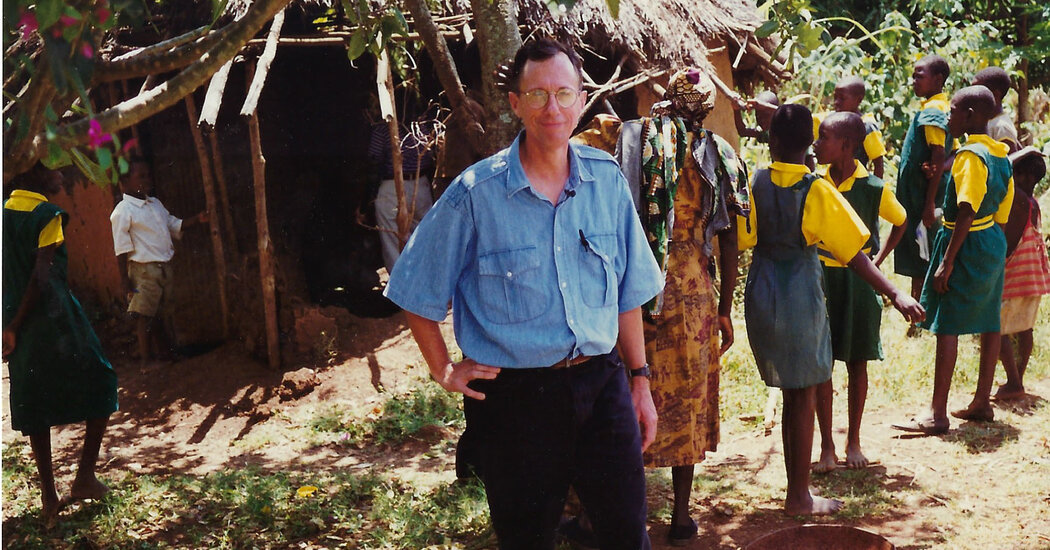

Kent Campbell, an instrumental figure in the global battle against malaria — most notably in Africa, where he led an innovative program providing bed nets to protect rural villagers from the mosquitoes carrying the disease — died on Feb. 20 in Oro Valley, Ariz., a suburb of Tucson. He was 80.
His death, in a nursing care facility, was caused by complications of cancer, his children said.
As chief of the malaria branch of the Centers for Disease Control and Prevention from 1981 to 1993, and later as an adviser to UNICEF and the Bill & Melinda Gates Foundation, Dr. Campbell is credited with helping to save lives on multiple continents.
In Zambia, where he began working on a program with the Gates Foundation in 2005 distributing bed nets and newer antimalarial drugs, malaria cases were cut in half within three years. The program was later expanded to more than 40 other countries in Africa.
“His legacy in my country is as one of the people who greatly contributed to the control and prevention of malaria,” Kafula Silumbe, a Zambian public health specialist who worked closely with Dr. Campbell, said in an interview. “It was a collective effort, but he definitely was part of that initial push.”
Tall and lanky, with a Southern drawl that revealed his Tennessee upbringing, Dr. Campbell stumbled on what would become a four-decade-long career in public health.
In 1972, during his pediatric residency in Boston, he joined the C.D.C. as a conscientious objector to the Vietnam War. Not long after, he was sent to Sierra Leone to help investigate an outbreak of Lassa fever, a virulent hemorrhagic virus.
“I had never heard of Lassa fever,” he said in a video history of the C.D.C. “Probably couldn’t even spell it if I’d been asked to.”
He had little to no training in the importance or use of personal protective equipment. For relief from the intense heat, he poked holes in his breathing apparatus, which he later admitted was a bad idea.
Hoping to learn more about Lassa fever, agency officials dispatched him to Ireland to conduct serologic, or antibody-detecting, tests on nuns who had previously worked in Sierra Leone. He traveled there with his wife, Elizabeth (Knight) Campbell, whom he had married in 1966.
A few days later, he nearly collapsed from an intense headache, high fever and an excruciating sore throat.
Dr. Campbell and his wife then traveled to London so he could be treated at a hospital with expertise in tropical diseases. The episode then took a surreal turn: When U.S. officials sent a military transport plane to retrieve the couple, they included a spare Apollo space capsule, which they rode in as a precautionary measure.
“In retrospect, it’s not clear whether I had Lassa fever,” Dr. Campbell later said. “But clearly I didn’t die.”
With a reprieve on life and a newfound appreciation for disease hunting, he stayed on with the C.D.C. He moved to El Salvador in 1973 to take on malaria, which had been essentially orphaned by global public health agencies and aid groups.

“He was indignant about the injustice and unfairness of things,” Laurie Garrett, who wrote about Dr. Campbell in her book “The Coming Plague: Newly Emerging Diseases in a World Out of Balance” (1994), said in an interview. “It just didn’t seem right to him that a scourge like malaria that was killing millions of people every single year wasn’t getting investment and concern and global attention because most of the people dying of it were poor.”
Carlos Clinton Campbell III was born on Jan. 9, 1944, in Knoxville, Tenn. His father was a life insurance salesman, and his mother, Betty Ann (Murphy) Campbell, managed the household. His parents wanted to call him Clint, but his younger sister, Ann, had trouble saying the name, and he wound up as Kent.
He took an early interest in medicine after his sister and mother both died from cancer — Ann when she was 5, their mother when he was in high school.
He studied biology at Haverford College in Pennsylvania, graduating in 1966. He earned his medical degree from Duke University in 1970 and received a master’s in public health at Harvard University after completing his pediatric residency there.
Dr. Campbell bounced around the world, from the corridors of public health to isolated villages, and back.
“He had a deceptive demeanor because of his Southern, laconic exterior,” Ms. Garrett said. “Almost every time you’d go into his office, these gigantic, long legs would go up on the desk and he’d lean back in his chair. And because he’s so tall, he would automatically fill up, you know, 12 feet of space.”
This made him seem easygoing.
“But then, when he got going, you could feel everything boiling up to the surface,” she added. “He was incredibly impatient, and I think that drove him to ask big questions and to take bold steps to try and help things.”
Following his work at the C.D.C., Dr. Campbell helped create a college of public health at the University of Arizona and consulted for several global health organizations. In 2005, he joined PATH, a health equity nonprofit based in Seattle, as director of the malaria program in Africa funded by the Gates Foundation.
With malaria becoming resistant to the most common drug treatments, he focused on prevention.
“The vector in Africa is basically a single species that is distributed all over the continent called Anopheles gambiae,” he said in an interview with AllAfrica, a Pan-African news organization. “It is like the superstar of transmitters.”
Two years after the bed-net program began in Zambia, the country saw a 29 percent decrease in child mortality, according to PATH.
“To put that in perspective: There’s nothing matching that, which is reflective of how much death malaria caused in Zambia and how powerful bed nets are to decrease transmission,” Dr. Campbell told AllAfrica. “That’s all it really took. It was just remarkable. Clinics emptied out during the transmission season.”
Dr. Campbell is survived by his wife; his children, Dr. Kristine Campbell and Dr. Patrick Campbell; his brothers, Robert and John Campbell; his stepsisters, Melissa Hansen and Rebecca Arrants; and four grandchildren.
Dr. Campbell retired from PATH in 2015.
“I hadn’t set out to battle this infection and disease,” he wrote of his professional career. “In reality, it chose me.”
He added, “We chose not to listen to the naysayers.”