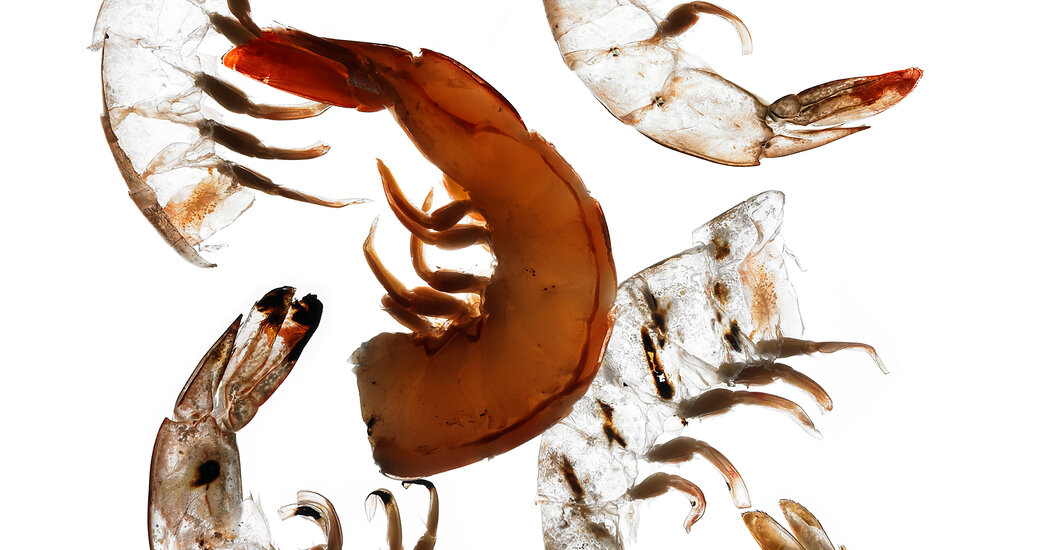

Americans aren’t particularly enthusiastic about seafood. We eat less than half of what a Japanese or Indonesian person does. Less than a third of the average Icelander. But there is one big exception: shrimp.
Our appetite for the fat little crustacean has increased for decades, with the average American now eating almost six pounds per year, far more than any other ocean product. Just ask Red Lobster: The struggling seafood chain declared bankruptcy this month, citing, among other things, an all-you-can-eat shrimp scheme that cost the company $11 million when it underestimated how much people would eat.
But how healthy is our favorite seafood? Is it good for our bodies? What about the world’s mangrove forests and sea turtle populations? And how do you know what to buy the next time you are at the seafood counter?
Human health
Shrimp is a good source of protein, on par with, say, a rib-eye steak. It’s high in calcium and vitamin B12. It’s low in saturated fat, which makes it heart-healthy. And while shrimp is high in cholesterol, experts no longer worry as much about dietary cholesterol’s effect on health.
But if you are looking for the other nutritional benefits we expect from seafood, you will be disappointed. Shrimp tails aren’t particularly high in omega-3 fatty acid, iron or iodine. “From a nutritional perspective,” said Zach Koehn, a nutrition researcher at Stanford University’s Center for Ocean Solutions, “it’s kind of like the white meat of the sea.”
Most seafoods are richer in nutrients than land-based meat, but the shrimp species that Americans consume are low on that list, near the bottom with cod and tilapia. Chicken has more protein, and seafood like sardines, salmon and oysters are far more nutrient rich.
However, because they’re near the bottom of the food chain, shrimp don’t generally tend to accumulate the environmental toxins, like mercury or dioxins, found in big predators such as tuna or swordfish. This puts them on the Food and Drug Administration’s “best choices” list for pregnant women and children, meaning they’re considered safe to eat two or three times a week.
So are there any health downsides to shrimp? A few. Frozen shrimp may contain preservatives like sodium tripolyphosphate and sodium bisulfite, which people with sulfite or phosphate sensitivities may want to avoid. And farmed shrimp can pose a few issues of their own, depending on their country of origin and the condition of individual farms.
Mercury and arsenic can build up in the sludge under shrimp ponds, said José Antonio Rodríguez Martín, a biologist who has studied the issue for the National Institute for Agricultural and Food Research and Technology in Spain. However, even the highest levels of heavy metals Dr. Martín has found in Ecuadorean farmed shrimp were half of what one sees in the least contaminated tuna. He said that meant they posed “no excessive risk” for most people.
In many countries, shrimp farms also use large amounts of antibiotics to keep the animals healthy. Some of the drugs, like nitrofurans, can cause liver damage and are linked to cancer, and almost all are banned in the United States.
Shipments that comply with U.S. law are safe — but not all shipments do, said Julie Lively, a crustacean expert and associate professor at the Louisiana State University AgCenter. Her research, and that of others, has found banned antibiotics in imported shrimp, as well as unlabeled preservatives.
While contaminated imported shrimp is a problem that needs more research, she said it was probably not a grave health risk, comparing it to that posed by plastic packaging. “It kind of comes down to personal choice,” she said. However, she added, antibiotics can cause an allergic reaction in people who are sensitive to them.
The environmental and human costs of shrimp
Now for the really bad news: When it comes to the health of the oceans, many experts say shrimp is among the most damaging foods you can eat. That’s not because shrimp are endangered — most species are resilient — but because of what we have to do to get them.
Most prawns on American plates are imported, primarily from Asia and Latin America. More than half of them are raised in farms: sprawling networks of densely packed coastal ponds, often next to the ocean. Building them destroys crucial coastal habitats like mangrove swamps and other wetlands. And once built, farms can further pollute the coasts with runoff like fertilizers and antibiotics.

Wild-caught shrimp also come with an enormous ecological price: bycatch. Because shrimp are so small, the nets used to catch them tend to catch everything else in their path. In some countries, as much as 90 percent of what comes up in a shrimp net isn’t shrimp. Those sharks, turtles, baby snappers and hundreds of other species tend to die in the nets or on the deck of the boat.
In some places, shrimp production has been downright horrific for humans as well. In 2015, The Associated Press revealed the wide use of slave labor in the Thai shrimp industry. The U.S. Department of Labor has also called out shrimp production in Bangladesh, Myanmar and Cambodia for using child or forced labor.
More recently, investigative reporting from The Outlaw Ocean Project offered a damning look at shrimp farming in India, the biggest shrimp importer to the United States, that raised concerns not just about labor practices, but also banned antibiotics and environmental damage.
How to buy shrimp that’s good for you and the world
Buying healthy and sustainable shrimp is possible — but it takes some work.
To begin with, you need to know where your prawns came from and how they were produced, said Corbett Nash, a spokesman for Monterey Bay Aquarium’s Seafood Watch, an online resource to help consumers make informed seafood choices.
If you are worried about your effect on the environment, farmed shrimp probably has a slight edge, Mr. Nash said. The most sustainable products come from the United States and Canada. But they represent less than 1 percent of the U.S. market and can be hard to find.
Ecuador, the second biggest source of shrimp in the United States, is a good alternative, Mr. Nash said. Honduras and Thailand have relatively strong environmental regulations, too, despite Thailand’s poor human rights record. Avoid most shrimp from India, Indonesia and Mexico, he added.
Wild-caught shrimp are more expensive but also tastier and less likely to be contaminated with environmental toxins. If you’re buying them, fishing practices in the United States and Canada again tend to be less harmful to ocean life than they are elsewhere. Otherwise, look for shrimp certified by the Marine Stewardship Council.
Beyond that, good advice gets complicated quickly, as it varies by country, species and fishing practices. You are best off consulting an online guide.
But experts said the most important thing you can do is simply ask about sustainable options. Even if your waiter or fishmonger has no idea where the shrimp came from — or whether, say, the boat used a turtle excluder device — the question puts pressure on the industry.
“That signifies that there is a desire for sustainable seafood,” Mr. Nash said, “and we can hope that that trickles up to the retailers, that’ll go to the buyers, that’ll go to producers.”
In the end, decisions around shrimp come down to your values about what you eat. Dr. Rodriguez Martín and Dr. Lively said they eat shrimp, as does Mr. Nash, though rarely, and he reads the packaging meticulously. Dr. Lively generally eats shrimp only from the United States.
Dr. Koehn doesn’t eat shrimp, but he tries not to lecture friends and family. Recently his niece had a first communion that included an all-you-can-eat shrimp buffet.
“Do I talk about the labor abuses and the impact on the oceans?” he asked, shaking his head. “They’re 10 years old. Let them enjoy it, and break it to them later.”