
In April 2024, HubSpot asked 537 email marketers across industries in the U.S. if email marketing was inbound or outbound — 51% said it was inbound, while 49% believed it to be outbound. It’s fascinating to see how opinions differ on this topic, even among professionals.

As an experienced marketing leader, I’ve always approached email marketing with a blend of both perspectives. So, I’ll dive deep into what inbound and outbound emails are and how they differ. I’ll also share some examples and insights from other experts.
Table of Contents
What is inbound email marketing?
Inbound email marketing attracts customers by creating valuable content and personalized experiences.
I send inbound emails to leads who’ve already expressed interest in my products or have subscribed to my email list. Examples of these emails include newsletters, content roundups, and discount codes for returning customers.
Now, is email marketing inherently inbound, as 51% of marketers think?
Justin Premick, former content marketing director at AWeber, an email marketing service, would tell you, “If you’re doing email marketing right, it’s inbound.”
However, Melanie Attia, former product marketing manager at Campaigner, an email and marketing automation platform, states, “Email marketing is about engaging in a dialogue which is both inbound and outbound.”
To help you better understand what inbound marketing means, let’s explore its key aspects:
- Audience and engagement.
- Reach and speed.
- Cost.
Audience and Engagement
Inbound email marketing follows the sales funnel, where you develop a content plan for every stage of the buyer’s journey. The steps include attracting strangers, engaging prospects, and securing customers.
The first step of this process is to build brand awareness through blog posts, social media, and search engine marketing (SEM).
It trickles into the second step, where customers express interest. They choose to join your email list or follow your social media accounts. Inbound email marketing takes place during this stage.

Since inbound marketing focuses on sending personalized messages to interested parties, I’ve found that it increases the chances of customers completing the buyer’s journey and making a purchase.
In fact, about 75% of marketers believe a personalized experience boosts sales and increases the likelihood of a prospect becoming a repeat shopper.
Reach and Speed
With inbound email marketing, the goal is to attract an interested audience. I use content, like newsletters and industry news, to draw in potential customers. This process takes time because it relies on organic growth and engagement.
When building my first email list, it took at least six months of persistence to reach the thousand-subscriber milestone. However, the same growth happens a lot faster for outbound email marketing, as you’ll soon see.
Cost
Cost doesn’t affect whether email marketing is inbound or outbound. However, Eliot Vancil, managing partner at Fuel Logic, a fuel delivery service, makes a compelling point: “If you want to grow your business and keep costs down, inbound is the way.”
I agree with him. Inbound marketing costs way less than outbound tactics for a few reasons. First, the return on investment (ROI) is higher since I’m targeting a list of warm leads.
As a result, the cost of acquiring and nurturing them is much lower compared to cold leads, who may need more effort and resources to build awareness and trust.
Second, inbound lists tend to have fewer subscribers at the initial stages, which keeps email service provider costs down since they often charge by the number of emails sent.
In my case, I use HubSpot Marketing Hub. It allows me to send up to 2,000 emails per month for free, so I can grow my email list while keeping costs low.
What is outbound email marketing?
In outbound email marketing, you reach out to prospects who haven’t subscribed to receive emails from you. So naturally, some people consider these emails disruptive.
That said, there’s no denying that outbound emails have their place, especially when you’re looking to make an immediate impact. That’s why 23% of salespeople use cold emails to reach out to prospects.
LawnStarter, a lawn care company, uses outbound emails to announce its presence when entering a new market. CEO Ryan Farle says, “A well-curated list of homeowners and property managers can quickly get several conversions for us when we first come on the scene.”
So, how does outbound email marketing differ from inbound? I’ll cover the three main aspects.
Audience and Engagement
While inbound emails target only people who’ve shown interest in your offerings, outbound emails don’t require recipients to opt in to receive them.
Most businesses will purchase email lists and basically “cold call” their target audience. The goal of this tactic is to reach a wider audience, regardless of expressed interest.
Reach and Speed
Compared to inbound tactics, outbound email marketing gives you a more extensive reach in a shorter amount of time.
Why? Because the goal of outbound emails is to push. Colt Agar, head of marketing at Red Stag Fulfillment, an order fulfillment company, says that outbound marketing is “very sales-driven.”
Marketers push their messages to as many people as possible, hoping to increase brand awareness, click-through rates, and conversion rates.
Although outbound emails can build a larger list in a shorter period, my unsubscribe rates slightly increase when I send cold emails. Outbound emails are unsolicited emails. So, it’s only natural for people to unsubscribe from emails they didn’t ask for.
Cost
Outbound tactics typically have an added cost. One of the primary expenses is acquiring email lists. Marketers often purchase or rent email lists to reach a broader audience. These lists can be expensive, especially if they’re highly targeted and have verified contact information.
Also, email marketing platforms like Mailchimp and Sendgrid increase the costs of their services based on the number of contacts you have and the number of emails you send. Ultimately, the more people you have on your email list, the more you pay to contact them.
Inbound vs. Outbound Email Marketing
By now, you already know that inbound email marketing strategies attract subscribers who are interested in your products and services, while outbound email marketing pushes your products and services to an audience regardless of expressed interest.
With this in mind, I combine the strengths of both approaches when creating an email marketing campaign. Professionals like Tayla Polia, owner of Beacon Strategy, a marketing and public relations company, do the same.
For inbound email campaigns, she focuses on creating relevant content that attracts potential clients. On the outbound side, she targets specific prospects with personalized sales messages.
In summary, here are the key differences between inbound and outbound email marketing:
- Audience and engagement. Inbound emails target a small list of interested subscribers, while outbound emails target anyone, including those who probably haven’t heard about your brand.
- Reach and speed. Inbound email marketing lists are typically slower to build and much smaller to start. Outbound email marketing lists are much larger, and you don’t have to build them from scratch — you can simply buy them.
- Cost. Inbound email marketing costs less on average due to a smaller subscriber count and increased ROI. Outbound email marketing costs more because you have to purchase email lists. Your expenses also increase based on the number of emails you send and the contacts you have. It also doesn’t turn a lot of recipients into customers; thus, the ROI is significantly lower.
Inbound Email Marketing Examples
Let me now share the five most common inbound emails you’ll probably send. Chances are you’ve already sent them if you have an email list or ecommerce website.
1. Curated Email
I use curated emails to combine the best content my company has to offer. I gather the content over a specific time or on a particular topic. The emails can include articles, images, links, and any other content that suits my subscribers.
HubSpot does this pretty well. It doesn’t try to sell me anything. The email is purely about sharing valuable information and insights. This approach builds trust and positions HubSpot as a helpful resource instead of just another company trying to sell its products.
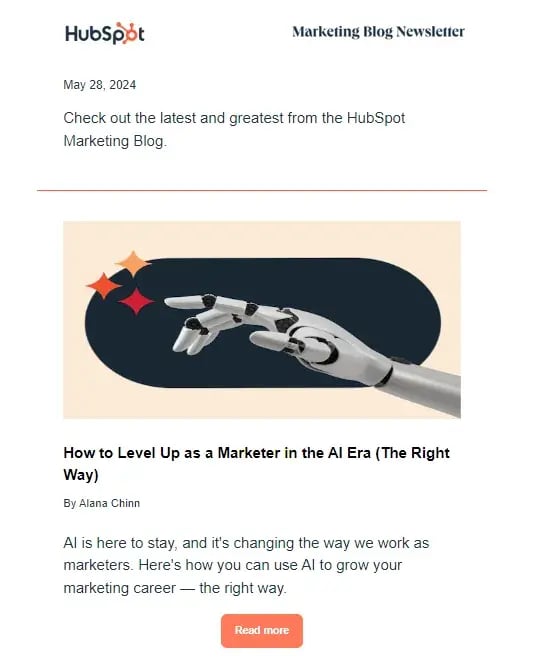
What I like: The email goes straight to the point. It opens with a brief subject line: “Check out the latest and greatest from the HubSpot Marketing Blog.” This immediately tells me what to expect.
2. Welcome Email
Welcome emails are usually the first line of communication in email marketing. You’ve probably received one within minutes of subscribing to a brand’s email list.
Here’s an example from Jacumba Hot Springs, a luxurious hotel:
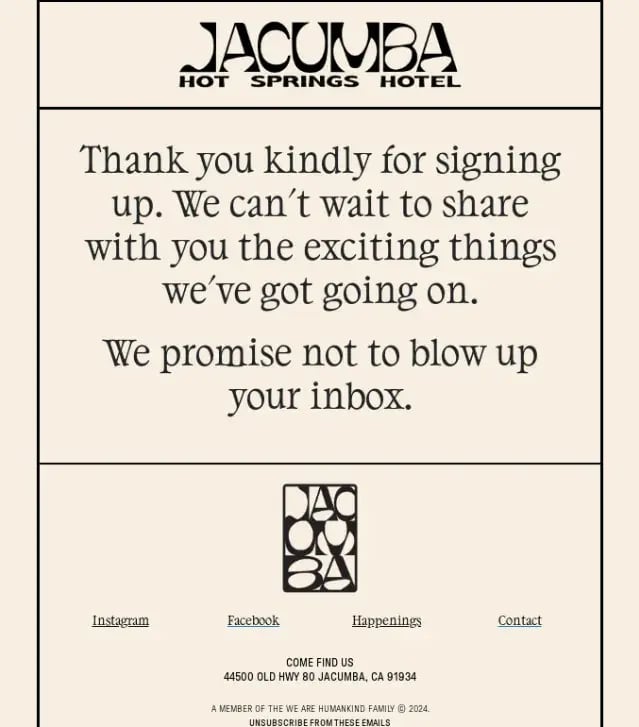
The email has a warm “Thank you kindly for signing up,” opening line, which immediately makes me feel valued as a new subscriber. It’s a nice touch that sets a positive tone.
What really stands out to me, though, is the promise the company makes: “We promise not to blow up your inbox.” It shows they respect my time and will only share exciting things rather than spam my inbox with unnecessary messages.
What I like: The welcome email is simple and courteous. Many emails overwhelm me with a flood of information about their products or services right off the bat. But this one does the opposite, and it’s so refreshing.
3. Abandoned Cart Email
The average shopping cart abandonment rate for ecommerce brands is 70.19%. It’s a pretty high number that makes abandoned cart emails all the more important. Without them, most businesses would lose a lot of potential sales.
Let’s look at an example from French Crown, an international clothing brand.
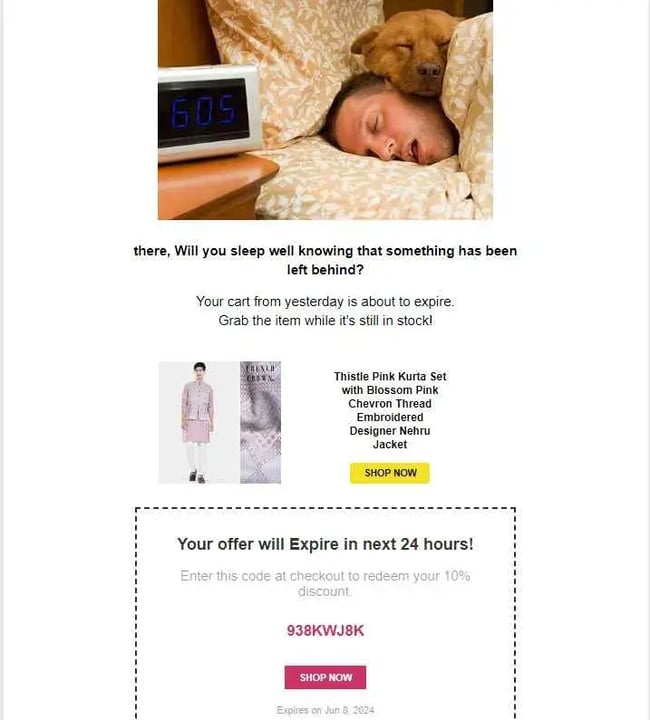
The image of a man sleeping peacefully with his dog, paired with the playful text “Will you sleep well knowing that something has been left behind?” immediately grabs my attention and makes me smile. It’s a lighthearted way to remind a customer about their abandoned cart without being pushy.
What I like: The 10% discount gives me the motivation I need to take action immediately. Highlighting that the offer will expire in the next 24 hours also makes me feel like I need to act fast before missing out on something special.
4. Promotional Email
Promotional emails have one goal — to market a product or service and secure a sale. They always include a clear call to action (CTA) and are often enhanced with a promotional code to entice shoppers.
Here’s a good example from Fossil, a jewelry and small leather goods manufacturer.
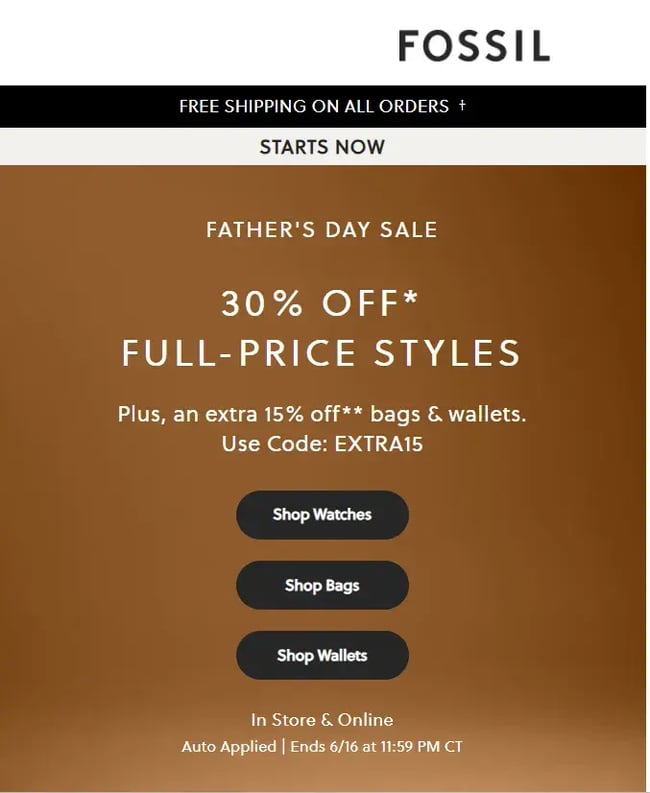
The discount code is prominently featured in all caps, which immediately draws my attention. The visual emphasis on the code “EXTRA15” ensures I don’t miss out on the additional savings. That’s a smart move because it highlights the extra value I’ll get from the purchase.
What I like: The design is simple and elegant. The background has a warm shade of brown, which contrasts nicely with the white text, making the information stand out.
5. Back-in-Stock Email
True to its name, a back-in-stock email tells customers when an item is back in stock. I always make sure my email focuses on one product and creates a sense of thankfulness or urgency in the customer.
This back-in-stock email from BLAQ, a beauty brand, is perfect.
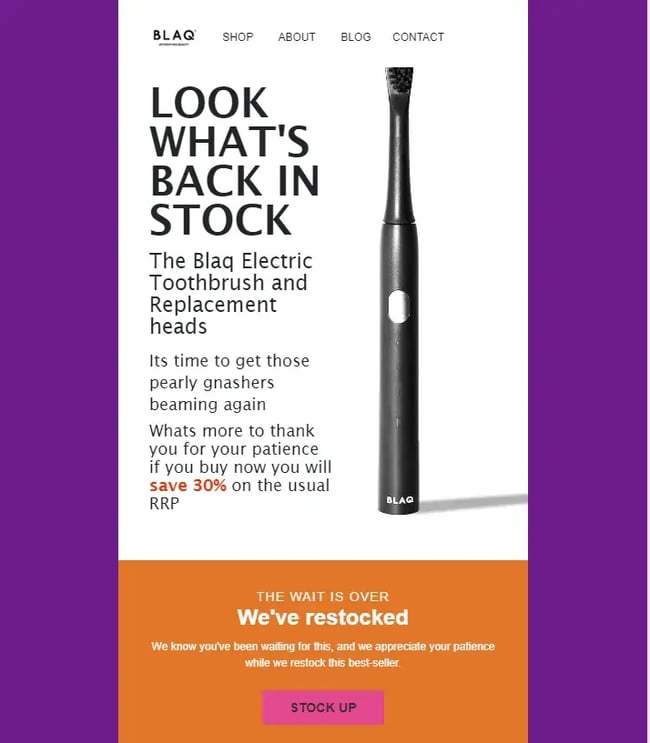
They’re rewarding me for my patience with a generous 30% discount on the retail price. This makes me feel appreciated and gives me a compelling reason to buy the product.
What I like: I love that the BLAQ Electric Toothbrush and Replacement heads image is right next to the headline. It reinforces the message visually, so I immediately know what product they’re talking about.
Outbound Email Marketing Examples
Although outbound emails are typically frowned upon in marketing, I’ve found them to be useful prospecting techniques. Most deals begin with a cold email, which can take on the following formats:
1. The Attention Grabber
The AIDA formula is an effective template for outbound sales emails. The acronym stands for attention, interest, desire, and action.
Here’s a good example that follows this marketing strategy:
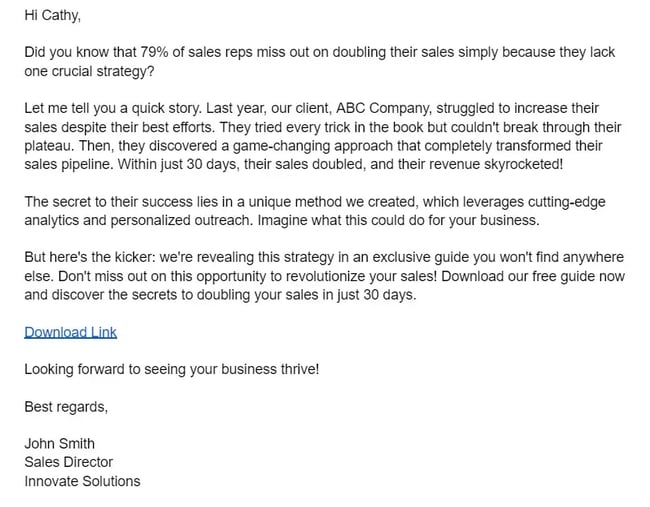
Why it works: John shares a statistic to get Cathy’s attention. He then uses a story to build interest and get her invested. After that, he creates a desire to buy by purposely leaving out a crucial piece of information, which evokes the fear of missing out (FOMO). John’s CTA is also very clear. It drives a specific action — downloading the free guide.
2. The Bridge
Bridging the gap is a common outbound email marketing tactic. In this strategy, I often describe the current reality of my potential customer, then explain how their situation would change if I solved their problem. Lastly, I give them the bridge — how my product or service gets them there.
Let’s look at an example.
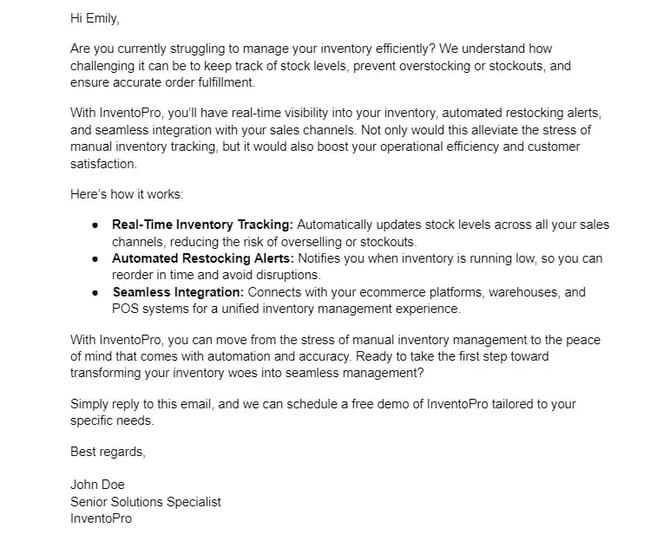
Why it works: The email acknowledges a pain point the recipient might be struggling with, which immediately grabs their attention. It also introduces the product (InventoPro) as the bridge to the desired outcome and highlights specific features that address the identified problems. This builds credibility by providing a concrete solution.
3. The People Pleaser
People love to be praised, so I normally reel them in with a simple and sincere compliment. Next, I follow up with a practical example of a relevant problem and what happened when I fixed it. Then, I give them an idea of how my company can benefit them. Finally, I close the email with a CTA to get more information.
The example below follows my steps brilliantly.
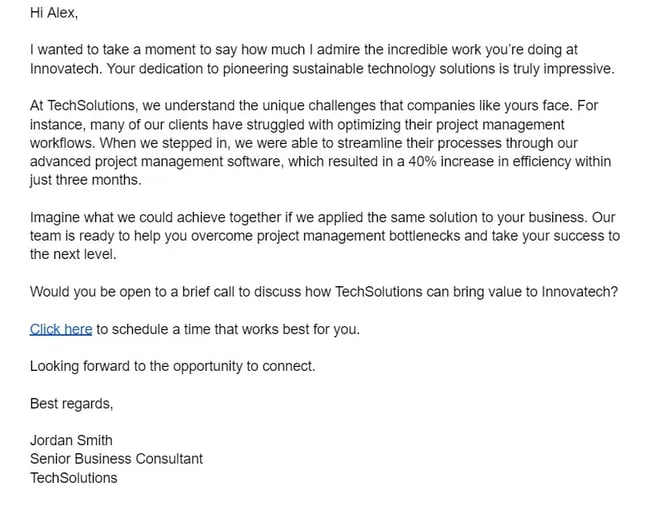
Why it works: The email mentions the recipient’s company and specific achievement, which shows the sender has done their homework and genuinely appreciates the recipient’s work. I also like the sincere compliment that makes the recipient feel recognized. It makes them more open to reading the rest of the email.
4. The Problem Solver
In this type of outbound email, it’s your job to identify a pain point and amplify its impact. You can mention statistics that further support your argument. After that, be the problem solver and offer a solution.
People find value in products or services that make their lives easier, and solving their problems is one way to do so.
Here’s a good example:
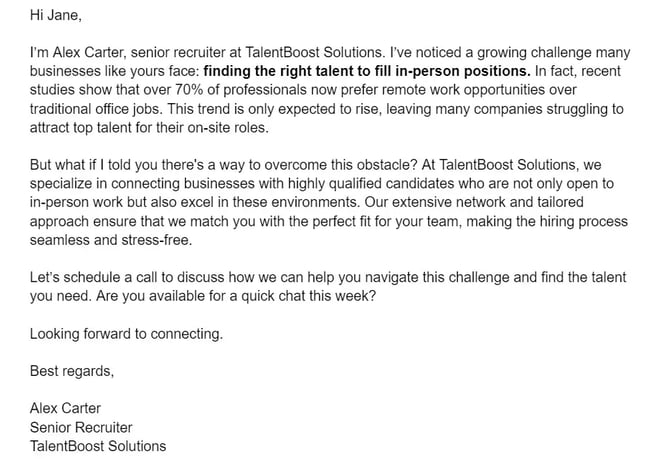
Why it works: The outreach email identifies a problem, emphasizes its significance, and offers a practical solution. In particular, the statistics highlight the trend’s growth, which stresses the severity of the problem. As a result, it’s likely to resonate with the recipient and prompt a response from them.
5. The “Do What You Want”
In the art of persuasion, you’re trying to convince someone to believe something you want them to. It means you’re “threatening their freedom” to choose.
While this sounds extreme, an important tactic is giving them back their choice by reminding them that they can do what they want.
With that in mind, offer recipients your product or service and make a request, but before you close, give them an out.
Let’s look at an example.
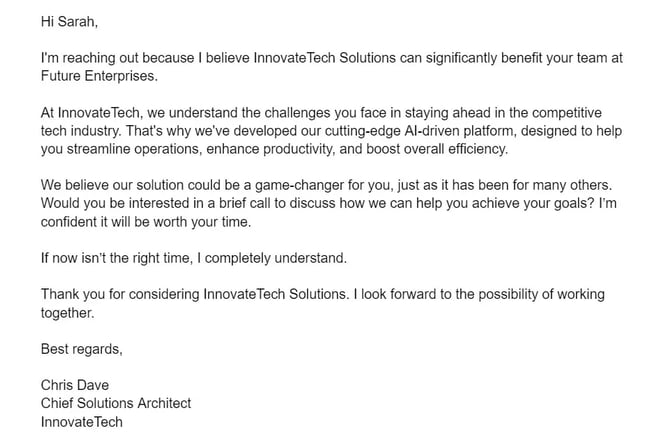
Why it works: The line “If now isn’t the right time, I completely understand” gives the recipient the freedom to choose what they want. This reduces the pressure and makes them more open to your suggestions.
Email Marketing is Inbound and Outbound
In my experience, email marketing is both inbound and outbound. Inbound email marketing allows me to build relationships with people who are interested in my products and services. Outbound email campaigns push my products and services to a wider audience regardless of their interest.
If you want to get the best of both worlds, I recommend a mix of inbound and outbound email marketing strategies. Whatever you do, remember to tailor your emails to your audience’s needs, as this is a proven way to boost your campaign’s effectiveness.
Editor’s note: This post was originally published in December 2021 and has been updated for comprehensiveness.