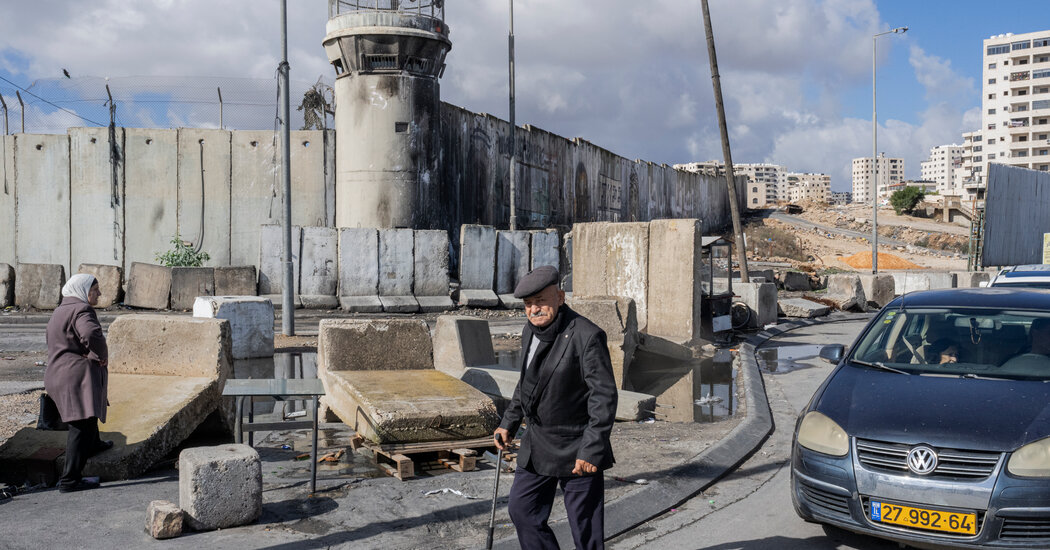

At one of the main checkpoints between the West Bank and Jerusalem, only two of four lanes were open recently and the hours of operation were shortened to 12 hours a day.
Haneen Faroukh, 26, said she now had to wait for hours to run simple errands. Israeli soldiers had sown panic among ordinary Palestinians who make the crossing frequently to reach jobs, doctors, relatives or just their homes.
“They yell at us all the time,” said Ms. Faroukh. “We’re too scared to say anything.”
For many Palestinians, life in the West Bank, already hard under years of Israeli occupation, is now subject to ever more onerous restrictions and an increased military presence since Hamas’s Oct. 7 attack on southern Israel that killed an estimated 1,200 people.
Israeli authorities have created new choke points for travel, throttling traffic. They have stopped allowing many Palestinians to work in Israel, a lifeblood for the local economy. And they have increased the intensity of raids and arrests in West Bank neighborhoods.
The Israeli military says there has been a “significant increase in terrorist attacks” in the West Bank since Oct. 7, necessitating the need for the additional security measures and raids.
Many Palestinians who spoke to The New York Times say these measures, at times humiliating, have provoked frustration and anger. They have watched in horror as an estimated 26,000 people, including friends and relatives, have been killed under heavy Israeli bombardment in Gaza, while facing worsening conditions at home under Israeli authority and attacks at the hands of Jewish settlers.
In the extreme, it has translated into violence by Palestinian factions. Last month, two Palestinian men stole cars and ran over Israelis in a suburb of Tel Aviv, the Israeli police said. One person was killed and 17 others were injured, according to emergency officials. Both men were residents of the Israeli-occupied West Bank.
The hundreds of thousands of Palestinians living in the West Bank — which includes a number of Palestinian cities interlaced with Israeli settlements — have long had to reckon with an Israeli occupation that largely dictates their lives.
Israel controls access to most of the water in the West Bank, restricts Palestinian access to several roads and decides who can enter Israel for work. Israel has continued to authorize the construction of thousands of new buildings on Jewish settlements, while making it extremely difficult for Palestinians to obtain building permits in the areas of the West Bank that Israel directly administers, a fact that blocks most Palestinian development in those areas.
Before the war, more than 100,000 Palestinians in the West Bank were working in Israel and Jewish settlements in the West Bank, according to Raja Khalidi, who leads the Palestine Economic Policy Research Institute.
Since Oct. 7, Israel has canceled the majority of those work permits. And the steady flow of workers from the West Bank who usually cross the border has been reduced to a trickle.
For a few weeks after the Hamas-led attack, buses from Jerusalem to Ramallah in the West Bank were only allowed to drop off passengers as far as the checkpoint, forcing passengers to take different forms of transportation.
Charlie Gabajee, 47, said he worked as a delivery man between Israel and the West Bank until his permit was revoked.

“Life is so restricted now,” he said in his car as he inched his way through the checkpoint to take his 85-year-old mother, Claire, to the hospital.
He explained how Israeli soldiers regularly check cars with their guns trained on the passengers. He fears that it could get worse in the West Bank.
“I think there is a plan for the Israeli government that, after they finish in Gaza, they’ll come here to the West Bank and try to shut it down even more,” he said.
By the middle of December, the number of “access and movement restrictions” Israeli forces established in the West Bank, including checkpoints and road blocks, rose to 694 from 645, according to the United Nations Office for the Coordination of Humanitarian Affairs.
The economic shock waves have rippled through the West Bank.
Israel collected tax money in Gaza and the West Bank and gave the funds to the Palestinian Authority, which has limited self-rule in the occupied West Bank. After Oct. 7, Israel withheld funds earmarked for salary and pension expenses in Gaza. The Palestinian Authority, in turn, refused to accept the partial transfer, which led to many Palestinian civil servants having their wages cut. The Israeli government recently approved a plan for the frozen tax funds to be held by Norway.
With the money frozen, Palestinian banks face increased risks of default on loans to Gazans, Palestinian workers in Israel and to salary-squeezed employees of the Palestinian Authority.
The Palestinian Authority was forced to take out a $400 million loan in December to keep itself afloat. This brought the Palestinian banking system’s overall public debt load to $2.5 billion, Mr. Khalidi said.
“I don’t want to use the phrase ‘perfect storm,’ because it seemed appropriate for Covid, but it’s much worse than that,” Mr. Khalidi said. “The overall blow to aggregate demand and consumption in the economy is being felt through the West Bank, while the collapse in Gaza is seen as a worst case that may yet befall the West Bank.”
Some public schools in the West Bank have shut down because teachers have stopped receiving salaries from the Palestinian Authority. Even if schools are open, some parents are too scared to send their children out of fear they may get caught in an Israeli raid.
“I send my daughter to school but I feel like she’ll die at any moment. I’m on my nerves,” said Manal Hamade, 42, who runs a women’s salon in the Balata neighborhood on the outskirts of Nablus.
“The Israelis used to carry out raids at night, but now at any moment they come in,” she said.
Her anxiousness and wariness reflected the mood of the neighborhood, where residents keep watch for any signs of outsiders that could signal an Israeli raid on the camp.
Across the West Bank and Jerusalem, the Palestinian Health Ministry in Ramallah says, at least 380 Palestinians have been killed since Oct. 7 by Israeli forces.
The Israeli military said in a statement that it “conducts nightly counterterrorism operations to apprehend suspects, many of them are part of the Hamas terrorist organization. In addition, as part of the security operations in the area, dynamic checkpoints have been put up over different places.”
Even before the Hamas attacks, settler violence was hitting its highest levels since the U.N. began tracking it in the mid-2000s. According to U.N. figures in November 2023, there was an average of one incident of settler violence a day in 2021. Since Oct. 7, the average is seven incidents per day. Extremist settlers have been attacking Palestinian homes and businesses in the West Bank. They have burned down the tents of seminomadic Bedouin herders and shot people, witnesses have said.
On Thursday, President Biden ordered broad financial and travel sanctions be imposed on Israeli settlers accused of violent attacks on Palestinians in the West Bank.
Hadya Sidr, 42, lives in the city of Hebron with her husband, Abed, and four children and stepchildren. They said they had gotten used to occasional harassment from settlers living nearby. But since the Oct. 7 attacks, they said, the settlers have felt more emboldened.
Most evenings, Ms. Sidr said, settlers throw stones, trash and empty wine bottles to harass them.
“We were living normally before, you could go out and about, but now, it’s not possible. It’s just too scary,” she said.
Her husband added that the settlers also yell profanity at them: “Muhammad is a pig,” referring to the Prophet Muhammad.
“After 4 or 5 p.m., we do not leave our homes. Why? Because we’re worried that a settler sees us and shoots at us,” he said.
The Sidrs, like many Palestinian families living in the West Bank’s numerous refugee camps — many of which are built-up areas that were established decades ago — said the declining economy had hit them particularly hard.
“In normal times, we’re barely able to get enough food,” said Mr. Sidr, who sews Palestinian embroidery on various textiles. “There is no more living here. Everyone who had some money hidden away has spent it.”
“After the war, we’re going to be forced to beg from people,” he added.
Gabby Sobelman , Hiba Yazbek and Johnatan Reiss contributed reporting.