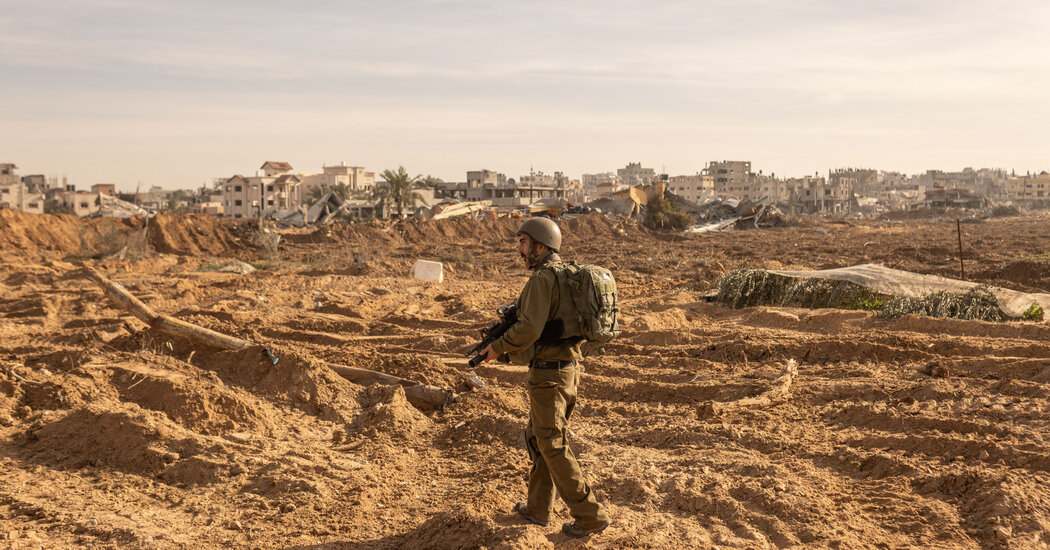

After more than 100 days of war, Israel’s limited progress in dismantling Hamas has raised doubts within the military’s high command about the near-term feasibility of achieving the country’s principal wartime objectives: eradicating Hamas and also liberating the Israeli hostages still in Gaza.
Israel has established control over a smaller part of Gaza at this point in the war than it originally envisaged in battle plans from the start of the invasion, which were reviewed by The New York Times. That slower than expected pace has led some commanders to privately express their frustrations over the civilian government’s strategy for Gaza, and led them to conclude that the freedom of more than 100 Israeli hostages still in Gaza can be secured only through diplomatic rather than military means.
The dual objectives of freeing the hostages and destroying Hamas are now mutually incompatible, according to interviews with four senior military leaders, speaking on the condition of anonymity because they were not permitted to speak publicly about their personal opinions.
There is also a clash between how long Israel would need to fully eradicate Hamas — a time-consuming slog fought in the group’s warren of underground tunnels — and the pressure, applied by Israel’s allies, to wrap up the war quickly amid a spiraling civilian death toll.
The generals further said that a drawn-out battle intended to fully dismantle Hamas would most likely cost the lives of the Israeli hostages held in Gaza since Oct. 7, when Hamas militants invaded Israel, killed roughly 1,200 people and took some 240 captives, according to Israel estimates.
Hamas freed more than 100 hostages in November, but has said it will not release the others unless Israel agrees to completely cease hostilities. Most of the remaining hostages are thought to be held by Hamas cells that are hiding within the subterranean fortress of tunnels that extends for hundreds of miles beneath the surface of Gaza.
On Thursday, Gadi Eisenkot, a former army chief who is serving in the war cabinet, exposed a rift inside the government when he said in a television interview that it was an “illusion” to believe that the hostages could be rescued alive through military operations.
“The situation in Gaza is such that the war aims have yet to be achieved,” said Mr. Eisenkot, adding: “For me, there’s no dilemma. The mission is to rescue civilians, ahead of killing an enemy.”
That strategic bind has amplified the military’s frustration at the indecisiveness of Israel’s civilian leadership, according to the four commanders.
The commanders said that Prime Minister Benjamin Netanyahu’s equivocation about a postwar plan for Gaza was at least in part to blame for the military’s predicament on the battlefield.
Mr. Netanyahu has yet to clarify how Gaza will be governed after the war — and the commanders said that without a long-term vision for the territory, the army could not make short-term tactical decisions about how to capture the parts of Gaza that remain beyond Israeli control. Capturing the southernmost part of Gaza, which lines the Egyptian border, would require greater coordination with Egypt. But Egypt is unwilling to engage without guarantees from Israel over the postwar plan, three of the commanders said.
Asked for comment, Mr. Netanyahu’s office said in a statement that “The P.M. is leading the war on Hamas with unprecedented achievements in a very decisive manner.” In a speech on Thursday, Mr. Netanyahu promised both to achieve “total victory over Hamas,” and also rescue the hostages.
The Israeli military declined to respond to the commanders’ comments.
The generals fear that a lengthy campaign — without a postwar plan — would erode any remaining support from Israel’s allies, limiting their willingness to supply additional ammunition.

Foreign leaders have grown alarmed by the death toll caused by Israel’s campaign: More than 24,000 Gazans have been killed in the war, according to health authorities in the enclave, prompting accusations — strongly denied by Israel — of genocide. Gazan officials have not said how many of those killed were combatants, but Israeli military officials say the toll includes more than 8,000 fighters.
Families of hostages have become more vocal about the need to free their relatives through diplomacy not force. Some hostages taken into Gaza have since been declared dead — and it is not yet clear whether they were accidentally killed by Israeli forces or by Hamas.
Of the more than 100 hostages liberated since the invasion began, only one was freed in a rescue operation. The others were all swapped for Palestinian prisoners and detainees during a brief truce in November.
By focusing its efforts on destroying the tunnels, the military risks mistakes that could cost the lives of more Israeli citizens. Three Israeli hostages were already killed by their own soldiers in December, despite waving a white flag and shouting in Hebrew.
“Basically, it’s a stalemate,” said Andreas Krieg, a war expert at King’s College London. “It’s not an environment where you can free hostages,” he added.
“If you go into the tunnels and you try to free them with special forces, or whatever, you will kill them,” Dr. Krieg said. “You either will kill them directly — or indirectly, in booby traps or in a firefight.”
Many tunnels have been destroyed but if the remaining tunnels are left intact, Hamas will remain effectively undefeated, decreasing the likelihood that the group would release hostages under any circumstances short of a complete cease-fire.
The remaining alternative is a diplomatic settlement that could involve freeing the hostages in exchange for thousands of Palestinians jailed by Israel, along with a cessation of hostilities.
According to three of the commanders interviewed by The Times, the diplomatic route would be the swiftest way of returning the Israelis who remain in captivity.
For some on the Israeli right, the war’s limited progress is the result of the government’s recent decision, following pressure from the United States and other allies, to slow the pace of the invasion.
But military leaders say their campaign has been stymied by a Hamas infrastructure that was more sophisticated than Israeli intelligence officers previously assessed.
Before the invasion, officials thought the tunnel network beneath Gaza was up to 100 miles in length; Hamas’s leader in Gaza, Yahya Sinwar, had claimed in 2021 that it was closer to 300 miles.
Military officials now believe there are up to 450 miles of tunnels underneath a territory that is just 25 miles at its longest point. Under Khan Younis alone, Israel estimates that there are at least 100 miles of passageways, spread across several levels. And across Gaza, there are an estimated 5,700 shafts leading to the network, making it so hard to disconnect the network from the surface that the army has stopped trying to destroy every shaft it finds.
Locating and excavating each tunnel is time-consuming and dangerous. Many are rigged with booby traps, according to the Israeli military.
Once inside, a highly trained Israeli commando loses most of the military advantage he holds above ground. The tunnels are narrow, often only wide enough to pass in single file. That means that any fighting within them is reduced to one-on-one close quarters combat.
On the eve of Israel’s invasion, the military assessed that it would establish “operational control” over Gaza City, Khan Younis and Rafah — Gaza’s three largest cities — by late December, according to a military planning document reviewed by The New York Times.
But by mid-January, Israel had yet to begin its advance into Rafah, Gaza’s southernmost city, and still had not forced Hamas from every part of Khan Younis, another major city in the south.
After the army appeared to establish control over northern Gaza at the end of last year, it said that the war had entered a new, less intense phase. Generals withdrew roughly half of the 50,000 troops stationed in northern Gaza at the peak of the campaign in December, and more departures are expected by the end of January.
That created a power vacuum in the north, allowing Hamas fighters and civilian officials to try to reassert their authority there, alarming many Israelis who hoped Hamas had been entirely vanquished in the area.
On Tuesday, Hamas militants in northern Gaza fired a barrage of about 25 rockets into Israeli airspace, angering Israelis who had hoped that after months of war that Hamas’s rocket launching abilities had been destroyed.
In recent days, police officers and welfare officers from the Hamas-run government have re-emerged from hiding in Gaza City and Beit Hanoun, two northern cities, and tried to maintain day-to-day order and restore some welfare services, according to a senior Israeli official who spoke anonymously in order to discuss a sensitive matter.
And Hamas’s top leaders in Gaza — including Mr. Sinwar, Mohammad Deif and Marwan Issa — remain at large.
Some Israeli politicians say that Israel could defeat Hamas faster, and rescue the hostages, by applying more force. They say that more aggression could also compel Hamas to release more hostages without a permanent cease-fire.
“We should apply much more pressure,” said Danny Danon, a senior lawmaker from Mr. Netanyahu’s governing party, Likud. “We made a mistake when we changed the way we were operating.”
But military analysts say that more force will achieve little.
“It is an unwinnable war,” Dr. Krieg said.
“Most of the time when you are in an unwinnable war, you realize that at some point — and you withdraw,” he added. “And they didn’t.”
Mr. Netanyahu says it is still possible to achieve all of Israel’s goals and has dismissed the idea of stopping the war.
“Halting the war before the goals are achieved will broadcast a message of weakness,” he said in his speech on Thursday.
Rawan Sheikh Ahmad and Johnatan Reiss contributed reporting.