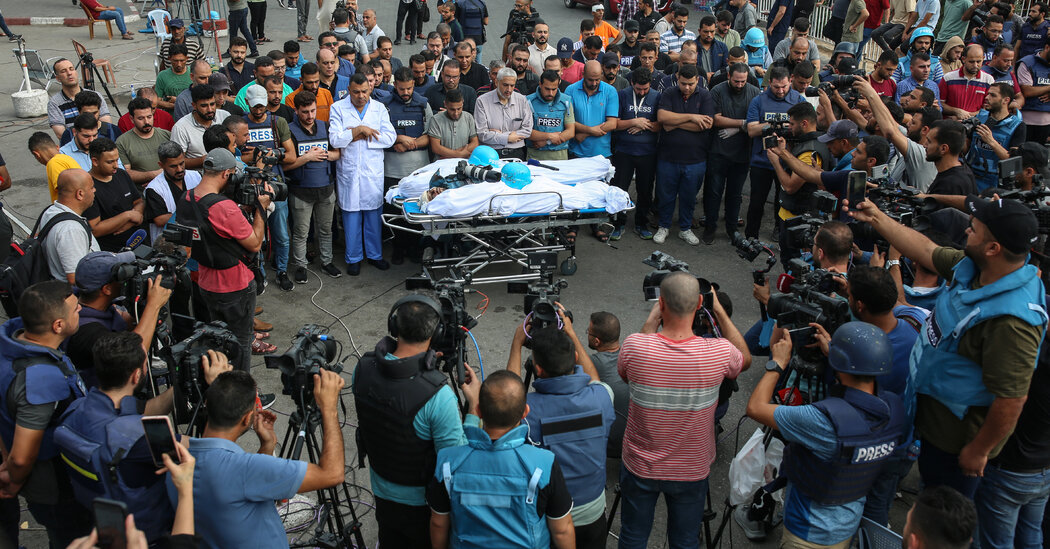

To many people outside Gaza, the war flashes by as a doomscroll of headlines and casualty tolls and photos of screaming children, the bloody shreds of somebody else’s anguish.
But the true scale of death and destruction is impossible to grasp, the details hazy and shrouded by internet and cellphone blackouts that obstruct communication, restrictions barring international journalists and the extreme, often life-threatening challenges of reporting as a local journalist from Gaza.
There are pinholes in the murk, apertures such as the Instagram feeds of Gaza photographers and a small number of testimonies that slip through. With every passing week, however, the light dims as those documenting the war leave, quit or die. Reporting from Gaza has come to seem pointlessly risky to some local journalists, who despair of moving the rest of the world to act.
“I survived death multiple times and put myself in danger” to document the war, Ismail al-Dahdouh, a Gaza reporter, wrote in an Instagram post this month to announce he was quitting journalism. Yet a world “that doesn’t know the meaning of humanity” had not acted to stop it.
At least 76 Palestinian journalists have been killed in Gaza since Oct. 7, when Hamas led an attack on Israel and Israel responded by launching an all-out war. The Committee to Protect Journalists says more journalists and media workers — including essential support staff such as translators, drivers and fixers — have been killed in the past 16 weeks than in a whole year of any other conflict since 1992.
“With every journalist killed, we lose our ability to document and understand the war,” said Sherif Mansour, the group’s Middle East program coordinator.
The New York Times and other major international outlets have evacuated Palestinian journalists who were working for them in Gaza, though some Western news agencies still have local teams there.
At the same time, foreign reporters have repeatedly sought to enter and been denied permission by Israel and Egypt, which control Gaza’s borders.
A handful have embedded with the Israeli military on very short visits that offer a limited and curated view of the war. And a CNN correspondent briefly reported from inside Gaza after entering with an Emirati aid group.
Apart from those, only Gazan journalists have been working there since the war began.
Nearly all the journalists who have died in Gaza since Oct. 7 were killed by Israeli airstrikes, according to the Committee to Protect Journalists, 38 of them at home, in their cars or alongside family members. That has led many Palestinians to accuse Israel of targeting journalists, though CPJ has not echoed that allegation.
“Israel is afraid of the Palestinian narrative and of Palestinian journalists,” said Khawla al-Khalidi, 34, a Gazan TV journalist for Al Arabiya, a well-known regional Arabic-language TV channel. “They’re trying to silence us by cutting the networks.”
An Israeli military spokesman, Nir Dinar, said that Israel “has never and will never deliberately target journalists.” But he cautioned that remaining in active combat zones carried risks. He called the accusation that Israel was deliberately cutting communications networks to hide the war a “blood libel.”
The Palestinian Journalists’ Syndicate, which has members in both Gaza and the West Bank, has counted at least 25 Gaza journalists who it says were wearing protective vests bearing the word “press” when they were killed, said Shuruq Asad, a syndicate spokeswoman. Some journalists have been sleeping away from their families for fear that sheltering with relatives would put them at risk, she added.

Since Oct. 7, Israel has blocked most of Gaza’s electricity and barred all but a slow drip of aid from entering the territory. The war has also damaged or severed communications networks, making it nearly impossible for most Gazans to give interviews to foreign media outlets. Telecommunications have disappeared entirely more than half a dozen times during the conflict.
It falls to Gazan journalists, mostly working for Palestinian or regional Arabic-language outlets such as Al Jazeera, or young freelancers equipped with little more than Instagram, to bring scraps of Gaza’s reality to outsiders. In their instantly recognizable navy-blue “press” vests, many have gained attention on social media for their raw, personal English-language videos and photos of the war.
Every time Amr Tabash, a 26-year-old freelance photojournalist in Gaza, rushes to capture the aftermath of an airstrike, he said he experiences a fear that he might find his family among the victims. Covering one strike, he found out that his uncle and his cousin had been killed.
“I need to be fully focused reporting” on Israel’s attacks, he said. “But I am always worried about my family, and that takes a big part of my focus.”
Others have chosen to leave Gaza altogether.
Motaz Azaiza, a photojournalist who built up a wide following on Instagram with his coverage of the war, evacuated to Qatar last week.
Ms. al-Khalidi, the Al Arabiya journalist, said she had never considered leaving journalism, even as the job got impossibly difficult, far worse than in the previous wars she had covered. But this time, there was no reporting on strikes by day and going home to her family at night, no hot showers, little food. She and her family had to abandon their home for a shelter, she said.
“We’re not just reporting on what is happening. We’re already part of what is happening,” she said.
One journalist who felt duty bound to cover the war was Roshdi Sarraj, 31, who founded a media company at age 18 and also worked as a photographer and fixer for international news outlets.
Before the war, his company, Ain Media, offered production, photography and filmmaking services to local and international clients including Netflix. He and his wife, Shrouq Aila, had worked on a documentary episode for Netflix about bee sting therapy together as they were falling in love, she said.
When the war broke out, they were married with a young daughter and the couple was on a pilgrimage to Mecca, Saudi Arabia. They were planning to fly on to visit Qatar.
Then Mr. Sarraj learned that a friend and fellow journalist back in Gaza had been killed. Another was missing.
Mr. Sarraj’s brother-in-law, Mahmoud Aila, who was helping Ain Media expand in Qatar, said that when he asked about their travel plans, Mr. Sarraj told him, “‘At a time like this, I can only be in Gaza.’” He canceled the trip.
Mr. Sarraj’s friends said this was typical of his loyalty to his birthplace.
Calm and soft-spoken, Mr. Sarraj was stubbornly principled when it came the struggle for justice and freedom for Palestinians. He told friends after the war began that he would not leave his hometown, Gaza City, ignoring Israeli evacuation orders, because he believed fleeing was akin to being forced from his home, as many Palestinians had been during the 1948 war surrounding Israel’s creation.
It was at his family’s home on Oct. 22, while he was sitting with his wife and daughter, that Ms. Aila said an Israeli airstrike hit. He was wounded so deeply that Ms. Aila could see his brain, she said by phone. They bandaged his head, Ms. Aila telling herself that, at worst, he would be paralyzed.
“Doesn’t matter as long as he’s still here,” she remembered thinking. “I don’t care at all if he was paralyzed. I’d stay beside him for life.”
But at the hospital, she was told his case was hopeless; the operating room was already overwhelmed. He died within half an hour, Ms. Aila said.
She remembered kissing his shoulder in farewell: She could swear he smelled of musk, as if someone had perfumed him at the moment of death.
It reminded her of when they were praying in Mecca, their hands on the holy Kaaba shrine’s black cover, which also smelled of musk. She said she had told her husband to pray that he would live to raise his daughter, Dania, so she would not be an orphan like Ms. Aila, who lost both her parents young.
But he had not seemed sure, she said.
Ms. Aila buried him in a mass grave. Amid the chaos, there was no other option.