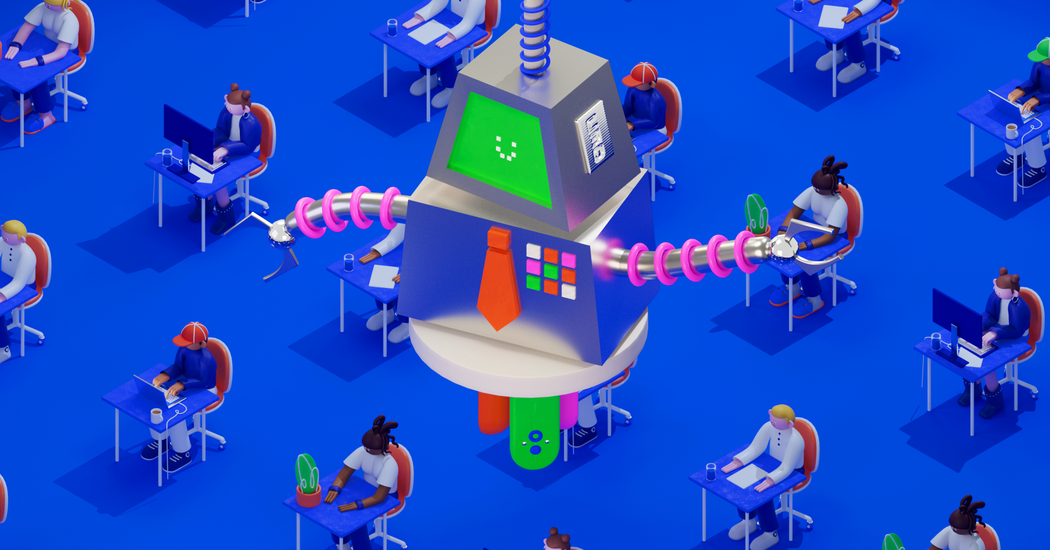

As artificial intelligence programs shake up the office, potentially making millions of jobs obsolete, one group of perpetually stressed workers seems especially vulnerable.
These employees analyze new markets and discern trends, both tasks a computer could do more efficiently. They spend much of their time communicating with colleagues, a laborious activity that is being automated with voice and image generators. Sometimes they must make difficult decisions — and who is better at being dispassionate than a machine?
Finally, these jobs are very well paid, which means the cost savings of eliminating them is considerable.
The chief executive is increasingly imperiled by A.I., just like the writer of news releases and the customer service representative. Dark factories, which are entirely automated, may soon have a counterpart at the top of the corporation: dark suites.
This is not just a prediction. A few successful companies have begun to publicly experiment with the notion of an A.I. leader, even if at the moment it might largely be a branding exercise.
A.I. has been hyped as the solution to all corporate problems for about 18 months now, ever since OpenAI rolled out ChatGPT in November 2022. Silicon Valley put $29 billion last year into generative A.I. and is selling it hard. Even in its current rudimentary form, A.I. that mimics human reasoning is finding a foothold among distressed companies with little to lose and lacking strong leadership.
“In struggling companies, you’ll be replacing operational management first but probably keep a few humans to think beyond the machines,” said Saul J. Berman, a former senior consulting partner with IBM. Overall, he said, “the change delivered by A.I. in corporations will be as great or greater at the higher strategic levels of management as the lower ranks.”
Chief executives themselves seem enthusiastic about the prospect — or maybe just fatalistic.
EdX, the online learning platform created by administrators at Harvard and M.I.T. that is now a part of publicly traded 2U Inc., surveyed hundreds of chief executives and other executives last summer about the issue. Respondents were invited to take part and given what edX called “a small monetary incentive” to do so.
The response was striking. Nearly half — 47 percent — of the executives surveyed said they believed “most” or “all” of the chief executive role should be completely automated or replaced by A.I. Even executives believe executives are superfluous in the late digital age.
When Anant Agarwal, the founder of edX and a former director of M.I.T.’s Computer Science and A.I. Lab, first saw the 47 percent, his initial response was that the executives should be saying something else entirely.
“My first instinct is they would say, ‘Replace all the employees but not me,’” he said. “But I thought more deeply and would say 80 percent of the work that a C.E.O. does can be replaced by A.I.”
That includes writing, synthesizing, exhorting the employees. More subtly, A.I. — if it reaches any of the levels its salespeople are promising — will democratize the job of top management even while scaling it back.
“There used to be a curve of people who were good with numerical skills and those who were not,” Mr. Agarwal said. “Then the calculator came along and was the great equalizer. I believe A.I. will do the same thing for literacy. Everybody could be C.E.O.”

Working for the robots has been a long time coming, at least in the realm of popular culture. Perhaps the first use of the phrase “robot-boss” was in 1939 in a story by David C. Cooke in a pulp magazine called simply Science Fiction. It was not an empowering tale of mentorship and mutual support.
“Remember,” the robot-boss says, “my photon gun will shoot faster than you can run, so don’t try to get away.”
Many science fiction stories and movies followed that portrayed the human-machine relationship in an equally dark light. Nevertheless, real people seemed to perversely warm to the idea. In a 2017 survey of 1,000 British workers commissioned by an online accounting firm, 42 percent said they would be “comfortable” taking orders from a computer.
Long before the current A.I. boom, Jack Ma, then the chief executive of the Chinese e-commerce company Alibaba, predicted that in 30 years “a robot will likely be on the cover of Time magazine as the best C.E.O.” He pointed out that robots were quicker and more rational than humans, and were not driven by emotions like anger.
The Chinese online game company NetDragon Websoft, which has 5,000 employees, appointed what it calls an “A.I.-driven rotating C.E.O.” named Tang Yu in 2022. “We believe A.I. is the future of corporate management,” said the company’s founder, Dejian Liu, adding that it was part of NetDragon’s move into the “metaverse-based working community.”
Tang Yu, who is personified as a woman, does not appear on an online chart of NetDragon’s management team, but the company announced last month that she had won “the coveted title of ‘China’s Best Virtual Employee of the Year’” at the China Digital Human Industry Forum. Another executive picked up the award for her. NetDragon’s A.I. employee team is in charge of performance evaluations and mentoring, among other duties, the company says.
On the other side of the world, the upscale Polish rum company Dictador announced in November that it had an A.I. humanoid C.E.O., Mika. She proclaimed on LinkedIn that she was “devoid of personal bias, ensuring unbiased and strategic choices that prioritize the organization’s best interests.”
Executives with the National Association of Chief Executive Officers might have something to say about this trend — if only to deny it — but its website does not list any actual human beings affiliated with the group. A message sent through a “contact us” prompt received no reply.
A.I. experts, the human kind, cautioned that we are still at the beginning of any transition but said this is a natural progression.
“We’ve always outsourced effort. Now we’re outsourcing intelligence,” said Vinay Menon, who leads the global A.I. practice at the consultant Korn Ferry. He warned that “while you may not need the same number of leaders, you will still need leadership.”
For one thing, humans provide accountability in a way that machines do not. “A.I. may be exploited by some as a way to shield folks from having to take fiduciary responsibility,” said Sean Earley, a managing director of the executive consulting firm Teneo. “At what point does it become culpable for a mistake?”
“Never” was the position one company took in court recently. A customer brought a case against Air Canada for declining to give the bereavement fare reduction that a chatbot on the airline’s site had promised. The customer took his complaint to a small claims tribunal. Air Canada argued in its defense that it cannot be held liable for information provided by one of its agents, servants or representatives — including a chatbot.
The judge ruled against the airline and in favor of the passenger in February, but the specter of a company’s arguing that its own A.I. could not be trusted did not bode well for A.I. management teams. Air Canada declined to comment.
Much of the discussion over the last year about A.I. in the workplace has revolved around how rank-and-file employees are at risk unless they incorporate new technology into their jobs — without, of course, letting their jobs become A.I. Automation historically puts workers at risk even as it benefits investors and managers.
Now the tables are turned. Researchers speculate that automation on the executive level could even help lower-level workers.
“Someone who is already quite advanced in their career and is already fairly self-motivated may not need a human boss anymore,” said Phoebe V. Moore, professor of management and the futures of work at the University of Essex Business School. “In that case, software for self-management can even enhance worker agency.”
The pandemic prepared people for this. Many office workers worked from home in 2020, and quite a few still do, at least several days a week. Communication with colleagues and executives is done through machines. It’s just a small step to communicating with a machine that doesn’t have a person at the other end of it.
“Some people like the social aspects of having a human boss,” Ms. Moore said. “But after Covid, many are also fine with not having one.”