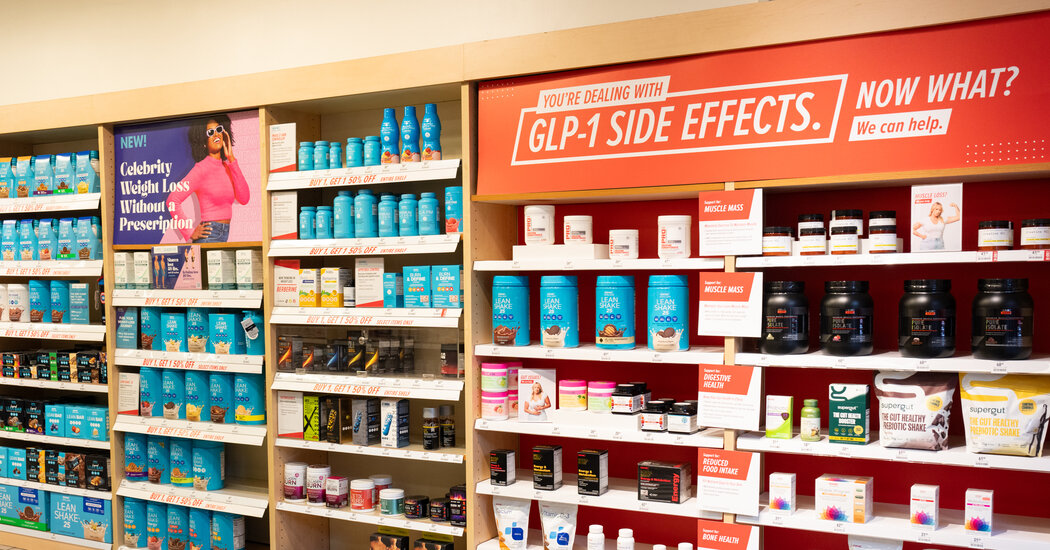

As diabetes and weight-loss drugs like Ozempic and Wegovy took off in the last few years, many people turned away from established diet and nutrition products.
Now, two retailers that specialize in nutritional supplements — GNC and the Vitamin Shoppe — are trying new approaches to win over people who are taking those drugs or who are interested in them.
GNC is dedicating a wall of supplements in its more than 2,300 stores to products that it believes will appeal to people on Ozempic, which contains the compound semaglutide, and other drugs that are known as GLP-1 medicines. The chain is also training workers to help customers assess which substances could help them manage common side effects of those prescription drugs.
Michael Costello, chief executive of GNC, said his company saw a “big opening” in helping individuals taking such drugs for weight loss.
“As we were looking at the trends with folks, where people are going, Ozempic and obviously Wegovy and other GLP-1s started blowing up,” Mr. Costello said in an interview. “We saw there were significant side effects for a lot of those drugs.”
It’s not clear exactly how many Americans are taking Ozempic and similar drugs for weight loss, but Mr. Costello referred to a study from Goldman Sachs that estimates up to 70 million Americans will have tried the medicines by 2028.
GNC thinks it can expand its weight-management category through this push. Currently, less than 10 percent of GNC’s business comes from its weight-management products, but recently, it said, sales in the category have grown more than 20 percent.
Retailers, food and other companies are all trying to figure out how Ozempic and similar drugs will hurt or help their businesses and what, if anything, they should be doing in response.
In October, Walmart, which has a sizable pharmacy business, said it had seen that people taking GLP-1 drugs bought slightly less food than other customers. The month before, an executive at Nestlé, the world’s largest food company, expressed optimism about consumers turning to its Lean Cuisine meals, which is “exactly what you’d end up eating on these kind of drugs.” And the fitness club chains Life Time Fitness and Equinox are offering training programs tailored to people on the medications.
GNC executives said they had assembled more than 20 products that could be used to treat common side effects like occasional fatigue, nutrient deficiency, reduced bone density and loss of muscle mass. It was already selling some of these products, but others are new to the retailer. The supplements include women’s once-daily multivitamins, ginger root capsules and a chocolate lean shake. On the wall, signs list side effects alongside shelves of supplements that can alleviate them.
None of the supplements that GNC has in its reconfigured store were specifically made for or clinically tested on users of the new weight-loss drugs. Medical experts say most people can get all the nutrients they need from a well-balanced diet. In addition, experts say some supplements may not be effective and could cause their own side effects.
“Most patients will not need any supplements,” said Dr. Maria Daniela Hurtado Andrade, an assistant professor at the Mayo Clinic in Jacksonville, Fla., whose research focuses on reducing obesity. She also treats patients who take GLP-1 medications.
Executives at the retail chains said they had curated the assortment in their displays after consulting external doctors, toxicologists, nutritionists and other professionals.
“All recommendations GNC is making for GLP-1 support align with the scientific substantiation, outcome of our consultations with doctors and review of credentialed professionals’ positions on this topic,” Rachel Jones, GNC’s chief product innovation and science officer, said in a statement.

Some retailers have gone a step further. The Vitamin Shoppe has teamed up with WellSync, a telehealth company that fulfills prescriptions of GLP-1 medications. It is the first time the Vitamin Shoppe, which started in 1977, has worked with another business to offer customers a pharmaceutical option — a sign of how seriously retail executives are taking Ozempic and its kin.
“I think there’s no question that we have seen people that have said, ‘Hey, if this isn’t something you offer, I’m going to look elsewhere,’” Lee Wright, chief executive of the Vitamin Shoppe, said in an interview.
In a Vitamin Shoppe survey of more than 1,500 customers, 40 percent of the respondents said they would be “extremely” or “very likely” to use a telehealth service that the retail chain offered. Mr. Wright said learning that some employees in his stores were already on GLP-1 drugs had helped persuade him to work with WellSync.
The Vitamin Shoppe is keeping an arm’s-length distance from the evaluation and prescription process, which involves an online questionnaire of medical history and goals and in some cases a live video interview with a licensed medical provider. (One of the questions is about body mass index.) WellSync manages that process, including working with clinicians. The companies have created a subscription service called Whole Health Rx, which starts at $219.
To bring people back to the chain, the Vitamin Shoppe offers people who subscribe a $25 voucher for use in its stores or on its website.
Similar to GNC, the Vitamin Shoppe is highlighting products like protein powders at its locations to attract people on Ozempic or similar drugs. By early May, Vitamin Shoppe and its sister brand, Super Supplements, will have displays in all 700 stores advertising its telehealth partnership and providing a QR code that directs consumers to the telehealth portal.
The market for supplements related to GLP-1 is pretty new. There have not been any significant trials testing the effectiveness of such products in easing the discomforts that come with using the drugs. And some doctors say many of the common side effects from weight-loss medicines can be easily managed or diminish over time, reducing the need for long-term use of supplements.
For example, Dr. Hurtado Andrade said, instead of recommending probiotic supplements, which have live micro-organisms like bacteria, she encourages her patients to eat food that contains those micro-organisms, like yogurt or kefir. After a detailed assessment, she has, in some cases, recommended protein shakes, powders and supplements to patients who aren’t consuming enough protein, she said.
“I think having that medical supervision is extremely important because we can truly mitigate, or decrease the incidence of, severe side effects that I believe could happen if patients were not closely followed,” Dr. Hurtado Andrade said.
GNC and Vitamin Shoppe executives said their workers — whom they refer to as health enthusiasts or coaches — weren’t standing in for medical professionals. The executives also said the companies’ approaches and strategies had been devised in consultation with staff nutritionists.
“We don’t want our health enthusiasts to try and act,” Mr. Wright at the Vitamin Shoppe said. “They’re not doctors. They’re not trying to give out any medical advice whatsoever.”
GNC’s Mr. Costello said his workers were trained to show empathy for the challenges. To that end, he has asked retail workers to watch Oprah Winfrey’s recent special on Ozempic. The company has also taught them to ask “lifestyle questions” before pointing out supplements, like “What are your goals?” and “What are you currently doing to achieve your goals?”
That’s all fine and good, Dr. Hurtado Andrade said, but she worries that retail workers are not as well informed as medical professionals about how to interpret and address symptoms. That requires knowing what questions should be asked, something that trained health practitioners and providers are trained to do, she said.
“I don’t think a retailer is going to have the capability of thinking of the questions that need to be asked in order to narrow that differential and understand what the diarrhea or any other side effect is related to,” she said.
Those concerns, however, are unlikely to stop retailers and the makers of supplements from diving deeper into what many analysts believe is going to be a fast-growing market.
Four years ago, before Ozempic had become a blockbuster drug, Supergut, a Los Angeles-based company, started selling prebiotic supplements, which feed micro-organisms. It marketed these products, like shakes and snack bars, in part as a way to help people control their blood sugar level.
Two years ago, Supergut began highlighting the potential benefits of its products for gut health and devoted a section on its website to GLP-1 drugs.
“This is the way that we’re going to connect to the consumer consciousness,” Marc Washington, chief executive of Supergut, said. “We’re super relevant for this time and for this Ozempic era,” he added.
In the past six months, sales have quadrupled, he said. GNC is stocking Supergut on its shelves in the GLP-1 section of its stores, the first time the brand is being sold in a national chain. Mr. Washington said he was talking to other national retailers, too.