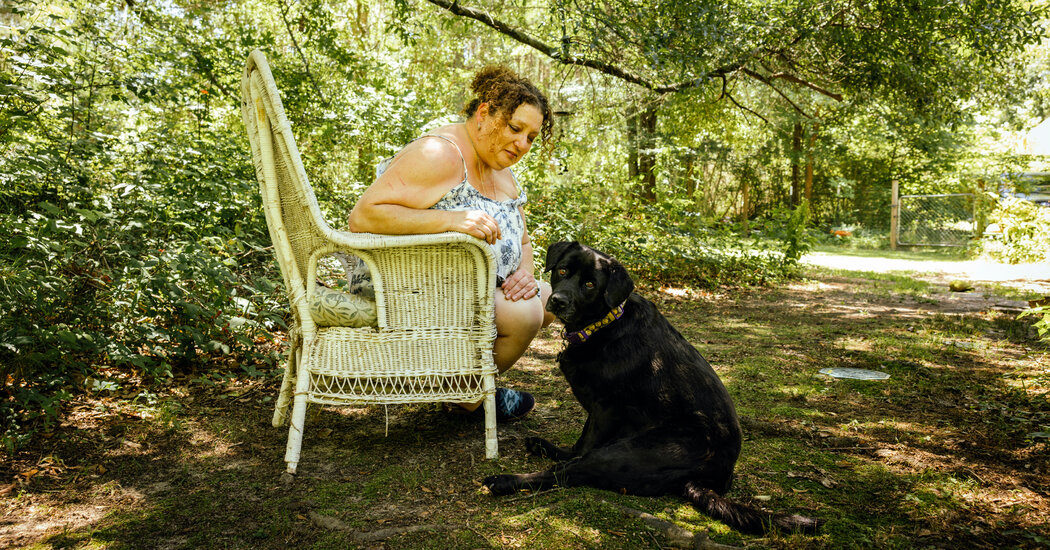

Heather Massey brought Ladybird to the veterinarian when the 9-year-old mutt began having seizures. A scan from an M.R.I. machine revealed bad news: brain cancer.
With the prognosis grim, Ms. Massey decided against further treatment at the animal hospital near her home in Athens, Ga., and Ladybird died four months later. The M.R.I. scan and related care had cost nearly $2,000, which Ms. Massey put on a specialty credit card she had learned about at a previous vet visit.
That was in 2018. She is still paying off the debt, with more than 30 percent interest.
“Could I afford to do that? Not really,” said Ms. Massey, 52, who is disabled and does not work. “Was it worth it to me? Yes.”
Ms. Massey’s experience illustrates the expensive new realities of owning a pet. For decades, veterinarians typically operated their own clinics, shepherding generations of pets from birth to death. They neutered, vaccinated and pulled thorns from paws and noses. When animals became seriously ill, vets often had little to offer beyond condolences and a humane death.
But in recent years, as people have grown more attached to their pets — and more willing to spend money on them — animal medicine has transformed into a big business that looks a lot like its human counterpart. Many veterinary offices have been replaced by hospitals outfitted with expensive M.R.I. machines, sophisticated lab equipment and round-the-clock intensive care units. Dogs and cats often see highly trained specialists in neurology, cardiology and oncology.
This high-tech care has spurred a booming market. Veterinary prices have soared more than 60 percent over the past decade, according to federal statistics. Private equity firms and large corporations have bought hundreds of facilities around the country, an acquisition spree reminiscent of the corporate roll-ups of doctors’ offices.
Veterinarians from around the country told The New York Times that their corporate managers were pushing clinics to become more efficient profit centers. Vets were often paid based on how much money they brought in, creating an incentive to see more pets, order more tests and upsell wellness plans and food.
The result is an increasingly unsustainable situation for animal owners, most of whom don’t have pet insurance.
The Times asked readers to share their stories about expensive vet bills, and hundreds responded. Sophia McElroy of Denver said she donated blood plasma and took extra freelance work to pay for her dog’s ongoing expenses.
Nancy Partridge of Waynesville, N.C., said that months after her cat was diagnosed with an inoperable tumor, she was still chipping away at the $1,500 bill. “We have a dead cat, and we’re still paying,” she said.
In 2015, Claire Kirsch was earning less than $10 an hour as a veterinary technician in Georgia when her own dog, Roscoe, and her horse, Gambit, each had medical emergencies, resulting in bills that totaled more than $13,000. Ms. Kirsch said her animals would have died had she not opted for additional care.
“I knew I would never be able to forgive myself if we didn’t try,” she said.
Ms. Kirsch maxed out a credit card, tapped into her husband’s retirement account and took out a personal loan. Roscoe lived another three years, and Gambit is still alive.

In interviews, veterinarians said pet owners who complained about care costs don’t appreciate the difficulties of running a clinic. Veterinarians make far less money than human doctors and are often in debt from years of education. Their prices have gone up partly because of the rising cost of drugs, vaccines and other supplies, as well as paying workers in a tight labor market.
And because of more advanced medical offerings, pets today can survive serious illnesses, like cancer, that would once have been unthinkable. They have access to surgeries and drugs that can vastly improve their lives.
“We live in the most technologically advanced time in human history, and how wonderful is that?” said Dr. Tracy Dewhirst, a veterinarian in Corryton, Tenn. “But it comes at a cost.”
Even run-of-the-mill visits can rack up big bills. Dr. David Roos, an 86-year-old veterinarian in Los Altos, Calif., said he decided to retire one day in 2014, when he checked on a dog whose owners were longtime clients. The animal had been admitted for vomiting. Dr. Roos said he normally would have told the owner to take the dog home and to give it sips of water. Instead, another vet had ordered X-rays, blood tests, intravenous fluids and a hospital stay. Dr. Roos knew the owners could not afford the bill.
“I realized at that stage that veterinary medicine had changed to the point where I no longer wanted to be a part of it,” Dr. Roos said.
With a growth in pet ownership and surveys showing that Americans are willing to go into debt to pay for their animals’ care, vet clinics have become increasingly attractive to investors. About one-quarter of primary care clinics and three-quarters of specialty clinics are now owned by corporations, according to Brakke Consulting, which focuses on the animal health industry.
In 2015, one major player, Mars — known for selling candy and pet food — acquired a specialty veterinary hospital chain, BluePearl, for an undisclosed sum. In 2017, it nabbed another hospital, VCA, for $9.1 billion. The trend peaked in 2021, with more than 200 private equity deals, according to Pitchbook.
Several veterinarians who have worked in corporate practices said that they were pressured to drive more business. One vet from California said she quit her job after she was told her “cost per client” was too low. Another, from Virginia, said she was told she needed to see 21 animals per day. A third, from Colorado, said she was taken aback when she overheard a manager saying some of the vets at her office needed coaching on “getting the client to a yes.” These vets asked to withhold their names because they worried that speaking out could jeopardize future job prospects with private-equity practices.
Other vets said that corporate ownership had no influence on the care they provided. Still, Dr. Andrew Federer, the medical director of a clinic in Mentor, Ohio, that is owned by a chain called National Veterinary Associates, said that when someone’s pay is tied to how many procedures and tests they perform, the incentives could be difficult to ignore, especially for vets who were just starting out.
“The more they bring into the hospital above their current salary, the more of a production bonus they will receive,” he said.
Only about 4 percent of pet owners have insurance, and even for them, the options are limited. Pet insurance often excludes pre-existing conditions and costs more for older pets who are more likely to get sick.
Companies can also change the terms. This spring, the insurance company Nationwide notified thousands of pet owners that it was discontinuing their coverage, leaving them scrambling to enroll in new plans that excluded the pets’ pre-existing conditions. About 100,000 plans are being discontinued, said Kevin Kemper, a Nationwide spokesman.
Stephanie Boerger of Royal Oak, Mich., said that Nationwide had been covering her cat’s chemotherapy, but told her it would not renew her plan when it expired in August. The treatment, which costs about $1,000 every other month, will not be covered under any available plan.
“Now I feel like I have to choose between paying for my cat’s chemo or letting her die,” said Ms. Boerger, who was able to find new coverage through a competing company.
In a statement, the Nationwide spokesman cited the rising cost of veterinary care. “We are making these tough decisions now so that we can continue to be here for even more pets in the future,” he said.
Many veterinarians offer specialty credit cards sold by outside companies, such as the CareCredit card that was used by Ms. Kirsch and Ms. Massey. Last year, the Biden administration warned that these medical credit cards — which were also promoted by doctors and dentists — drove many consumers into debilitating debt. A spokeswoman for CareCredit said that about 80 percent of cardholders paid off their debt before the no-interest introductory period expired.
Some groups, including the American Society for the Prevention of Cruelty to Animals, are researching how vets can perform common procedures more cheaply. And many veterinarians say they try to offer a “spectrum of care,” a nonjudgmental way of discussing less expensive options.
For many people, a pet’s companionship is priceless.
After Ladybird died, Ms. Massey adopted Lunabear, a Lab mix that she jokes is “allergic to the very air we breathe.” Lunabear needs prescription food that costs $6 a can and takes a $3 allergy pill three times a day. Last year, she had leg surgery.
These costs have totaled nearly $4,000, much of which has been charged to the high-interest credit card. But Ms. Massey, who has major depression and lives alone, said her dogs took top priority. “I pay my bills, and then I buy food,” she said.
Ben Casselman contributed reporting.