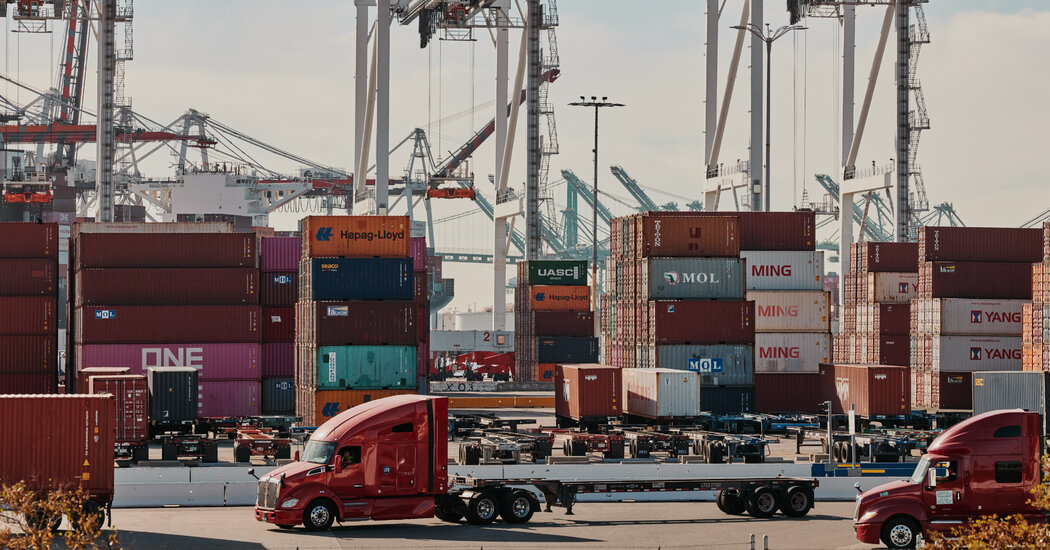

Hot inflation has raised the stakes of President Trump’s plans to escalate his use of tariffs on the country’s biggest trading partners, risking even higher consumer prices and pushing back the prospects of the Federal Reserve lowering interest rates soon.
New inflation data released this week showed price pressures intensifying. The unexpected jump in January’s Consumer Price Index reflected in part seasonal quirks that tend to crop up at the start of the year, but the increase overall was large enough to fuel fresh apprehension about the outlook.
Mr. Trump was quick to point fingers at his predecessor — a line of attack later seized on by Karoline Leavitt, his press secretary, who called the latest inflation data an “indictment on the Biden administration’s mismanagement of the inflation crisis and their lack of transparency in addressing it.”
But imposing tariffs at a time when inflation is not yet vanquished is seen as a risky strategy, especially for a president who vowed on the campaign trail that he would bring prices down on “Day 1.”
“Introducing large increases in the prices of imported goods could breathe new life into some of the inflationary embers that are still glowing in the economy,” said Michael Strain, an economist at the American Enterprise Institute, a conservative think tank.
In Mr. Trump’s first weeks back in the White House, he has already put an additional 10 percent tariff on all U.S. imports from China and slapped 25 percent tariffs on metal imports. He also has held out the possibility of imposing 25 percent tariffs on nearly all goods from Canada and Mexico, although he temporarily paused those levies until March 4. Altogether, the measures will hit more than $1.3 trillion of U.S. imports, and the president has said that tariffs for many other countries and industries, from copper to pharmaceuticals, are in the works.
Mr. Trump is expected to go even further on Thursday and impose what he calls “reciprocal tariffs.” That would raise the levies the United States charges on certain imports — like cars — to match what other countries impose on American products when those goods cross their borders.
The Trump administration on Wednesday gave no indication that it was preparing to change course on its economic strategy based on signs that high inflation was persisting.
Kevin Hassett, the director of the White House’s National Economic Council, said on CNN that Mr. Trump’s plans to cut spending, expand energy production and lower taxes would reduce costs.
That is an argument that has also been made by Peter Navarro, the president’s trade counselor. “These tariffs aren’t happening in a vacuum,” he said in an interview in his office in late January.
Mr. Navarro said he expected countries like China, whose economy relies on Americans’ buying their products, to react to U.S. tariffs by cutting their own prices. “Tariffs do not cause inflation when they’re imposed by the largest market in the world,” he added.
The Chinese government is also likely to devalue its currency, to offset the effects of the tariffs, making its goods cheaper abroad. Mr. Navarro argued that tariffs would also result in more investment domestically in the United States, raising the productivity of workers, which he said was “the best way to fight inflation.”
Stephen Moore, a former senior economic adviser to Mr. Trump, acknowledged that the “inflation dragon has not been slayed,” but also suggested that the president’s tariffs were unlikely to worsen inflation in the context of his overall tax and deregulation agenda. Although he expressed some skepticism about the merits of higher steel and aluminum tariffs, Mr. Moore said he thought that the tariff threats were most likely a negotiating strategy and that Mr. Trump would succeed in curbing inflation.
“If Trump just raised tariffs, that would probably have an inflationary effect, but when you look at the whole agenda — further cuts in income taxes, producing more energy, deregulating energy — in my opinion it will put downward pressure on prices,” Mr. Moore said.

But many economists are more uneasy about the outlook.
Alan S. Blinder, a Princeton economist who previously served as a vice chair of the Fed, warned that tariffs and mass deportations — another cornerstone of Mr. Trump’s economic agenda — constitute “stagflationary shocks.”
“They’re inflationary, and they’re anti-growth,” he said.
According to an analysis published by economists at the Federal Reserve Bank of Boston this month, an additional 10 percent tariff on imports from China as well as a 25 percent tariff on goods from Canada and Mexico could add as much as 0.8 percentage point to “core” inflation, a measure that strips out volatile food and energy prices.
The effects would be significantly greater if Mr. Trump followed through on his campaign pledge to impose a universal tariff, the economists warned. Core inflation could rise by an additional 2.2 percentage points if a 10 percent levy was imposed on imports from the rest of the world and tariffs on Chinese imports rose to 60 percent, their research showed.
Typically, tariffs are viewed as policies that lead to just a one-off increase in prices that does not translate to sustainably higher inflation. But the actual impact depends on a number of factors, including how they are phased in, if businesses pass along those higher costs to consumers and, perhaps most importantly, if those consumers end up changing their spending patterns to account for higher prices.
Raphael Bostic, president of the Federal Reserve Bank of Atlanta, said at a recent event that business executives he had spoken to expected to pass on higher costs to consumers “100 percent.”
“It’s one thing to expect it — it’s another thing to do it, and so we’ll actually have to see what happens,” he said.
Drawing lessons from Mr. Trump’s first trade war in 2018, Omair Sharif, founder of the research firm Inflation Insights, said he expected higher costs tied to tariffs on certain household goods to be passed on to consumers this time around, too.
Back then, for example, the C.P.I.’s laundry equipment index jumped roughly 18 percent over three months after a 20 percent tariff was placed on large residential washing machines, suggesting to Mr. Sharif that “nearly the entire tariff was passed through quickly.”
“I would expect something similar,” he said.
Given the uncertainty about the inflation outlook and Mr. Trump’s policies, the Fed has opted to stand pat on further interest rate cuts for the time being. The Fed’s chair, Jerome H. Powell, told lawmakers this week that the central bank wanted to see more progress that inflation was on track to return to its 2 percent target and that if price pressures did not improve, the Fed would “maintain policy restraint for longer.”
That plan runs counter to Mr. Trump’s desire for lower interest rates, which he reiterated in a social media post on Wednesday. “Interest Rates should be lowered, something which would go hand in hand with upcoming Tariffs!!!,” he wrote.
Austan Goolsbee, president of the Federal Reserve Bank of Chicago, acknowledged that extracting a signal from the inflation data is likely to get more challenging as Mr. Trump enacts policies that are expected to directly impact prices. That puts the Fed in an “uncomfortable situation of trying to distinguish what component of the increase in prices is coming from a thing that we should look through and what is a sign of overheating,” he said in an interview on Wednesday.
Fed officials will also be closely watching to see whether consumers start to materially change their expectations about future inflation in a substantive way — something Mr. Goolsbee said would be “a very alarming sign.”
So far, the evidence is scant that Americans have lost faith that over time inflation will come down. Still, the situation is fraught given the circumstances of the past few years.
“We’ve just been through the most wrenching inflation experience in the past 40 years,” said David Wilcox, a senior fellow at the Peterson Institute for International Economics and the director of U.S. economic research at Bloomberg Economics who previously ran the Fed’s research and statistics division. “The policy risks associated with unfounded complacency on inflation have to be much greater.”