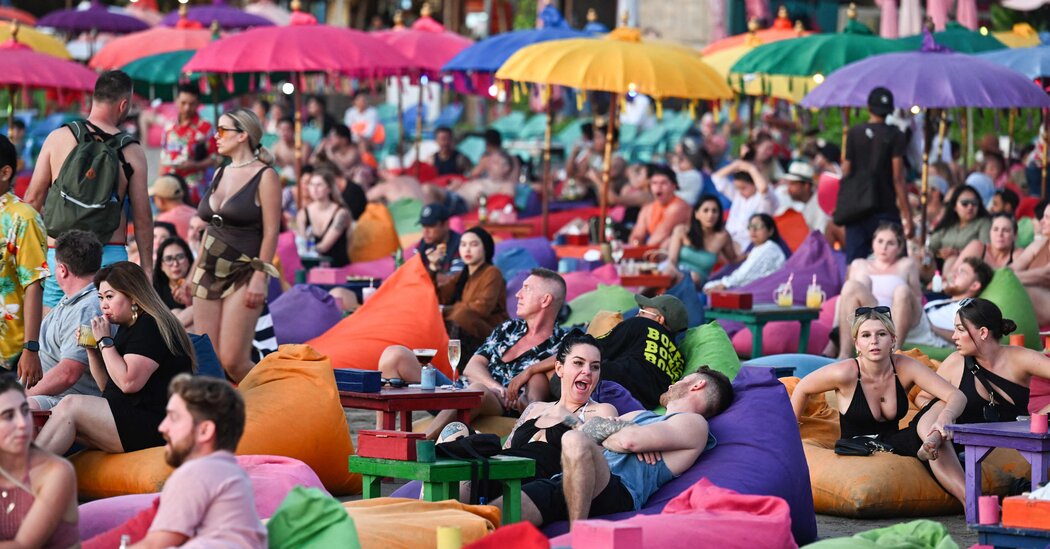

A new tourist fee in Bali. Higher hotel taxes in Amsterdam and Paris. Stricter rules on public drinking in Milan and Majorca. Ahead of the summer travel season, leaders in many tourist spots have adopted measures to tame the tourist crowds — or at least earn more revenue from them.
All of this may pose headaches for travelers, although in most cases, the new fees or tax increases represent only a tiny fraction of the total cost of a trip. The goal is to ensure that tourism functions smoothly for visitors and locals alike, said Megan Epler Wood, managing director of the Sustainable Tourism Asset Management Program at Cornell University.
“All tourism is dependent on beautiful natural and cultural resources. You have to protect those resources in order to be a viable tourism destination — and if you don’t, they degrade,” Ms. Epler Wood said.
In some places, proposals for new fees or visitor rules have drawn opposition from residents, who fear they might scare away the tourists who bolster the local economy. But destinations need to find ways to counteract what Ms. Epler Wood calls “the invisible burden” of tourism, which includes strains on a community’s infrastructure, utilities and housing stock, as well as tourists’ carbon footprint and any challenges they might impose on residents’ daily lives.
“You put so much pressure on the place that the people who live there become unhappy, and then they don’t present a very good face to tourists,” Ms. Epler Wood said. “The longer you wait, the higher the cost to fix it.”
Here is a look at new measures that travelers can expect this summer, and where others might be coming in the future.
New visitor fees
Since February, visitors to the Indonesian island of Bali have been asked to pay a levy of 150,000 Indonesian rupiahs, or about $9.40 per visit. Revenue will be used to support the preservation of cultural and natural assets on the island, where tourism has brought major challenges related to litter, water supply and overcrowding. Visitors are encouraged to pay the new fee online before departure, although it’s also possible to pay on arrival at the airport.
Beginning Aug. 1, most foreign travelers to the Galápagos Islands — which had a record-breaking 330,000 visitors last year — must pay a $200 entry fee, double the current rate. The money raised will be used to support conservation, improve infrastructure and fund community programs.
The change is the first increase to the entry fee since it was introduced in 1998, said Tom O’Hara, communications manager for the Galápagos Conservation Trust. Mr. O’Hara noted that the increase comes a year after the UNESCO World Heritage Committee urged the government of Ecuador to work toward a “zero-growth model” for tourism in the Galápagos.
“It’s quite a complicated topic,” Mr. O’Hara said, noting that the fee increase has been viewed “as part of the solution to overtourism.” On the other hand, he added, “everyone is trying to reassure the local tourist industry that this isn’t going to kill tourism on the islands.
In April, Venice began imposing a fee — 5 euros, about $5.40 — on day-trippers visiting on peak days, with the goal of striking “a new balance between the tourists and residents.”
But the new Venice Access Fee has drawn criticism from residents. “This project is a disaster for us. We are a city, not a park,” said Matteo Secchi, the president of Venessia.com, an association of Venice residents. Mr. Secchi said that a communications campaign would have been more effective.
The possibility of a new tourist fee has also drawn local opposition in Hawaii, where Gov. Josh Green has proposed a “climate impact fee” for visitors to the state. The measure failed during a recent meeting of the State Legislature, but Governor Green has persisted in calling for visitors to help fund the state’s preparation for future climate shocks.
“We have to get this tiger by the tail,” he told journalists in May, adding that $25 per visitor could raise $250 million a year, which the state could use to guard against climate disasters, manage erosion, strengthen infrastructure and protect parks.

Hotel fees and other taxes get a bump
Hotel taxes, also known as occupancy or accommodation taxes, are widespread in the United States and Europe, where they were on the rise for a decade leading up to the pandemic. With tourism’s rebound to prepandemic levels, several destinations have increased or adjusted the tax to capture more revenue.
Like Hawaii, Greece — which also suffered severe wildfires last summer — is looking to steel itself against climate disasters, and the government wants tourists to help foot the bill. Greece is calling the charge a climate crisis resilience fee, and it will be collected by accommodation providers. The tax will be higher from March to October, when it will top out at €10 per night at five-star hotels. The rate drops from November to February, and for hotels with fewer stars. The fee replaces the previous hotel tax, which ranged from €0.50 to €4 per night.
In Amsterdam, the hotel tax, which was already one of the highest in Europe, rose to 12.5 percent from 7 percent on Jan. 1. City lawmakers have also raised the tax on cruise passengers to €14 from €11 per person per night.
The hotel tax in Barcelona also rose this year, increasing to €3.25 per night. The measure was the final step-up in a gradual increase that began before the pandemic. A spokesman for Barcelona City Hall said that further tax increases would be aimed at tourist rental apartments and cruises that make short stopovers, which contribute less to the city’s income. The spokesman also noted that revenue generated by the tourist tax is being used, among other things, to fund the installation of solar panels and air-conditioning in Barcelona’s public schools.
Ahead of this summer’s Olympic and Paralympic Games in Paris, lawmakers in the Île-de-France region have imposed a new tax, on top of the normal hotel levy. With the new tax, which will fund public transportation in the region, a guest in a five-star hotel now owes a total of €10.73 in tax per night stayed, while a stay in a two-star hotel incurs a tax of €3.25 per night.
Though the measure was adopted by the regional government, it was not supported by the leadership in Paris itself. A spokeswoman for Paris City Hall called the move “a democratic power grab” that “in no way benefits the city of Paris.” She noted that even with the funds generated by the new tax, the region still raised the price of tickets for public transportation in the city during the Olympics — a measure that has disgruntled many Paris residents.
Introducing new rules
In other tourist spots, the focus is on curbing behavior that pollutes the local environment or harms residents’ quality of life.
In Japan, authorities at Mount Fuji will cap visitors at 4,000 per day. They have also imposed a new fee of 2,000 yen (about $13) for access to the iconic summit. Elsewhere in the country, a community council in the Gion neighborhood of Kyoto has closed some small roads to tourists, after complaints that the area, home to the city’s geisha district, was suffering from crowds.
“We will ask tourists to refrain from entering narrow private streets in or after April,” Isokazu Ota, a leading member of the community council, told Agence-France Presse in March. “We don’t want to do this, but we’re desperate.”
A spokeswoman for the city’s tourism board described the road closures as “a local initiative,” adding that “neither Kyoto City nor the Kyoto City Tourism Association are aware of any details beyond what is reported in the media.”
Rowdy visitor behavior has been the target of new rules in Milan. In some areas, city leaders have banned outdoor seating after 12:30 a.m. during the week and 1:30 a.m. on the weekend in response to resident complaints. They have also limited the late-night sale of takeaway food and drinks.
And in certain areas on the Spanish Balearic Islands of Majorca and Ibiza that are overrun with drunk tourists, the government has imposed a ban on late-night sales of alcohol and the consumption of alcohol in the street. New restrictions have also been imposed on party boats in the same areas.
“Tourism has negative externalities that must be managed and minimized,” Marga Prohens, the president of the Balearic Islands, told a local gathering this month, according to The Majorca Daily Bulletin. Local tourism, she said, “cannot continue to grow in volume.”
Paige McClanahan, a regular contributor to the Travel section, is author of “The New Tourist: Waking Up to the Power and Perils of Travel,” forthcoming from Scribner on June 18.