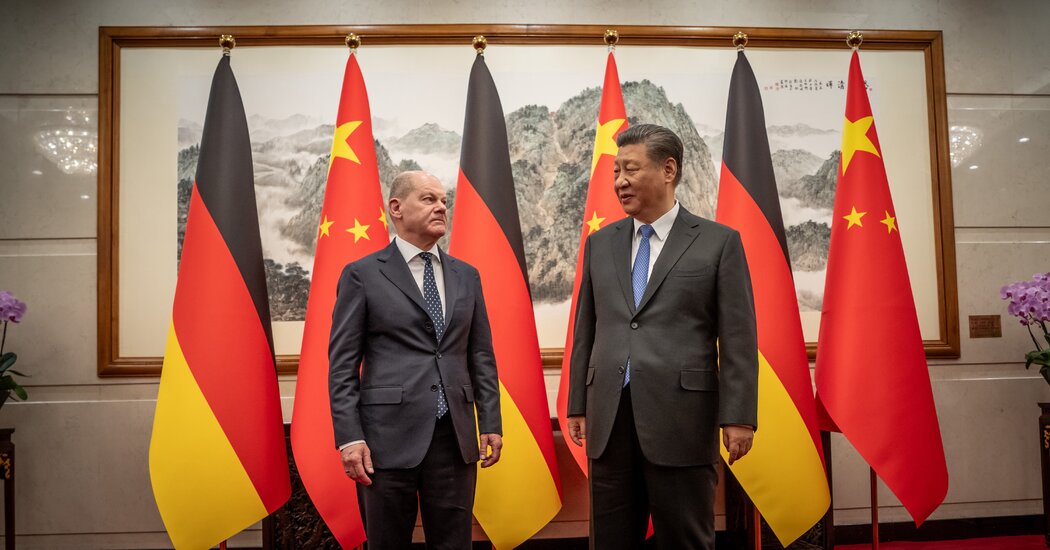

Chancellor Olaf Scholz of Germany tried to strike a delicate balance on a trip to China this week, promoting business ties with his country’s biggest trading partner while raising concerns over its surge of exports to Europe and its support for Russia.
Mr. Scholz met with China’s top leader, Xi Jinping, at the Diaoyutai State Guesthouse in Beijing on Tuesday, the culmination of a three-day visit with a delegation of German officials and business leaders. He also met with Premier Li Qiang as the two countries navigate relations strained by Russia’s war in Ukraine and China’s rivalry with the United States, Germany’s most important ally.
Throughout his trip, Mr. Scholz promoted the interests of German companies that are finding it increasingly hard to compete in China. And he conveyed growing concern in the European Union that the region’s market is becoming a dumping ground for Chinese goods produced at a loss.
But Mr. Scholz chose a conciliatory tone over a combative one in his opening remarks before sitting down with Mr. Xi on Tuesday morning, in a meeting that stretched over three hours and turned into a walk and lunch.
It was the German leader’s first visit to China since his government adopted a strategy last year that defined the Asian power as a “partner, competitor and systemic rival,” calling on Germany to reduce its dependency on Chinese goods.
Germany’s economy shrank last year, and its weaknesses have exposed a reliance on China for growth. Energy prices have risen because of the war in Ukraine, which has been facilitated by Beijing’s support for the Kremlin. German companies have pushed for more access to China and complained that they face unfair competition.
The chancellor visited German companies with extensive investments in China and met with trade representatives and officials in the sprawling industrial metropolis of Chongqing in China’s southwest and in Shanghai and Beijing.
At a talk with a group of students in Shanghai on Monday, Mr. Scholz fielded a question from a student who planned to study in Germany this year, who said he was “really worried” because the country had partially legalized cannabis. “When you study in Berlin, you can run around the whole time and never meet anyone who does that,” the chancellor assured him.
But he also used the platform to push more serious messages about trade. “Competition must be fair,” Mr. Scholz told the students. “We want a level playing field,” he said.
Mr. Scholz’s trip was an example of the difficult dance that Germany is trying to do: maintaining economic ties with China while managing U.S. pressure to align itself more closely with Washington against Beijing.
In his meetings, Mr. Scholz highlighted Germany’s commitment to doing business with China, but he also warned that Beijing had to curb the flood of Chinese goods into Europe. At the same time, he expressed reservations about the European Union’s investigations into China’s use of subsidies for green technology industries, saying that any discussion about trade must be based on fairness.
“This must be done from a position of self-confident competitiveness and not from protectionist motives,” Mr. Scholz told reporters on Monday.
China’s manufacturing push in green sectors like electric cars and solar panels has touched off trade disputes with Europe and the United States, where such industries have also received government support. But with 5,000 German companies active in the Chinese market, Germany stands to lose more than many of its European partners would if Beijing were to retaliate against the European Union.
“If the E.U. goes too hard against China, we could expect countermeasures and this would be a catastrophe for us,” said Maximilian Butek, the executive director of the German Chamber of Commerce in China.

“For us it’s extremely important that the Chinese market remains open,” he said.
In his meeting with Mr. Xi, Mr. Scholz indicated that Russia’s war on Ukraine and its arms buildup were high on his agenda. “They directly affect our core interests. Indirectly, they damage the entire international order,” he said in opening remarks at the meeting, a transcript of which was provided by Mr. Scholz’s office.
Despite pressing the issue with Mr. Xi, he did not appear to win the commitment that he had sought from the Chinese leader to take part in an international conference for Ukraine planned in June. Germany had hoped that China could use its influence over Russia to help work toward a peace agreement.
Germany would also like China stop selling goods to Russia that have potential uses on the battlefield, and Mr. Scholz told reporters that he had brought up the issue in his meeting. “The point has been made,” he said. “There can be no misunderstanding about how we see things.”
China is hoping to drive a wedge between Europe and the United States by courting leaders such as Mr. Scholz. State media reports depicted his visit as demonstrating the strength of China’s relations with Europe, playing up its economic ties with Germany.
In his opening remarks to Mr. Scholz, Mr. Xi said cooperation between China and Germany, which have the second- and third-largest economies, was beneficial to the world, a remark that could be read as directed at those who have urged Berlin to distance itself from Beijing.
“The two countries should view and develop bilateral relations from a long-term and strategic perspective and work together to inject more stability and certainty into the world,” Mr. Xi told Mr. Scholz, emphasizing the importance of seeking “common ground.”
Beijing is sure to welcome the message that German businesses are committed to China. The Asian giant is trying to court foreign investment to reinvigorate its economy, which has faltered because of a housing slowdown. Some Western businesses and investors have also been rattled by Mr. Xi’s emphasis on national security, which they regard as making it riskier to operate in the country.
From China’s perspective, Germany may be its best hope of delaying or watering down any trade restrictions from Europe, said Noah Barkin, a senior adviser in the China practice at the Rhodium Group, a research firm.
German carmakers have invested billions of dollars in China, and much of their revenue comes from there. Many worry that if the European Commission imposes higher tariffs on Chinese exports, and Beijing retaliates, German businesses will suffer most.
Chinese officials “know that German companies are heavily invested and they use that politically to influence political decision making in Berlin,” Mr. Barkin said.
Germany’s biggest companies, including BMW, Mercedes-Benz and BASF, have large operations in China and strong, effective lobbies in Berlin, Mr. Barkin added. Executives from those companies, along with several others, traveled with Mr. Scholz to China.
“The supply chain in China is stuffed with German goods,” said Joerg Wuttke, a former president of the E.U. Chamber of Commerce in China. “If China has a price war with Germany, then no one will make money anymore.”
Mr. Scholz also brought along the German ministers for agriculture, the environment and transportation, officials who experts said would be particularly interested in working with China.
“You set an agenda with these three ministers, the tonality is overall a cooperative one, these are areas that we want to work on,” said Janka Oertel, director of the Asia Program at the European Council on Foreign Relations.
Chinese officials, for their part, have brushed off the European accusations of unfair trading practices, calling them groundless and an act of “typical protectionism.” They have hinted that they could retaliate for any actions taken by the European Union, saying that China was “strongly dissatisfied with and firmly opposes” its investigations.
In an interview with the German newspaper Handelsblatt, Wu Ken, China’s ambassador to Germany, said the competitive edge of Chinese electric vehicles “relies on innovation, not subsidies.”
“The challenge faced by developed countries lies more in the fact that Chinese companies are more efficient,” the ambassador said.
Vivian Wang contributed reporting from Beijing and Zixu Wang from Hong Kong.