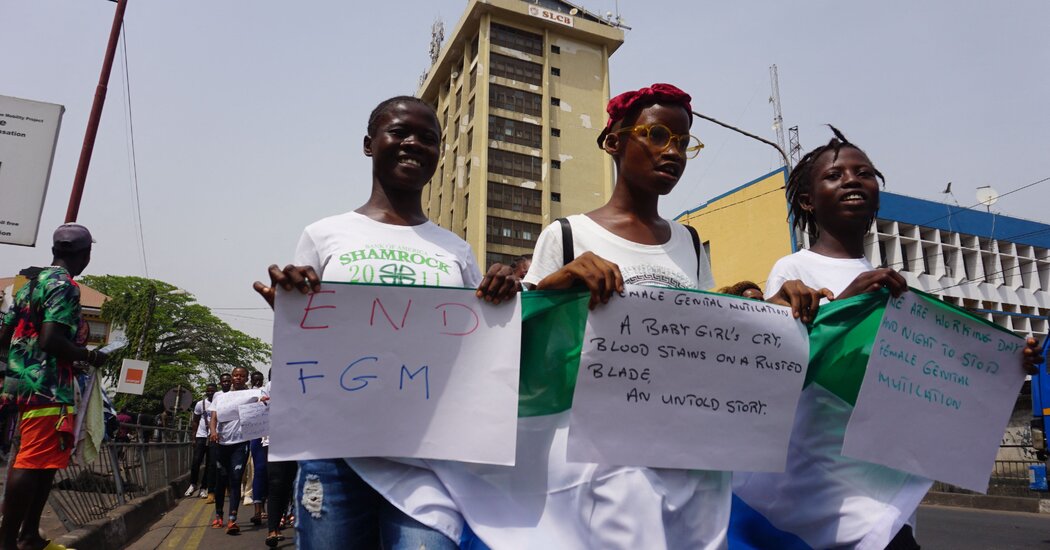

More than 230 million women and girls around the world have undergone female genital cutting, according to a new analysis by UNICEF, an increase of 30 million since the organization’s last global estimate in 2016.
While the data shows that in some countries a new generation of parents have chosen to forgo the practice, in other countries laws and campaigns against it have had no impact. In Burkina Faso, the share of girls aged 15 to 19 years who have undergone cutting has fallen to 39 percent from 82 percent over the past three decades. But in Somalia, where an estimated 99 percent of women have had their clitoris excised, the level of cutting has not changed.
Because the countries where the practice is most prevalent are also those with the highest rates of population growth, the overall number of girls who are subject to cutting is growing each year.
“The total number of women and girls is 15 percent higher than the last estimate,” said Claudia Cappa, an expert on global trends in female genital cutting with UNICEF. “The progress that has been made is too slow compared to the growth of the population of girls who are born each day in the countries that are most affected.”
The United Nations has set the goal of eliminating female genital cutting by 2030, but change would need to be occurring 27 times faster than the current rate to meet that goal, she said.
Some countries that have seen reductions in the prevalence of cutting now see that progress imperiled, as conflicts and displacement from climate emergencies make people increasingly vulnerable and more reliant on traditional community structures, such as religious groups, that still endorse the practice.
The new data also highlights the degree to which the practice of cutting is worldwide. While it is most common in sub-Saharan African countries, the practice also remains widespread in parts of the Middle East and Asia and continues to be a clandestine practice in some immigrant communities in North America and Europe.
An estimated 144 million women and girls in Africa have been cut (the largest number are in Egypt, Ethiopia and Sudan), 80 million in Asia, and 6 million in the Middle East (more than half of them in Yemen), according to the new report. In Asia, the largest share of cases is in Indonesia, where 55 percent of girls undergo a genital mutilation procedure, government figures show.
UNICEF made its calculations using the responses from routine national household surveys in the 31 countries where the practice is more common. Those surveys ask women if they have been cut, and if their daughters have been cut, and asks both women and men in households where a woman has been cut whether they think the practice should continue.
In Burkina Faso, the country that has seen the sharpest decline, criminalization of the procedure and strong support from top political figures has helped push the change, said Mariam Lamizana, president of an anticutting organization called Voix de Femmes in Ouagadougou, the capital.
“We worked with religious and traditional leaders, and we said, ‘What you are doing in the name of culture, here are the consequences for women, the consequences for little girls’,” said Ms. Lamizana, who led the first national commission established by the president to fight cutting. “We found it was good to engage young religious leaders because they had more education, and they were more open.”
Nankali Maksud, who leads UNICEF’s work to end the practice, said that most countries that have seen a decline have outlawed cutting. But other strategies that seem to have driven change in some countries do not appear to be working in others, she said.
In Sierra Leone, the share of girls aged 15 to 19 years who have undergone cutting has fallen to 61 percent from 95 percent over the past three decades. The change has been driven in part by education campaigns, mounted by both local and international organizations, about the physical and psychological damage caused by cutting.
But in Somalia, the practice has proved fiercely resistant to efforts at change.

“It’s persistent, it’s constant,” said Dr. Mariam Dahir, who is a rare public opponent of cutting in Somaliland, a breakaway region in the north of the country.
Dr. Dahir said that there had been a campaign by some international anticutting groups to have religious leaders endorse a less-extreme version of the practice, involving the removal of some or all clitoral tissue, over the traditional practice of the full stitching closed of the labia. The latter increases the likelihood that women will experience health complications from sexual activity or in childbirth. The less extreme option appealed to some parents and was endorsed in 2018 by a fatwa, telling parents to have a health worker rather than a traditional cutter perform the procedure, she said.
However, she and a few other campaigners could not embrace this idea of moderate improvement, she said. “How can we be saying for decades that nothing needs to be cut off a woman’s body, there is no religious justification for this practice and then turn around and say this?” she asked.
She posts Facebook videos calling for a total ban on cutting, which attract widespread criticism. “Then at least I know people are hearing the idea,” she said. And that, at least, is a change from the past, when it was totally taboo for people to discuss the practice at all.
The new data shows that a significant shift has happened in a few countries, such as Kenya, where the practice was widespread 30 years ago and is limited today to the areas of the country where most people are from the Somali ethnic community. One clear trend, Ms. Cappa, the UNICEF adviser said, is that changing norms around cutting is easier in countries such as Kenya, where the practice is not universal but rather a tradition of some religious or ethnic groups.
“In countries where there is diversity, the progress can be faster because communities who practice it are confronted by those who don’t, and they’re able to see that alternatives to their beliefs and their values are possible and can be culturally acceptable,” she said.
Sadia Hussein channeled her experience as a cutting survivor into an anti-cutting organization, the Brighter Society Initiative. Working in her home region in the northwest of Kenya, she said that getting people to speak publicly about the practice has been key to lowering the practice’s prevalence to 9 percent of girls aged 15 to 19 years, from 23 percent three decades ago.
“Men say, ‘Women never told us this thing is bad, even our wives,’” she said. “So I have to build the confidence of survivors to share their own pain because our society has really conditioned women in such a way that they endure pain in silence. So I tell them, whatever we went through shouldn’t happen to our daughters.”
The places where the prevalence of cutting remains highest are also some of the most fragile countries, those beset by conflict or climate disasters or both. Such circumstances make it harder to address the needs of girls who have been cut and to implement prevention policies.
Ms. Hussein said that climate change has complicated the anticutting efforts in her region. Families lose livestock in weather disasters and need money to rebuild their herds, and they may seek dowries for young daughters as a source of funds.
“Many girls get mutilated so they can be married off at a tender age,” she said. “When there are floods and droughts, we see more girls being cut.”
The national surveys found that two-thirds of men and women in households where a woman had been cut, in Africa and the Middle East, said that they thought the practice should end. In countries such as Djibouti and Sierra Leone, where it is still common, more men than women said they were opposed.
Ms. Cappa cautioned that what people say privately in a survey may not match the view they express publicly. Even parents who would like to see the practice end may still have their daughters cut out of a fear of social repercussions, such as an inability to marry, if they were not to comply, she said.
“There is doom and gloom in these numbers, but you do still have young girls and women — and even men — who feel that this practice should stop. That’s something positive,” Ms. Maksud at UNICEF said.