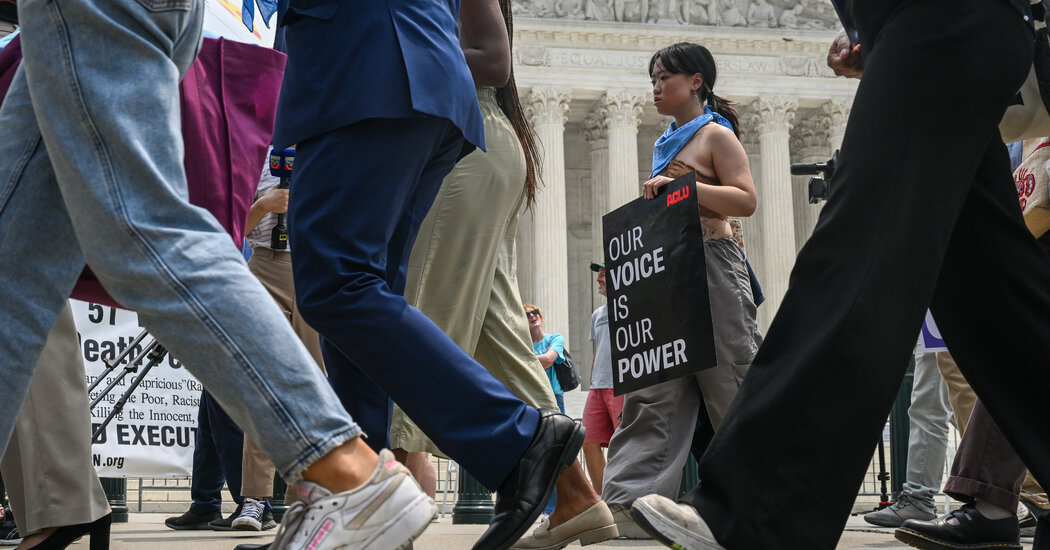

Over the past two years, as Ishan Bhabha and his colleagues at the law firm Jenner & Block prepared briefs for the affirmative action case the Supreme Court ruled on last year, Mr. Bhabha had a realization: If higher education institutions like Harvard were the first target of litigation about diversity, equity and inclusion, America’s corporate boardrooms were probably next.
Mr. Bhabha began working with dozens of Fortune 500 companies to evaluate their diversity programs and ensure that they were on solid legal ground if they were sued.
Proponents of corporate diversity, equity and inclusion programs, commonly called D.E.I., argue that they are important to hiring and retaining people of color. Critics now argue that some such programs can exclude white and Asian people unfairly from hiring processes.
In recent months, hundreds of companies have been re-examining those initiatives after a series of challenges to diversity programs: the threat of litigation in the wake of the Supreme Court’s decision striking down race-conscious college admissions, criticism of D.E.I. initiatives from some high-profile business leaders, and a wave of layoffs in the tech industry that heavily affected D.E.I. teams.
This pushback — which has come as more than 20 states weighed or passed new laws last year targeting D.E.I. initiatives — has had a chilling effect on some corporate D.E.I. offices, according to diversity advisers.
“When the economy is booming and when the politics are amenable, we see a lot of growth in diversity programming,” said Frank Dobbin, an expert on D.E.I. at Harvard and author of the 2022 book “Getting to Diversity.” “When there’s either a change in the political winds — which is what’s happening now — or a recession, we’ve seen cutbacks.”
The backlash, Dr. Dobbin said, has pushed some human resource professionals to keep their D.E.I. efforts “under the radar.” At recent conferences he has attended, Dr. Dobbin added, corporate leaders have discussed how to approach D.E.I. “in a less in-your-face way.”
Some have explored moving away from initiatives that attract a lot of public attention, like mandatory anti-bias trainings, and instead focusing on lower-profile D.E.I. strategies, like diversity task forces that bring together leaders from different corporate departments.
“If companies lighten up on things that are ineffective, that could be a good outcome,” Dr. Dobbin said, noting that mandatory anti-bias trainings have been shown to sometimes even worsen bias. “But I do worry that the baby will go out with the bath water.”
So far, few companies seem to have cut back their programs because of the Supreme Court’s ruling. Three-quarters of employers polled by Littler Mendelson P.C., the employment law firm, said they had not changed their approach to D.E.I. because of the ruling last year, and only 1 percent reported a significant decrease in their efforts, according to a survey released this month.
And some executives say they are doubling down, like Crystal Castille-Cromedy, who leads D.E.I. strategy for Hines, one of the world’s largest real estate companies. Ms. Castille-Cromedy joined the firm in June 2020, days after George Floyd’s murder, and has overseen a number of diversity efforts, including the creation of a mentoring program for underrepresented groups in real estate.
Mr. Bhabha, a partner at Jenner & Block and a chairman of the firm’s D.E.I. Protection Task Force, said he had “some clients that say, ‘Look, if I was sued over this and I have to become the face of defending D.E.I. against a conservative backlash, I’d be happy to.’” But, he said: “There are the vast majority of my clients not in that bucket. They think, ‘We’d like to keep our heads under the parapet.’”
The American Alliance for Equal Rights, a conservative nonprofit organization devoted to challenging race-based policies, sued a handful of law firms last year over their diversity fellowship programs, arguing that these programs discriminate against white and Asian applicants.
The American Alliance’s founder, Edward Blum, also established Students for Fair Admissions, the group that sued Harvard over its affirmative action policies and won.

“These lawsuits have sent a powerful message to corporate America: The law firms upon which you turn to for legal advice concerning D.E.I. are themselves violating the law,” Mr. Blum said.
American Alliance filed lawsuits against the law firms Perkins Coie, Morrison Foerster and Winston & Strawn. Those firms have all since opened their diversity fellowships to applicants of all races and backgrounds, and Mr. Blum’s group dropped the suits.
“Following the Supreme Court’s landmark decision striking down race-conscious affirmative action in college admissions, we undertook a thorough review of our programs,” Winston & Strawn said in a statement. Perkins Coie said in its statement that the program’s revised criteria would continue to “ensure” that the firm hired lawyers “with a diversity of backgrounds and experiences.”
Morrison Foerster said it had been in the process of opening up the fellowship even before the lawsuit.
On top of the threat of litigation, some prominent business leaders have recently criticized diversity programs. The billionaire financier Bill Ackman wrote an essay this month in The Free Press, after the resignation of Claudine Gay as president of Harvard, faulting what he said was “the penetration of D.E.I. ideology into the corporation board room.” Elon Musk, posting on X, wrote, “Discrimination on the basis of race, which D.E.I. does, is literally the definition of racism.” (The billionaire investor Mark Cuban, meanwhile, wrote on X that “the loss of DEI-Phobic companies is my gain.”)
Leaders who have been critical of specific types of diversity programs from within the industry argue that broad-brush criticisms of D.E.I. can be counterproductive, distracting from meaningful efforts to reform corporate diversity initiatives.
“I’ve critiqued things like our relative lack of metrics, the relative lack of accountability, the fact that leaders can release a D.E.I. statement and otherwise not do anything,” said Lily Zheng, a D.E.I. strategist and author of “Reconstructing D.E.I.” Mx. Zheng views critiques of racial quotas as focusing on “a straw man of D.E.I.”
In 2020, after a wave of protests for racial justice in the wake of the killing of George Floyd, corporate D.E.I. programs saw a rush of support, and hundreds of employers came forward to announce new diversity initiatives. In that year alone, companies spent an estimated $7.5 billion on D.E.I.-related efforts. But some D.E.I. leaders say that attention and investment since then have not been sustained.
“It’s a sugar rush phenomenon,” said John Amaechi, a retired basketball player who now works with companies on D.E.I. strategy. “It creates a huge amount of energy followed by a withdrawal.”
In some cases, D.E.I. programs have been hard hit by job cuts. RevelioLabs, a work force database, published a study last year that looked at 600 companies that have laid off workers since 2020 and found that the attrition rate for people working in D.E.I. was nearly twice that of employees in non-D.E.I. roles.
Many executives still argue that their efforts to recruit diverse employees contribute to company performance. For instance, Armughan Ahmad, the chief executive of Appen, an artificial intelligence company, says a diverse talent pool allows the company to build products that are trained on diverse users, helping to prevent racial bias in A.I. algorithms.
Plenty of corporate leaders share that view.
“Even in places where there’s legislation that is anti-D.E.I. being passed, it’s not about companies being relieved somehow they don’t have to do this work,” said Jensen Harris, co-founder of Textio, an A.I. human-resources platform used by more than 1,000 companies. “It’s them figuring out, ‘OK, D.E.I. work is still really important, so how do we work around this legislation?’”
The Supreme Court’s recent decision on race-conscious admissions policies does not directly apply to most employers. The decision was focused largely on Title VI of the Civil Rights Act of 1964, which covers institutions receiving federal funding and doesn’t apply to most private companies. But many employers worry that their D.E.I. initiatives could be challenged legally under Title VII, which deals with employment relationships, or Section 1981 of the 1866 Civil Rights Act, which covers contracts.
Kenji Yoshino, the director of the Meltzer Center for Diversity, Inclusion and Belonging at NYU School of Law, has been advising managers at Fortune 500 companies to code their D.E.I. programs as either green, yellow or red. A red program indicates an initiative that has a high risk for potential litigation, such as a hiring process that provides an advantage to candidates of color; on the other hand, a program that offers mentorship widely to anyone at the company may be categorized as green.
Mr. Yoshino noted that some D.E.I. critics have a limited view of what the programs consist of. Many corporate diversity programs extend beyond hiring processes to touch on mentoring, training and career development.
“The pessimists say, ‘This is a terrible moment for D.E.I., D.E.I. is over, the sky is falling,” Mr. Yoshino said. “I want to ask people what they think D.E.I. actually is.”