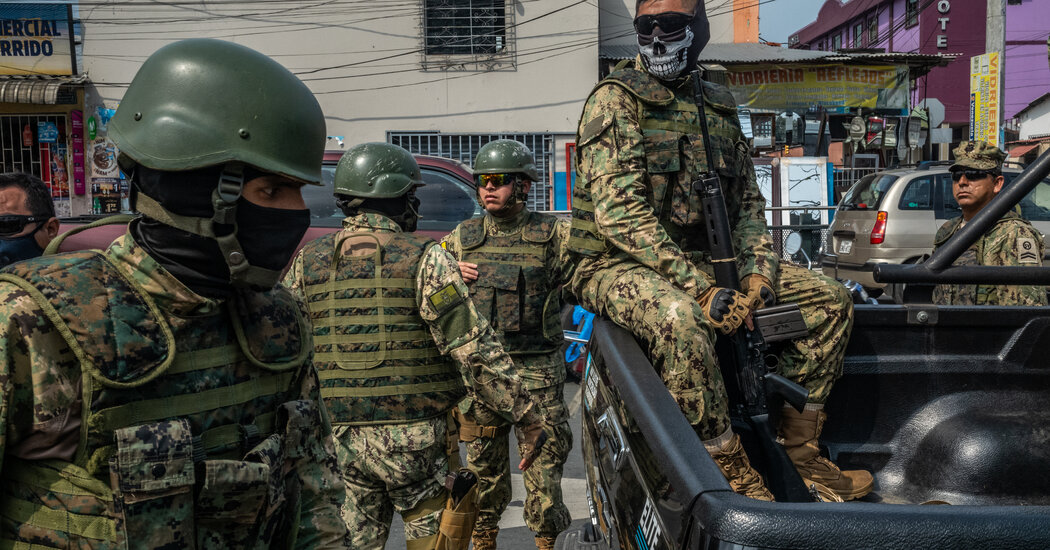

Since Ecuador’s president declared war on gangs last month, soldiers with assault rifles have flooded the streets of Guayaquil, a sprawling Pacific Coast city that has been an epicenter of the nation’s yearslong descent into violence.
They pull men from buses and cars looking for drugs, weapons and gang tattoos, and patrol roads enforcing a nighttime curfew. The city is on edge, its men and teenage boys potential targets for troops and police officers who have been ordered to take down powerful gangs that have joined forces with international cartels to make Ecuador a hub of the global drug trade.
Yet when people see soldiers pass, many clap or give them a thumbs-up. “We applaud the iron fist, we celebrate it,” said Guayaquil’s mayor, Aquiles Álvarez. “It has helped bring peace.”
In early January, Guayaquil was hit by a wave of violence that could prove to be a turning point in the country’s long-running security crisis: Gangs attacked the city after the authorities moved to take charge of Ecuador’s prisons, which gangs largely controlled.
Police officers were kidnapped, explosives were detonated and in an episode broadcast live, a dozen armed men briefly seized a major television station.
The president, Daniel Noboa, declared an internal conflict, an extraordinary step taken when the state has come under attack by an armed group. He deployed troops against the gangs, which have overtaken much of Ecuador, battling to control cocaine-trafficking routes and transforming it from one of South America’s most peaceful countries into the deadliest.
Ecuador’s top military commander warned that every gang member was now “a military objective.”
Mr. Noboa’s aggressive response has reduced violence and brought a precarious sense of safety to places like Guayaquil, a city of 2.7 million and a key drug-trafficking port, pushing approval of the government to 76 percent in a recent national survey.
It has also raised alarms among human rights activists.
“We’re not seeing anything new or innovative,” said Fernando Bastias of the Permanent Committee for the Defense of Human Rights of Guayaquil. “What we’re seeing is an increase in cases of grave human rights violations.”
Ecuador’s approach has drawn comparisons to El Salvador, whose young leader, Nayib Bukele, has largely dismantled its vicious gangs, earning him a landslide re-election victory and adulation across Latin America. But critics say he has also trampled human rights and the rule of law, ordering mass arrests that ensnared innocent people.
“Ecuador is an important case because it’s almost like a second laboratory for Bukele’s policies,” said Gustavo Flores-Macías, a government and public policy professor at Cornell University who specializes in Latin America. “People are so desperate that they buy into the need for these iron-fist policies to bring down crime.”
The policies can be effective, but, he added, “the cost in civil liberties is high.”
Like Mr. Bukele, Mr. Noboa, 36, wants to build mega-prisons and his social media posts feature pumping music and images of prisoners handcuffed and stripped to the waist. He proclaims it “The Noboa Way.”

Still, there are important differences, said Christopher Sabatini, a senior research fellow for Latin America at Chatham House, a research group in London. While Mr. Bukele disdains democracy, Mr. Noboa “has portrayed his government as a democracy under siege,’’ Mr. Sabatini said.
Mr. Noboa is also facing a different adversary, said Will Freeman, a fellow in Latin America studies at the Council on Foreign Relations.
“El Salvador was never important to drug trafficking,” he said. “It is just too small.” Ecuador, by contrast, is now central to the global cocaine trade, he said, with links to cartels from Mexico to Europe. As a result, its gangs have millions to arm themselves to fight the authorities.
But, he added, “we do see Noboa moving toward a strategy of mass arrests.”
Since the president declared war on the gangs, authorities in Ecuador have detained more than 6,000 people.
In Guayaquil, soldiers and police officers destroy camera systems installed by gangs to watch over entire neighborhoods, storm into areas once largely off-limits to the police and knock down doors to uncover caches of guns and explosives.
The crackdown has had some effect.
From December to January, the number of killings in Guayaquil dropped by 33 percent, from 187 to 125. Outside the city’s morgue, Cheyla Jurado, a street vendor who sells juice and pastries to families waiting to retrieve bodies, said the crowds had visibly thinned.
“Now, they’re car accidents, drownings,” she said.
At the city’s largest hospital, the number of patients arriving with gunshot wounds and other violence-related injuries is down from five a day to as few as one every three days, said Dr. Rodolfo Zevallos, an emergency doctor.
The reprieve from the bloodshed — while still in the early stages — has many rooting for the young president.
“We can sit outside in the evening,’’ said Janet Cisneros, who sells home-cooked meals in Guayaquil’s Suburbio neighborhood. “Before, we couldn’t — we were just completely stuck inside.”
Mr. Noboa, an heir to a banana fortune, was elected in November to finish his predecessor’s term, which was cut short when he dissolved parliament, triggering snap elections.
In January, as violence erupted, he traded his business suits and bashful smile for a grimace, buzz cut and black leather jacket, announcing that Ecuador would no longer take orders from “narcoterrorist groups.”
The hard-line message is meant for Ecuadoreans, who will vote for president again next year, said Mr. Flores-Macías, the political scientist, but is also intended to gain support from international leaders — particularly President Biden. Mr. Noboa, he said, “clearly sees he needs the support — the guidance, funding and aid — of the United States.”
So far, the Biden Administration has provided Ecuador with equipment and training along with roughly $93 million in military and humanitarian aid.
Ecuador’s officials have said the military is crucial to reclaiming neighborhoods from gangs that have become the de facto authorities, recruiting boys as young as 12 to shuttle drugs, kidnap and kill.
Mr. Noboa’s office did not respond to requests for comment.
In Guayaquil, police paint over murals depicting gang leaders. Soldiers conducting street raids lecture young men found with small bags of marijuana on the perils of drugs or a life of crime.
But videos have circulated online showing the authorities also using rougher tactics: men and boys rounded up on the streets are hit on the head or forced to kiss one another. In one widely-shared video, a teenager is made to scrub a tattoo until his chest is bloody.
In the prisons where the military was sent to seize control from gangs, similar abuses are taking place, according to advocates and inmates’ families.
“They have the prisoners beaten up worse than Jesus Christ,” said Fernanda Lindao, whose son is serving time for robbery in Guayaquil’s Litoral Penitentiary. “For inmates, there are no human rights.”
Still, arrest videos are enormously popular, with many Ecuadoreans praising soldiers and the president.
“The public applauds what’s happening,’’ said Mr. Álvarez, Guayaquil’s mayor, “and they don’t applaud it because they are bad people, but because they are tired of all the violence they have endured.”
To explain their support for Mr. Noboa’s tactics many describe how bad things had gotten.
“They killed here, they dumped bodies,” said Rosa Elena Guachicho, who lives in Durán, a suburb of Guayaquil with unpaved roads and no potable water. “A month ago they found one in a pillowcase, chopped into pieces.”
Dolores Garacoia said gangs had taken over Durán. Taxi drivers refused to enter, fearing they would be robbed or kidnapped, she said. Not even the police felt safe.
Gangs threatened the owners of tiny businesses like Ms. Garacoia, who said she shut down the shop she ran for years after getting a call demanding payment of thousands of dollars, known as a vacuna, or vaccine.
“I had to take down the sign and close immediately,” she said.
Just as the people of Guayaquil have changed to adapt to violence — staying indoors, getting pitbulls — so too has the city’s physical appearance. Houses have become cages, enmeshed in bars rising two or three floors.
Ángel Chávez, 14, sat behind wrought-iron bars of a community center in Monte Sinai, part of Guayaquil’s most dangerous district, where more than 500 people were killed last year.
He had mixed feelings about the military’s arrival.
“Maybe it will finally put an end to what we have been suffering,” he said.
But, he added, the way soldiers treated teenagers in some videos troubled him. “I don’t like it when they abuse them.’’
Still, for many in Guayaquil, their biggest fear is the military pulling out.
Ms. Cisneros, the cook who is finally able to serve meals outside, said, “They must not leave.”
Thalíe Ponce contributed reporting.