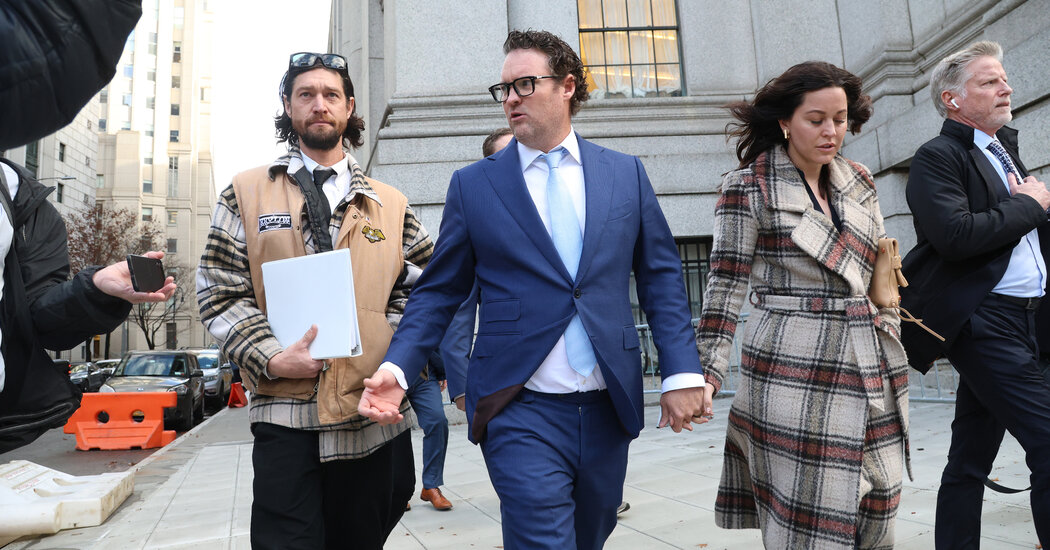

The founder of the electric truck company Nikola was sentenced to four years in prison on Monday in a fraud case that highlights the financial carnage left behind by a crop of electric vehicle start-ups and their promoters.
A federal judge in Manhattan, Edgardo Ramos, sentenced Trevor Milton, Nikola’s founder and former chief executive, after a jury found him guilty last year of one count of securities fraud and two counts of wire fraud. Mr. Milton was accused of pumping up the value of Nikola stock by making extravagant claims about the company.
Mr. Milton told investors that Nikola had working prototypes of emission-free long-haul trucks, had billions of dollars’ worth of binding orders and was producing low-cost hydrogen fuel. All those statements were false, said prosecutors, who had asked Judge Ramos to hand down an 11-year prison term and a $5 million fine. Lawyers for Mr. Milton, who denied the charges, had sought probation.
Judge Ramos also fined Mr. Milton $1 million and said he would be required to pay restitution, which will be determined later. Mr. Milton will remain free on bail while he pursues an appeal.
Choking back tears and quoting scripture during a lengthy plea for mercy, Mr. Milton told the judge that he felt “terrible for everyone involved.” But, he insisted, “I did not commit these crimes.”
Judge Ramos said Mr. Milton was not as bad as some people convicted of fraud whom he had sentenced, but told him that “there were still real people hurt by your actions.” He added, “The loss amount was immense.”
Few electric vehicle executives have been convicted of crimes, but Nikola was hardly the only new auto company to attract billions of dollars of investment without generating profits or producing many cars or trucks, leaving shareholders with huge losses.
Inspired by the success of Tesla, investors poured money into start-ups like Canoo, Lordstown Motors and Lucid Motors in recent years. Their backers and executives viewed electric vehicles as a chance to challenge established automakers like Ford Motor and General Motors — and become rich in the process.
With far fewer parts than gasoline cars, electric vehicles should have theoretically been easier to manufacture. But building thousands of cars, establishing brands and meeting safety standards turned out to be much more difficult and costly than many start-up executives and their backers expected. Some businesses proved more adept at generating lawsuits than cars.
Many of the electric vehicle start-ups listed themselves on the stock exchange by merging with special purpose acquisition companies, which allowed businesses to avoid much of the disclosure and regulatory scrutiny that accompany conventional initial public offerings of stock.
Investors who bought these stocks have suffered enormous losses. Shares in Nikola, which is still in business but warned investors in November that it could run out of money in the next 12 months, have lost 99 percent of their value since 2020.
Nikola’s stock was trading at about 90 cents a share on Monday afternoon; it traded for more than $65 in June 2020.
One group of investors profited — short sellers, who make money by betting that a stock price will decline. Firms that specialize in exposing overvalued stocks feasted on Nikola and other electric vehicle start-ups.
Mr. Milton’s false claims about Nikola were first reported by Hindenburg Research, an investment firm that specializes in uncovering corporate malfeasance.

Hindenburg also published a report on Mullen Automotive last year that accused the company of marketing electric vehicles imported from China as its own and claiming it was close to offering advanced solid state batteries, a technology that much larger companies like Toyota are still years away from perfecting. Mullen shares, which peaked at more than $3,600 in 2020, traded recently for 13 cents.
A Mullen spokesman said that “many of the points in Hindenburg were inaccurate at the time, and now dated, which renders all completely inaccurate now.” In recent news releases, Mullen has said it has begun manufacturing electric trucks at a factory in Mississippi.
Another Hindenburg target was Lordstown, a would-be electric truck maker that took over a former G.M. plant in Ohio with help from the Trump administration. President Donald J. Trump hosted Lordstown’s chief executive, Steve Burns, at the White House in 2020, calling the company’s vehicle “an incredible concept.”
Mr. Burns resigned after Hindenburg accused him of exaggerating the number of orders for Lordstown’s pickup truck. The company filed for bankruptcy protection in June. (In October, an investment vehicle that Mr. Burns controls bought machinery and other Lordstown assets.) Lordstown declined to comment.
Mr. Burns said in an email that he never inflated orders, and noted that a study by an outside law firm had found inaccuracies in the Hindenburg report. He bought Lordstown’s assets and hired some of the company’s engineers, Mr. Burns said, because he believes that the business has unique technology.
“Under the LandX brand, we intend to build several exciting vehicles and look forward to announcing our full lineup soon,” Mr. Burns said.
Short sellers have also targeted Faraday Future, a company based in Los Angeles that has so far delivered nine of its “ultra luxury” electric vehicles after a decade in business.
After J Capital Research, another short seller, published a report on Faraday in 2021, the company admitted that it had misled investors when it claimed to have 14,000 reservations which, in fact, were unpaid expressions of interest.
In September, Faraday said in a regulatory filing that its “corporate culture failed to sufficiently prioritize compliance.” The company has also disclosed that it is under investigation by the Securities and Exchange Commission and the Department of Justice.
Faraday is cooperating with authorities, a spokesman said in an email, adding that the company has “made substantial changes and enhancements to process and procedures to strengthen our governance and internal controls.”
Even for companies that short sellers have not publicly accused of exaggerating their achievements and prospects, producing vehicles has proved incredibly challenging.
Canoo has announced orders worth $750 million from Walmart and other customers for its electric vans. The company is increasing production at a factory in Oklahoma, a spokesman said, but he declined to say when it would begin delivering vehicles in large numbers.
Canoo told investors in November that there was “substantial doubt” that it would survive. Although accounting rules required the warning, Canoo has raised $380 million to fund its expansion, Chris Nguyen, the spokesman, said.
Investors have grown skeptical even of companies that have managed to produce thousands of cars. Shares of Fisker, which delivered about 3,000 vehicles through the beginning of November, have fallen 95 percent from a high set in 2021. Shares of Lucid, which has said it will produce at least 8,000 luxury electric sedans this year, are down 93 percent. Shares of Rivian, a maker of electric pickups and sport utility vehicles that many analysts consider the start-up most likely to survive, are down 80 percent.
Less sophisticated investors often bore the brunt of the losses. Mr. Milton, prosecutors said in a sentencing memo, “engaged in a sustained scheme to take advantage of individual, nonprofessional investors.” That included posting a video on YouTube of a prototype rolling down a hill, creating a false impression that the company had a working vehicle.
Mr. Milton also lied about his personal history, prosecutors said. He had said he dropped out of college to pursue his entrepreneurial dreams even though he was expelled for paying someone to do his academic work.
After selling some of his Nikola shares for $100 million in mid-2020, Mr. Milton spent $83.5 million on luxuries like an airplane and estate in the Turks and Caicos Islands.
Nikola investors lost more than $660 million, prosecutors said in the memo, rejecting claims by an expert hired by the defense who said the losses that could be blamed on Mr. Milton were far less and possibly zero.