
Some hot springs look like palaces, others like holes in the ground. Some feel like parties, others like prayers. There are hot baths within cities, on remote islands, in the desert, inside thick forests. Thermal water can be green, orange, blue, yellow or turquoise. It can be milky and opaque, silty with sediment or as clear as a municipal pool. Sometimes it’s barely lukewarm; other times it’s so hot it hurts.
Several years ago, with the dream of making a book, I set out to learn and document how people around the world make use of thermal waters. At 23 locations across 12 countries, I talked with workers, stewards and experts, who taught me about the local history and personality of each place. Many told me about the ways they manage land and water as a collective. They explained how the presence of bathing places can affect the bodies, communities and cultures.
I met visitors who reveled in the ways that hot water softens their minds and muscles. Some, like me (and perhaps like you), were enthusiasts with a certain devotion to hot water, enthralled with the way it reminded them to be citizens of nature.
Below are eight highlights adapted from my book “Hot Springs” — from an onsen in Aomori Prefecture, Japan, to a set of high-altitude pools near Mount Sajama, in Bolivia.
Aomori, Japan
When I was 14, my parents, both schoolteachers, took jobs teaching on a United States Air Force base in Misawa, Japan. I went to the on-base high school, and we lived in a small house between a potato field and a rice paddy. The few local onsen, or public hot baths, were so different from the hot springs I’d been to back home in Idaho, places that were outdoorsy and sometimes a little rowdy.
In Japan, the hot springs are ritualized and structured. In an onsen, there is a palpable sense of reverence for your own body, for others and for the water.
I learned to use the onsen properly: to pull up a small stool and a bowl to the shared shower area, to scrub every inch of the body, to shampoo and condition my hair, to clean between my toes and under my fingernails, to rinse my body and the area I occupied.
Once clean, you soak. You soak until your body is red with warmth. And inside you feel purified, too.
Ponta da Ferraria, the Azores
Ponta da Ferraria is set on the westernmost point of São Miguel Island, in the Azores, where volcanic hills slope sharply toward the ocean. A thermal cove, it can be reached only at low tide, when the waves aren’t too wild and the hot water isn’t diluted by the rising sea.
Heat ebbs and flows with each set of waves. Swimmers hold tight to ropes that hover at the water’s surface, providing stability as the waves move bodies like strands of kelp. People gasp and cheer as each wave approaches. It feels daunting and electrifying, being at the edge of nature like this.
When the tide rises, people climb a little ladder over the ledge of black rock, with the sea still surging below them, shivering in the wind, wrapping themselves in towels and wringing water from their hair. They are animated by adrenaline — wild-eyed and addled by wonder.
Himachal Pradesh, India
Each day at 7 a.m. and 7 p.m., a priest named Mahant Shiv Giri performs puja, a set of religious rites, in a small temple at the hot springs near the Gaj River in the northern Indian state of Himachal Pradesh.
First, he bathes himself in the hot springs, washing his body and face in thermal water. “The significance of bathing is to purify yourself,” he said. “It is a way to mark your attendance in the house of God.”
Many of the other hot springs in Himachal Pradesh are in and around temple structures, too. In the larger town of Manikaran, Sikh and Hindu temples sit snugly against each other on the banks of the Parvati River, sharing the same potent thermal source.

Uunartoq Hot Spring, Greenland
The stone-dammed pool at Uunartoq Hot Spring is a ruin, most likely built by Norse settlers a thousand years ago. It may have been the only place to submerge in warm water for generations of Greenlanders. For a millennium, people have rested their bodies in the same place, finding warmth in the cold just as people do today.
Uunartoq is registered under historical, natural and cultural-heritage preservations. But all of Greenland is uniquely managed: No one can own land there. All land can only be borrowed, with the terms of its use agreed upon cooperatively.
Land use in Greenland, explained the Arctic social scientist Naja Carina Steenholdt, is “rooted in very traditional, very Indigenous views of our nature.”
And Dr. Steenholdt emphasized that Greenland’s approach can be a part of a modern life. Greenlandic society, she said, operates on principles of sharing everything: land, food, time, care.
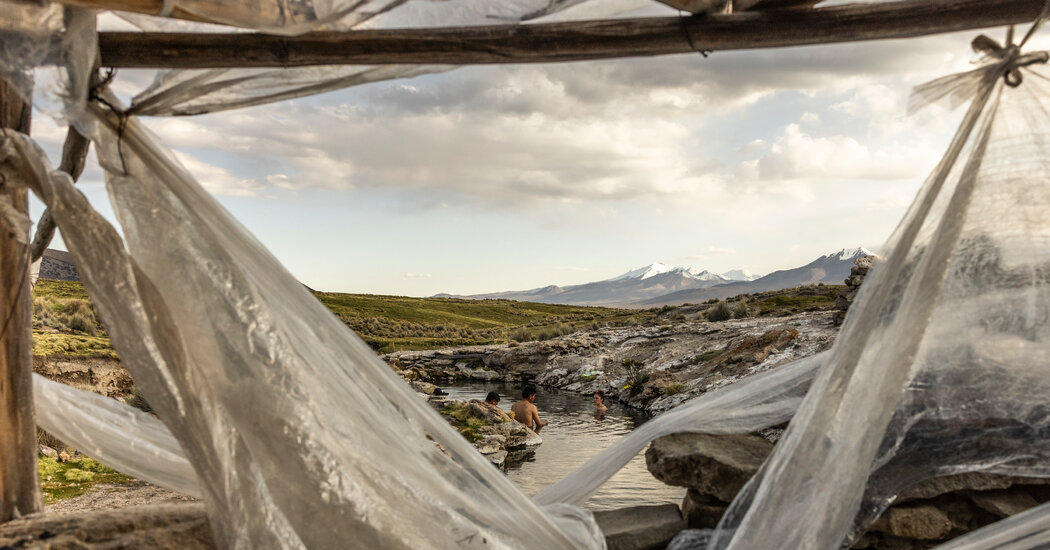
Mount Sajama, an extinct volcano and Bolivia’s tallest mountain at over 21,000 feet, rises from a windswept, high-altitude valley dotted with simple homes, llama herds, a central village and a few geothermal hot spots.
Micaela Billcap owns a parcel of land with a thermal spring, but it is collectively managed and operated by the community, which shares in the profits.
“Sajama is a doctor,” said Marcelo Nina Osnayo, who grew up in the area. The hot springs, too, are considered medicinal — a balm for the hard-working people of the area.
The weather at such high altitudes is harsh, and the daily work is relentless. Marcelo told me that his wife developed arthritis after working in a kitchen with only cold water. “When we used to go to the water springs, it moved in her bones,” he said. “They contain many minerals, like sulfur, arsenic, potassium and salt. It is a mixture of medicines.”
Nevada is home to more than 300 natural geothermal springs. But only about 40 of them are safe and accessible for soaking. There’s a hot spring shaped like a heart, a hot spring in a repurposed cattle trough, a languid thermal river and a deep tub that looks out over Joshua trees and jack rabbits. Each requires a spirit of adventure, some research and a bit of chance.
(The hot springs I visited in Nevada are the only purely wild hot springs in the book — the only bathing places without someone granting admission or monitoring the flow of visitors. Because of that, to prevent overuse, I decided not to share specific names of the pools there.)
The springs can be well maintained or trashed by careless visitors or roving livestock; the roads can be too rough for passage; the climate too hot in summer or too frigid in winter. But when you time it right, the air is scented by sagebrush, and the silence so pure you can hear your ears drumming.
Riemvasmaak, South Africa
In 1973 and 1974, during South African apartheid, the Black residents of Riemvasmaak, a settlement in northwest South Africa, were torn from their homes so that the government could build a military site. Among those residents were Henry Basson and his family, who were forcibly relocated to northern Namibia.
For decades the community’s land was occupied by the armed forces, to train infantry and practice bombing. In the 1990s, when Namibia gained independence and Nelson Mandela was elected in South Africa, Riemvasmaak became one of South Africa’s first repatriated lands.
“It was a very emotional experience to return,” said Mr. Basson, “because of that sense of belonging.”
Now the manager of the area’s hot springs, Mr. Basson always takes a soak whenever it’s cleaning time, lowering himself into the small pools that sit beneath imposing cliffs. “We give ourselves a chance to be in the water and feel it,” he said.
This is his true home, where he continues his ancestors’ story. But he tells me that this kind of connection to the land is available to anyone. “When you are visiting a hot spring, or any place, don’t just come for a jolly thing,” he said. “Try to make that connection.”
“In a hot spring, you get yourself disconnected from the things that rush you, and connect again to nature itself,” he added.
7132 Thermal Baths, Switzerland
The baths at 7132 Hotel in Vals, Switzerland, are an austere, Brutalist shrine to hot water. Designed by the Swiss architect Peter Zumthor, the complex was built from 60,000 slabs of locally sourced quartzite. The stone is warm to the touch, absorbing sounds so that everything is muffled, reverent, churchlike.
Bathing in hot springs can involve intricate practices. But the baths in Vals remind us that it’s really the bathing itself that constitutes the ritual. Perhaps there’s no need for ceremony when soaking is enough.
Neither cellphones nor cameras are allowed in the baths, but I got permission from the staff to photograph the area while it was being cleaned. The cleaners are specialists, using specific cloths and sprays for each surface. They explained their careful techniques, and how it took trial and error over time to figure them out.
I thought about how our sacred, special places require work and maintenance, the ongoing negotiation of personality, politics and place. That’s part of the ritual, too.
Greta Rybus is a photojournalist based near Portland, Maine. Her book “Hot Springs: Photos and Stories of How the World Soaks, Swims and Slows Down,” from which this photo essay is adapted, will be published by Ten Speed Press on March 19.