
The Nashville Area Chamber of Commerce has convened an annual meeting of local business leaders since the 1800s, but the most recent gathering had a decidedly modern theme: artificial intelligence.
The goal was to demystify the technology for the chamber’s roughly 2,000 members, especially its small businesses.
“My sense is not that people are wary,” said Ralph Schulz, the chamber’s chief executive. “They’re just unclear as to its potential use for them.”
When generative A.I. surged into the public consciousness in late 2022, it captured the imagination of businesses and workers with its ability to answer questions, compose paragraphs, write code and create images. Analysts projected that the technology would transform the economy by driving a boom in productivity.
Yet so far, the impact has been limited. Although adoption of A.I. is rising, only about 5 percent of companies nationwide are using the technology, according to a survey of businesses from the Census Bureau. Many economists predict that generative A.I. is years away from measurably affecting economic activity — but they say change will come.
“To me, this is a story of five years, not five quarters,” said Philipp Carlsson-Szlezak, the global chief economist at Boston Consulting Group. “Over a five-year horizon, am I going to see something measurable? I think so.”
While some of the largest companies, in Nashville and elsewhere, are finding uses for A.I. — and devoting money and time to developing more — many smaller companies are just starting to dabble in the technology, if they use it at all.
“The best and the biggest are actually working on implementing it and getting value from it now, but the adoption curve is really early,” Mr. Carlsson-Szlezak said.
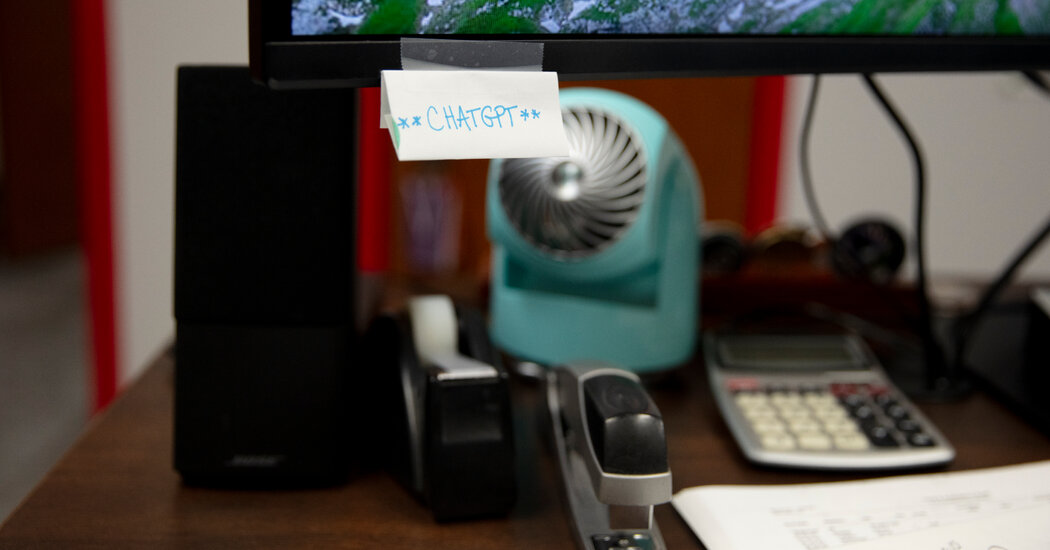
Allison Giddens, a co-president at Win-Tech, an aerospace manufacturing company with 41 employees in Kennesaw, Ga., said she started using ChatGPT about six months ago for some operational tasks, like writing emails to employees, analyzing data and drafting basic procedures for the company’s front office. A note taped to her computer monitor says simply “ChatGPT” to remind her to use the technology.
“We have to get in the habit of actually using the tool,” she said.
But she faces hurdles in implementing it more broadly and using it to make her company more efficient. Sometimes she finds ChatGPT’s responses off base. Cybersecurity is important in her industry, so she must be careful about the information she feeds into A.I. models. And she hasn’t found a place for the technology on the factory floor, where machinists make custom aluminum and titanium parts for the defense industry.
“There’s not a whole heck of a lot of use cases for the shop floor yet,” she said.
Technological innovations, including computing and the internet, have historically taken many years or decades to diffuse through the economy and affect productivity and output. The American economist Robert Solow said in 1987, “You can see the computer age everywhere but in the productivity statistics.”
Economists generally believe that the diffusion and adoption of generative A.I. will occur much faster, in part because information flows more quickly than it did in the past. The consulting firm EY-Parthenon, for instance, concluded in a recent series on generative A.I. that the technology could juice productivity in three to five years.

But there are some significant barriers, including hesitation around using the technology, legal and data security hurdles, regulatory friction, cost and the need for more physical and technological infrastructure to support A.I., including computing power, data centers and software.
“We’re still at the initial stages of the revolution in that we have started to see significant investment in establishing the foundations for that revolution,” said Gregory Daco, the chief economist at EY-Parthenon. “But we have not yet seen the full extent of the benefits from a productivity standpoint, from a greater output standpoint, from a greater labor deployment standpoint.”
David Duncan, the chief executive of First Hospitality, a hotel management company in Chicago, said the company was working to ensure that its internal financial data could be used by A.I. systems in the future.
“We’re planning for the next generation of applications of A.I.,” he said.
Mr. Duncan said he envisioned using A.I. to analyze this data and create initial drafts of reports, freeing up executives and general managers. The company, with about 3,600 employees, also hopes to leverage A.I. to analyze weekly surveys of workers over the course of a year to glean insights about trends in their teams’ overall morale.
“I think we’re in the early stages of a massive transformation of the way we process business ideas, strategy, data and outputs,” Mr. Duncan said.
According to surveys, A.I. use is greatest in the information and professional services, which include graphic design, accounting and legal services — traditionally white-collar jobs that have been less threatened by automation.
The research shows that marketing is among the most common uses for A.I. across all businesses. Gusto, a small-business payroll and benefits platform, found that among businesses created last year that were using generative A.I., 76 percent were doing so for marketing.
Still, many economists think that in the long run, few if any occupations will be unaffected by A.I. in some way. EY-Parthenon estimated that two-thirds of U.S. employment — more than 100 million jobs — is highly or moderately exposed to generative A.I., meaning those jobs could be altered by the technology. The remainder, typically jobs with more social and human interaction, are likely to be affected as well, through tasks like administrative work.
And A.I. diffusion appears to be gaining steam. A working paper from the Center for Economic Studies, using data from the Census Bureau’s Business Formation Statistics, found a “substantial, discrete jump” last year in applications for A.I.-related businesses, which could fuel the technology’s spread. The paper also showed that businesses originating from A.I.-related applications over the years had greater potential than others for job creation, payroll and revenue.
Putting this together, “we believe that there is potential for these A.I. start-ups to have an impact on our economy in the near future,” said Can Dogan, an associate professor of economics at Radford University in Virginia and one of the paper’s authors.
“In general, existing businesses should find out what they can do with these technologies,” he added. “I think that is the key for wider adoption.”
Chris Jones, the founder of Planting Seeds Academic Solutions, an education and tutoring business with nine employees and 100 to 150 independent contractors, is among those trying to figure out how to use emerging A.I. technologies. Mr. Jones, based in Dallas, said that he became interested in using A.I. at his company in 2021 or 2022 but that he “never had the full focus to pinpoint how A.I. could be incorporated into our business.”
He hopes to enlist a consultant soon to show the company how to use A.I. for sales, administrative tasks and program operations like curriculum creation. He is mindful of the potential effect on his employees’ jobs, he said, but cleareyed about the changing economic landscape.
“As a business, I need to stay afloat, because competition is real,” Mr. Jones said.
In Nashville, a driving force in pushing small and midsize companies to embrace A.I. is the chamber’s chair, Bob Higgins. He has been talking to other business leaders, holding webinars and working with a Vanderbilt University professor who is an expert on generative A.I.
Mr. Higgins is trying to lead by example, too. At Barge Design Solutions, an engineering and architecture services firm where he is the chief executive, his human resources team has used generative A.I. to help create job postings that yielded more qualified applicants for hard-to-fill positions. He also uses the technology as a “thought partner” to prepare for meetings and create agendas.
The ultimate goal, he said, is “to help make Nashville this GenAI city.”
“If you live in the fear of it,” he said, “I think you’re going to be left out.”