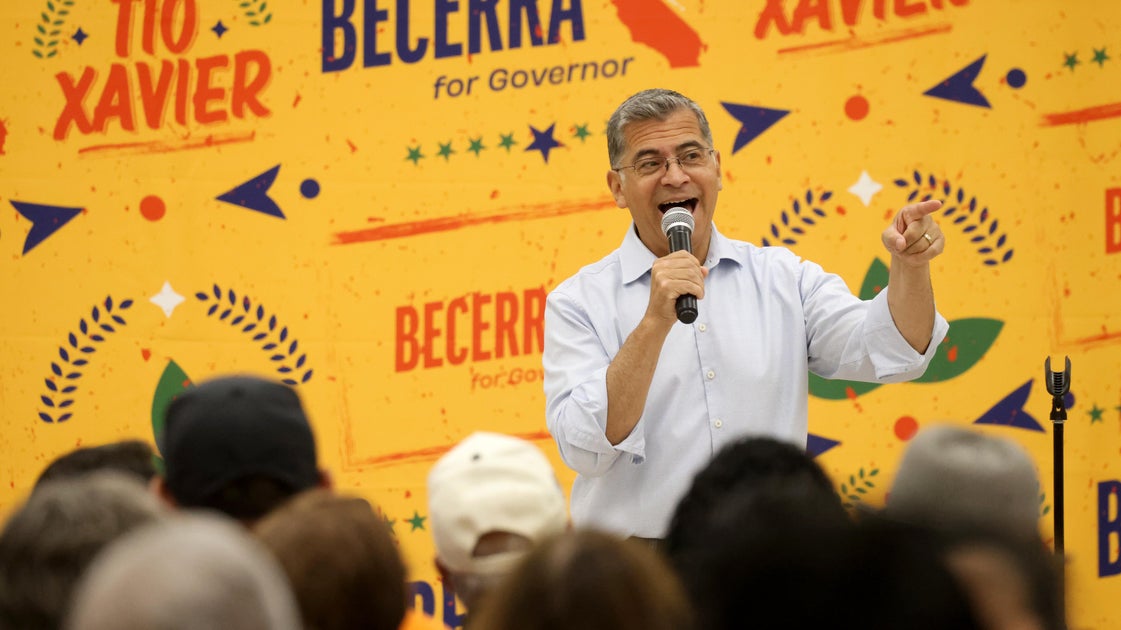

The single-most viewed clip of the 2026 election cycle might be from Xavier Becerra’s appearance at the League of California Cities conference last month. A moderator asks Becerra, a former state attorney general and the frontrunner in the governor’s race, about other candidates’ criticism of his decision to accept a donation from Chevron, the oil giant founded in Southern California. Becerra argued that fossil fuels were a fact of life.
“Chevron employs a lot of very hard-working people, talented folks — engineers, construction workers. That’s the problem with politics: They’re not the bad guy. Does everybody here drive an electric vehicle?” he says. “You need Chevron. I need Chevron. My people in the state of California need Chevron.”
“If Chevron wants to give me a check, that’s their prerogative,” he adds.
Tom Steyer, the billionaire Democratic activist who is Becerra’s most serious challenger for the job, made sure millions upon millions of Californians saw Becerra’s answer. He’s featured it in three different attack ads, omitting much of the answer to make Becerra’s statement that he “needs Chevron” sound like he needs the oil company to fund his campaign.
“Xavier Becerra is part of a broken system that delivers for them, not you,” the narrator says in one of the ads.
Becerra’s answer, and the speed at which Steyer turned it into an attack ad, highlights an ongoing struggle within the Democratic Party over whether the party should adopt a more conciliatory approach towards the oil and gas industry as it seeks a political comeback.
And while Becerra does not appear eager to repeat his answer — his campaign did not respond to a request for comment — races outside of bright blue California show many of the party’s most-hyped candidates are taking a notably friendlier tack towards the industry.
“It is unrealistic for policymakers to only talk about oil and gas in a negative light, because people are deeply reliant on oil and gas in their day-to-day lives,” said Emily Becker, who works for the climate and energy program at Third Way, a center-left think tank. “We can’t tell people that every time you gas up your car, you’re doing something wrong.”
It’s a notable shift compared to how the party talked about energy issues following President Donald Trump’s first election and into Biden’s administration, when an overwhelming focus on battling climate change predominated and activist groups pushing for a “Green New Deal” led presidential candidates to compete about whose plan could complete the transition away from fossil fuels the fastest. Even when American oil production reached record highs under Biden’s administration, the president declined to boast about it.
The shifting message has gone hand in hand with two trends: the clean energy industry’s viability has increased, and the Democratic Party has made fighting climate change less central to its message. But Tre Easton, a vice president at the moderate Searchlight Institute, said the party still needs to go further into turning its climate change policy into a broader energy policy.
“There’s still sort of this consensus from the past 10 years where oil and gas companies are persona non grata for most Democrats in D.C.,” Easton said. “That’s an untenable situation. If that’s the entirety of the conversation, Republicans are going to dictate the terms. And that’s not good for anybody.”
So far, the message shift has been most pronounced in regions of the country where oil and gas is a major industry. Bobby Pulido, a former Tejano music star running as a Democrat in a rural district in south Texas, has been unapologetically positive about oil and gas production. More than 600,000 Texans work in oil and gas, and the industry makes up about 13% of the state’s gross domestic product.
“In many of the counties, some of the best-paying jobs are in oil and gas,” he said of his district in a phone interview. He said many oil company owners and executives play up Democratic threats to the industry to their employees: “They say ‘the other ones want to take your job,’ so vote Republican.”
“It’s just not a winning strategy if voters think you want to take away their job,” he continued.

Pulido emphasized that he also supports clean energy and said he wants to secure better protections for oil industry workers in the region, many of whom are contractors and lack severance protections if they are laid off when oil prices drop.
In a recent joint podcast appearance with Pulido, state Rep. James Talarico similarly gave the industry a bear hug.
“I owe everything to this industry,” Talarico said, referring to how taxes on the industry helped fund schools in the state. “The idea that politicians in Washington think they can eliminate this industry is something we had to fight against, something we have to fight against in our own party.”
Talarico, however, once sounded more like a Biden-era Democrat: He backed legislation requiring Texas to cut its carbon emissions by 50% by 2030 as a state representative, and Republicans have already signaled they plan to argue that he is insufficiently supportive of the industry.
Beyond Texas, former Rep. Mary Peltola has been supportive of oil and gas exploration in Alaska, adopting positions similar to those of GOP Sens. Lisa Murkowski and Dan Sullivan, the man she is aiming to oust. And New York Gov. Kathy Hochul has shrugged off criticisms from progressives to roll back a climate law seen as aggressively cracking down on fossil fuels.
Some mainstream environmental groups, meanwhile, are largely accepting the shift as long as Democrats continue to contrast themselves with Trump’s unmitigated hostility towards wind and solar power, which has led his administration to make it as difficult as possible to get new clean energy projects off the ground.
“There’s going to be a massive energy buildout to meet demand from data centers one way or the other, and the question is are you going to give wind, solar and batteries a fair shot to win that buildout or are you not?” said Jesse Lee, a senior adviser at Climate Power. “There’s only one party trying to ban new energy sources in this country right now, and it’s the Republicans.”
But there are real questions about how accepting Democratic voters will be of this shift. Steyer’s attacks on Becerra’s ties to big oil are among the most effective anti-Becerra messaging, according to Democratic operatives who have seen polling on the race. California environmental groups have lined up behind Steyer.
“Becerra is wrong. Big Oil is absolutely the bad guy,” California Environmental Voters political director Matt Abularach-Macias said after Becerra’s comments last month. “Big Oil knew their products would cause devastating impacts to our health, economic and physical safety decades ago, and they decided to lie about it and continue their destructive, deadly business practices.”
Chevron and another major oil company, the California Resources Corporation, have both donated $500,000 to an independent expenditure campaign backing Becerra. Steyer has used the cash to justify calling Becerra “big oil Becerra” and put out a digital ad mocking the donations.
While Becerra battled with the oil industry as attorney general from 2017 to 2021 ― “Google ‘AG Becerra lawsuits against fossil fuel industry,’” he said somewhat flippantly at the conference when asked about his climate change bona fides ― the industry seems to be embracing him mostly as an alternative to the climate-focused Steyer, said one California Democrat who has worked with the industry but requested anonymity to speak frankly about the contested race.
If Steyer’s attacks are successful — it’s possible both men will advance to the general election in California, so a verdict might not be immediately forthcoming — it could impact how 2028 presidential candidates approach the issue. But Becker thinks there’s little chance the aggressive posture the party adopted in 2020 will ever return.
“The ground has shifted, and I think you’re going to see something a lot more reflective of what the American people actually want,” she said.