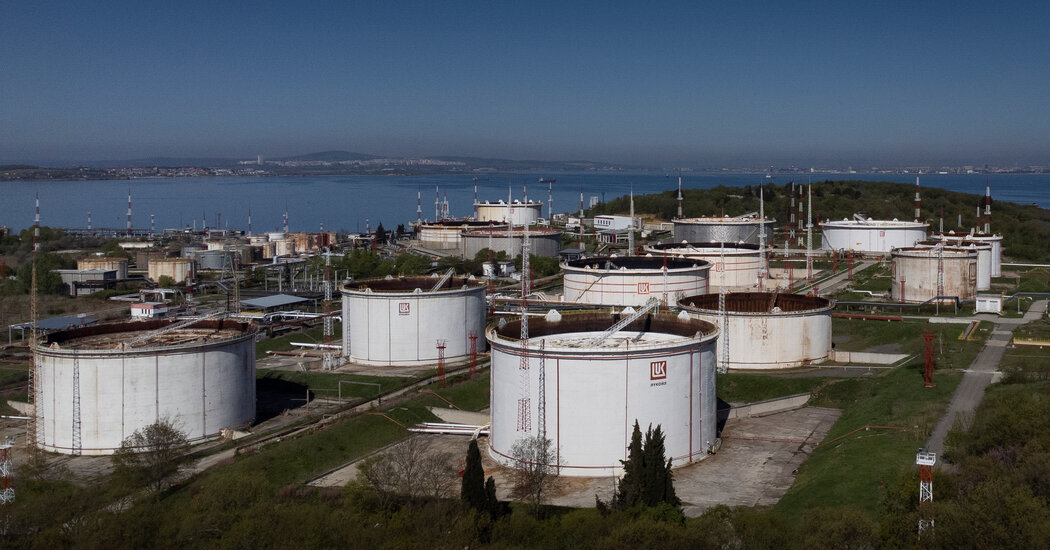

The oil terminal’s piers stretch just a few score yards into the Black Sea from the Bulgarian coast. For 25 years, the Russian crude they received fed a sprawling network of economic and political influence that helped keep Bulgaria tethered tightly to the Kremlin.
How much oil arrived at the terminal for use by a nearby Russian-owned refinery was something only the Russians knew: they controlled the piers, the meters recording the volumes delivered and the security force guarding the perimeter fences.
In recent months, however, Russia has steadily lost its grip on the Rosenets Oil Terminal, near the Black Sea port city of Burgas.
Bulgaria has taken back control of the piers and has laid plans to take over management of the refinery from its Russian owner, Lukoil, if it balks at processing non-Russian oil. In January, Bulgaria halted shipments of Russian crude.
Russia’s increasing loss of control of the facility highlights an unintended — and, for Moscow, undesirable — consequence of its invasion of Ukraine.
Even as Russia’s military battles to entrench its occupation of territory grabbed from Ukraine on the other side of the Black Sea, Moscow has suffered setbacks on previously friendly terrain in Bulgaria. Long bound to Russia by history, common Slavic roots and a shared Orthodox Christian faith, Bulgaria was once so loyal to the Kremlin it asked to be absorbed into the Soviet Union.
Past loyalty has now curdled into deep distrust of Russia among the country’s main political parties over the war in Ukraine. When Russia invaded, Bulgaria’s government was dominated by pro-Western reformers and it took a hard line against Moscow, expelling 70 Russian diplomats over espionage concerns and arresting several Bulgarian officials suspected of spying for Moscow.
That government, led by Kiril Petkov, collapsed a few months later but rival parties have often taken an even tougher line, except for a far-right ultranationalist group.
Dependent on Russia for around 95 percent of its natural gas before the war in Ukraine, Bulgaria now imports no Russian gas. It also ditched Rosatom, Russia’s nuclear power company and a longtime partner, in favor of America’s Westinghouse for its supply of nuclear fuel and the construction of new reactors.
“We need to be 100 percent independent in energy from Russia,” said Nikolai Denkov, who, before stepping down in March as prime minister, oversaw a drive to break Lukoil’s grip on the oil terminal and the nearby Neftohim refinery. “Everyone knows that Lukoil is ultimately controlled by the Kremlin.”
Lukoil disputes that, insisting it is a private company focused on business. But the company, which produces nearly all of Bulgaria’s gasoline and jet fuel at its Neftohim refinery, operates 220 gas stations in the country and has become the most visible emblem of what many view as Russia’s malign influence in Bulgaria, the poorest country in the European Union.
“Remove Lukoil from the equation and Russia’s influence in Bulgaria crumbles,” said Ilian Vassilev, a former ambassador to Moscow.
Complaining of “unfair, biased political decisions” against its business, Lukoil announced in December that it was reviewing its strategy in Bulgaria with a view to perhaps selling the Neftohim refinery.
The unraveling of a once intimate relationship by the authorities in Sofia, the Bulgarian capital, has stirred unease on the Black Sea coast, where Russians were long a mainstay of the tourism and real estate sectors but are now mostly staying away. Lukoil is the area’s biggest employer, with more than 5,000 people dependent for work on its refinery, oil terminal and related ventures, according Dimitar Nikolov, the mayor of Burgas.

“Every family in Burgas has a relative who has worked at the refinery at some point,” Mr. Nikolov said. He said he did not care whether Russia keeps ownership of the refinery or sells it so long as it keeps working and paying salaries — and keeps funding the city’s volleyball club, a frequent national champion, and other good-will investments.
The Russia Center, a private visa agency in the city whose main business used to be helping Russians get residency permits, still flies a Russian flag at the entrance. But wary of upsetting the Ukrainians and other Russian-speaking clients it now needs to offset a decline in business from Russia, it also displays a digital sign reading, “No to War!”
The manager, Plamen Dotor, said Russians were still welcome in Bulgaria, “but it is difficult for them now because of geopolitics” and because of the cancellation of many of their visas and what, before the war, were at least four daily flights between Burgas and Russia.
Few ordinary Bulgarians express hostility to Russia but, according to a recent opinion poll, only 20 percent approve of the Russian president, Vladimir V. Putin, compared with 58 percent before he invaded Ukraine. Bulgaria’s fractious politicians — so bitterly divided and unable to cooperate that there have been five general elections since 2021 — have found rare common cause against Russia and Lukoil.
“Lukoil’s influence here has been huge and very bad,” said Delyan Dobrev, chairman of the Bulgarian Parliament’s energy committee. “We have to do everything to show that they are not wanted here. We don’t want Lukoil,” he said.
When the European Union prohibited seaborne transfers of Russian crude in June 2022, the Bulgarian government pleaded for an exemption, saying that an end to shipments would cripple its biggest industrial enterprise, the Lukoil-owned refinery, which used only Russian crude, and send gasoline prices soaring. To avoid that, Bulgaria secured the right to skirt the E.U.-imposed ban until the end of this year.
But, in a sign of how far the war in Ukraine has shifted Bulgaria’s political winds against Russia, the government at the time — headed by Mr. Petkov’s pro-Western party, We Continue the Change — found itself under heavy fire from previously Moscow-friendly political forces.
The party’s foes accused it of aiding Russia and its war by pushing for the exemption and stalling on ending it, even when evidence emerged that Lukoil was exploiting the loophole to ship Russian oil beyond Bulgaria.
“They brag all the time about being the West’s biggest allies in Bulgaria but they wanted to keep Russian oil flowing,” said Mr. Dobrev, whose own party, GERB, used to take pride in having good relations with Russia and its energy companies.
GERB’s leader, the former prime minister Boyko Borissov, in 2020 joined Mr. Putin in Turkey to celebrate the opening of Turkstream, a pipeline that allowed the Russian energy behemoth Gazprom to bypass Ukraine and make deliveries through Bulgaria to Serbia, Hungary and Bosnia.
In a 2006 cable to Washington leaked by WikiLeaks, the United States ambassador to Bulgaria then, John R. Beyrle, said that Mr. Borisov, who at the time was the mayor of Sofia, “has close financial and political ties” to Lukoil’s longtime boss in Bulgaria, Valentin Zlatev, described as a “kingmaker” and “power broker.” Mr. Zlatev has since left Lukoil.
“We have tamed the dragon, but we have not killed it,” said Martin Vladimirov, the director of the energy and climate program at the Center for the Study of Democracy in Sofia. Getting control of the Lukoil refinery is vital not only for energy security, he added, but for the future good health of a political system deformed for years by “the cancer of Russian money.”
“The only way to disentangle fully from Russia,” he said, “is to kick out Lukoil.”
Most of the more than 100 Russian executives at the refinery have already gone home, according to the mayor of Burgas.
Since January, the facility has had to use non-Russian oil and cut production sharply. Lukoil declined a request to visit the refinery.
When Lukoil took control of the refinery from the Bulgarian state in 1999 in a privatization deal tainted by allegations of corruption, the arrival of a deep-pocketed Russian oil company “did not seem like a bad idea,” recalled Dimitar Naydenov, a pro-Western member of Parliament from Burgas. “But it was a different Russia we were dealing with back then. Russia has changed, and we have to stop it exporting fear and corruption along with its oil.”
Boryana Dzhambazova contributed reporting from Sofia, Bulgaria.