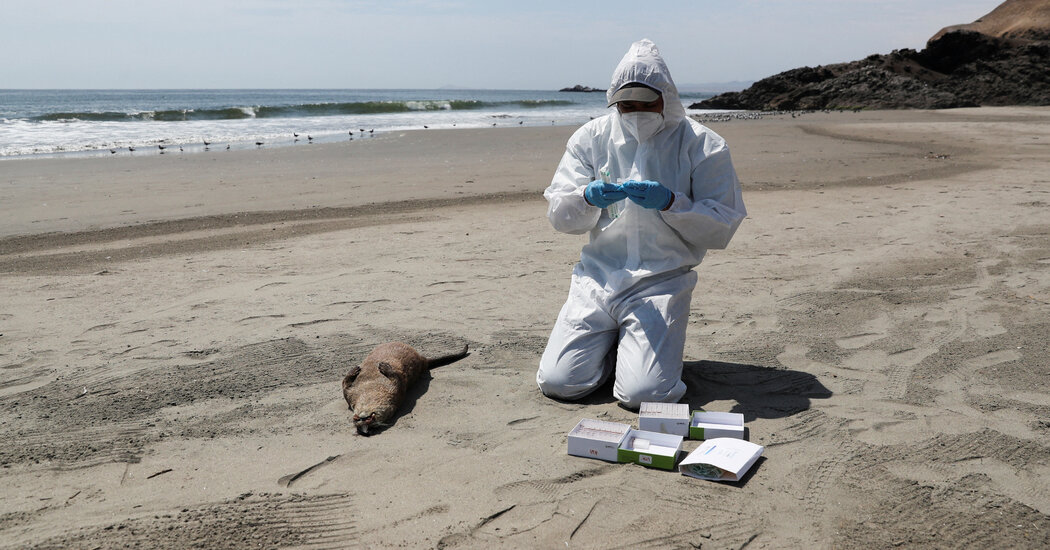

In her three decades of working with elephant seals, Dr. Marcela Uhart had never seen anything like the scene on the beaches of Argentina’s Valdés Peninsula last October.
It was peak breeding season; the beach should have been teeming with harems of fertile females and enormous males battling one another for dominance. Instead, it was “just carcass upon carcass upon carcass,” recalled Dr. Uhart, who directs the Latin American wildlife health program at the University of California, Davis.
H5N1, one of the many viruses that cause bird flu, had already killed at least 24,000 South American sea lions along the continent’s coasts in less than a year. Now it had come for elephant seals.
Pups of all ages, from newborns to the fully weaned, lay dead or dying at the high-tide line. Sick pups lay listless, foam oozing from their mouths and noses.
Dr. Uhart called it “an image from hell.”
In the weeks that followed, she and a colleague — protected head to toe with gloves, gowns and masks, and periodically dousing themselves with bleach — carefully documented the devastation. Team members stood atop the nearby cliffs, assessing the toll with drones.
What they found was staggering: The virus had killed an estimated 17,400 seal pups, more than 95 percent of the colony’s young animals.
The catastrophe was the latest in a bird flu epidemic that has whipped around the world since 2020, prompting authorities on multiple continents to kill poultry and other birds by the millions. In the United States alone, more than 90 million birds have been culled in a futile attempt to deter the virus.
There has been no stopping H5N1. Avian flu viruses tend to be picky about their hosts, typically sticking to one kind of wild bird. But this one has rapidly infiltrated an astonishingly wide array of birds and animals, from squirrels and skunks to bottlenose dolphins, polar bears and, most recently, dairy cows.
“In my flu career, we have not seen a virus that expands its host range quite like this,” said Troy Sutton, a virologist who studies avian and human influenza viruses at Penn State University.
The blow to sea mammals, and to dairy and poultry industries, is worrying enough. But a bigger concern, experts said, is what these developments portend: The virus is adapting to mammals, edging closer to spreading among people.
A human pandemic is by no means inevitable. So far at least, the changes in the virus do not signal that H5N1 that can cause a pandemic, Dr. Sutton said.
Still, he said, “We really don’t know how to interpret this or what it means.”
Marine mortalities
A highly pathogenic strain of H5N1 was identified in 1996 in domestic waterfowl in China. The next year, 18 people in Hong Kong became infected with the virus, and six died. The virus then went silent, but it resurfaced in Hong Kong in 2003. Since then, it has caused dozens of outbreaks in poultry and affected more than 800 people who were in close contact with the birds.

All the while, it continued to evolve.
The version of H5N1 currently racing across the world emerged in Europe in 2020 and spread quickly to Africa and Asia. It killed scores of farmed birds, but unlike its predecessors it also spread widely among wild birds and into many other animals.
Most infections of mammals were probably “dead-end” cases: a fox, perhaps, that ate an infected bird and died without passing on the virus. But a few larger outbreaks suggested that H5N1 was capable of more.
The first clue came in the summer of 2022, when the virus killed hundreds of seals in New England and Quebec. A few months later, it infiltrated a mink farm in Spain.
In the mink, at least, the most likely explanation was that H5N1 had adapted to spread among the animals. The scale of the outbreaks in sea mammals in South America underscored that probability.
“Even intuitively, I would think that mammal-to-mammal transmission is very likely,” said Malik Peiris, a virologist and expert in bird flu at the University of Hong Kong.
After it was first detected in South America, in birds in Colombia in October 2022, the virus swept down the Pacific coast to Tierra del Fuego, the southernmost tip of the continent, and up the Atlantic coast.
Along the way, it killed hundreds of thousands of seabirds, and tens of thousands of sea lions, in Peru, Chile, Argentina, Uruguay and Brazil. The sea lions behaved erratically, experiencing convulsions and paralysis; pregnant females miscarried their fetuses.
“What happened when the virus moved to South America we had never seen before,” Dr. Uhart said.
Exactly how and when the virus jumped to marine mammals is unclear, but the sea lions most likely came into close contact with infected birds or contaminated droppings. (Although fish make up the bulk of sea lions’ diet, they do sometimes eat birds.)
At some point, it’s likely the virus evolved to spread directly among the marine mammals: In Argentina, the sea lion deaths did not coincide with the mass mortality of wild birds.
“This could suggest that the infection source was not the infected birds,” said Dr. Pablo Plaza, a wildlife veterinarian at the National University of Comahue and National Scientific and Technical Research Council in Argentina.
It is not hard to imagine how the virus might disperse in these animals: Elephant seals and sea lions both breed in colonies, crowding together on beaches where they fight, mate and bark at one another. Elephant seals sneeze all day, dispersing large droplets of mucus each time they do.
It is difficult to prove exactly how and when the virus moved from one species to another. But genetic analysis supports the theory the marine mammals acquired their infections from one another, not birds. Samples of virus isolated from sea lions in Peru and Chile and from the elephant seals in Argentina all share about 15 mutations not seen in the birds; the same mutations were also present in a Chilean man who was infected last year.
There are numerous opportunities for H5N1 to jump from sea mammals into people. One sick male elephant seal that sat for a day and a half on a public beach in Argentina turned out to carry enormous amounts of virus. In Peru, scientists collected samples from sea lion carcasses that lay alongside families enjoying a beach day.
Scavenging animals, such as dogs, could also pick up the virus from an infected carcass and then spread it more broadly: “None of the wildlife exists in their little silos,” said Wendy Puryear, a virologist at Tufts University who studied the New England seal outbreaks.
In some South American countries, apart from a few carcasses that were buried, the rest have remained on the beaches, rotting and scavenged upon.
“How do you even scale up to remove 17,000 dead bodies out in the middle of nowhere, places where you can’t even bring down machinery, and humongous cliffs?” Dr. Uhart said.
A mutating pathogen
Flu viruses are adept at picking up new mutations; when two types of flu virus infect the same animal, they can shuffle their genetic material and generate new versions.
It is unclear exactly how, and how much, the H5N1 virus has changed since it first emerged. One study last year showed that after the virus entered the United States, it quickly mixed with other flu viruses circulating here and morphed into various versions — some mild, others causing severe neurological symptoms.
“So now after 20 years of reassortment, you have a virus that actually does extraordinary well in a whole variety of avian and mammal species,” said Vincent Munster, a virologist at the National Institute of Allergy and Infectious Diseases who has studied the mutations needed for H5N1 to adapt to people.
Every new species that harbors the virus creates opportunities for H5N1 to continue to evolve, and to jump into people.
And the virus may stumble across mutations that no one has yet considered, allowing it to breach the species barrier. That is what happened in the 2009 swine flu outbreak.
That virus did not have the mutations thought to be needed to infect people easily. Instead, “it had these other mutations that no one knew about or thought about before then,” said Louise Moncla, an evolutionary biologist who studies avian influenza at the University of Pennsylvania.
Still, even if the virus jumps to people, “we may not see the level of mortality that we’re really concerned about,” said Seema Lakdawala, a virologist at Emory University. “Preexisting immunity to seasonal flu strains will provide some protection from severe disease.”
What happens next
The U.S. is prepared for an influenza pandemic, with some stockpiled vaccines and antivirals, but its efforts at monitoring the virus may not pick it up quickly enough to deploy those tools.
It took several weeks before farmers, and then officials, knew that H5N1 was circulating in dairy cows.
The dairy farm outbreak has resulted in only one mild human infection, but farms are fertile ground for the virus to jump species — from cat to cow to pig and human, in any order.
Many scientists worry in particular about pigs, which are susceptible to both human and avian flu strains, providing the perfect mixing bowl for viruses to swap genes. Pigs are slaughtered when very young, and newer generations, with no prior exposure to flu, are particularly vulnerable to infections.
So far, H5N1 does not seem adept at infecting pigs, but that could change as it acquires new mutations.
“I never let my kids go to a state fair or animal farm, I’m one of those parents,” Dr. Lakdawala said. “And it’s mostly because I know that the number of interactions that we increase with animals, the more opportunities there are.”
Should H5N1 adapt to people, federal officials will need to work together and with their international counterparts. Nationalism, competition and bureaucracy can all slow down the exchange of information that is crucial in a developing outbreak.
In some ways, the current spread among dairy cows is an opportunity to practice the drill, said Rick Bright, the chief executive of Bright Global Health, a consulting company that focuses on improving responses to public health emergencies. But the U.S. Agriculture Department is requiring only voluntary testing of cows, and is not as timely and transparent with its findings as it should be, he said.
Dr. Rosemary Sifford, the department’s chief veterinarian said the staff there were working hard to share information as quickly as they can. “This is considered an emerging disease,” she said.
Government leaders are typically cautious, wanting to see more data. But “given the rapid speed at which this can spread and the devastating illness that it can cause if our leaders are hesitant and don’t pull the right triggers at the right time, we will be caught flat-footed once again,” Dr. Bright said.
“If we don’t give it the panic but we give it the respect and due diligence,” he added, alluding to the virus, “I believe we can manage it.”