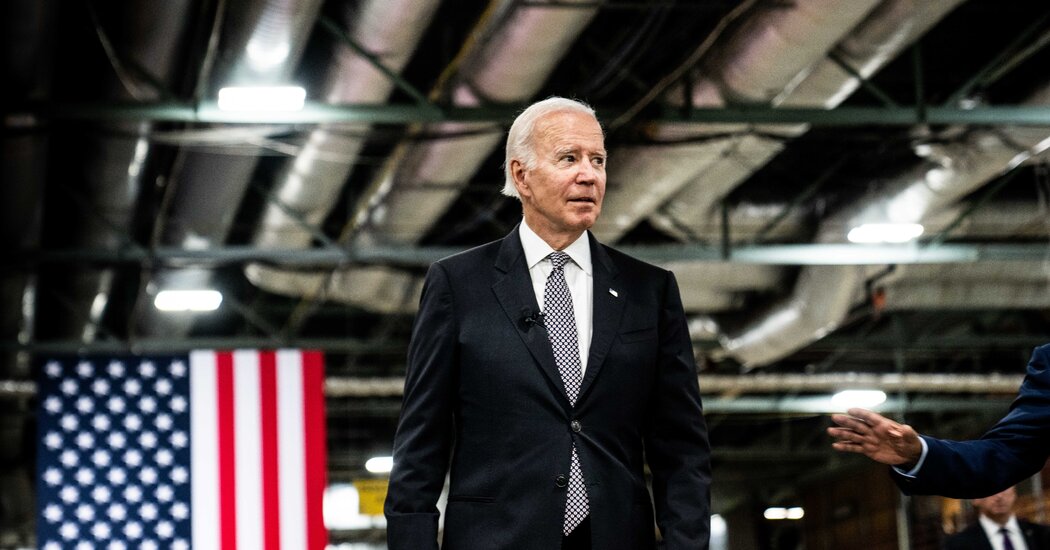

President Biden was standing in an Upper East Side townhouse owned by the businessman James Murdoch, the rebellious scion of the media empire, surrounded by liberal New York Democrats who had paid handsomely to come hear optimistic talk about the Biden agenda for the next few years.
It was Oct. 6, 2022, but what they heard instead that evening was a disturbing message that — though Mr. Biden didn’t say so — came straight from highly classified intercepted communications he had recently been briefed about, suggesting that President Vladimir V. Putin’s threats to use a nuclear weapon in Ukraine might be turning into an operational plan.
For the “first time since the Cuban Missile Crisis,” he told the group, as they gathered amid Mr. Murdoch’s art collection, “we have a direct threat of the use of a nuclear weapon if in fact things continue down the path they’ve been going.” The gravity of his tone began to sink in: The president was talking about the prospect of the first wartime use of a nuclear weapon since Hiroshima and Nagasaki.
And not at some vague moment in the future. He meant in the next few weeks.
The intercepts revealed that for the first time since the war in Ukraine had broken out, there were frequent conversations within the Russian military about reaching into the nuclear arsenal. Some were just “various forms of chatter,” one official said. But others involved the units that would be responsible for moving or deploying the weapons. The most alarming of the intercepts revealed that one of the most senior Russian military commanders was explicitly discussing the logistics of detonating a weapon on the battlefield.
Fortunately, Mr. Biden was told in his briefings, there was no evidence of weapons being moved. But soon the C.I.A. was warning that, under a singular scenario in which Ukrainian forces decimated Russian defensive lines and looked as if they might try to retake Crimea — a possibility that seemed imaginable that fall — the likelihood of nuclear use might rise to 50 percent or even higher. That “got everyone’s attention fast,” said an official involved in the discussions.
No one knew how to assess the accuracy of that estimate: the factors that play into decisions to use nuclear weapons, or even to threaten their use, were too abstract, too dependent on human emotion and accident, to measure with precision. But it wasn’t the kind of warning any American president could dismiss.
“It’s the nuclear paradox,” Gen. Mark A. Milley, the chairman of the Joint Chiefs of Staff until he retired in September, told me over dinner last summer at his official quarters above the Potomac River, recalling the warnings he had issued in the Situation Room.
He added: “The more successful the Ukrainians are at ousting the Russian invasion, the more likely Putin is to threaten to use a bomb — or reach for it.”
This account of what happened in those October days — as it happened, just before the 60th anniversary of the Cuban Missile Crisis, the closest the United States and the Soviet Union ever came to a nuclear exchange in the Cold War — was reconstructed in interviews I conducted over the past 18 months with administration officials, diplomats, leaders of NATO nations and military officials who recounted the depth of their fear in those weeks.
Though the crisis passed, and Russia now appears to have gained an upper hand on the battlefield as Ukraine runs low on ammunition, almost all of the officials described those weeks as a glimpse of a terrifying new era in which nuclear weapons were back at the center of superpower competition.
While news that Russia was considering using a nuclear weapon became public at the time, the interviews underscored that the worries at the White House and the Pentagon ran far deeper than were acknowledged then, and that extensive efforts were made to prepare for the possibility. When Mr. Biden mused aloud that evening that “I don’t think there’s any such thing as the ability to easily” make use of “a tactical nuclear weapon and not end up with Armageddon,” he was reflecting urgent preparations being made for a U.S. reaction. Other details of extensive White House planning were published Saturday by Jim Sciutto of CNN.
Mr. Biden said he thought Mr. Putin was capable of pulling the trigger. “We’ve got a guy I know fairly well,” he said of the Russian leader. “He is not joking when he talks about potential use of tactical nuclear weapons or biological or chemical weapons because his military is, you might say, significantly underperforming.”
Since then, the battlefield advantage has changed dramatically, and October 2022 now looks like the high-water mark of Ukraine’s military performance over the past two years. Yet Mr. Putin has now made a new set of nuclear threats, during his equivalent of the State of the Union address in Moscow in late February. He said that any NATO countries that were helping Ukraine strike Russian territory with cruise missiles, or that might consider sending their own troops into battle, “must, in the end, understand” that “all this truly threatens a conflict with the use of nuclear weapons, and therefore the destruction of civilization.”

“We also have weapons that can strike targets on their territory,” Mr. Putin said. “Do they not understand this?”
Mr. Putin was speaking about Russian medium-range weapons that could strike anywhere in Europe, or his intercontinental ballistic missiles that can reach the United States. But the scare in 2022 involved so-called battlefield nukes: tactical weapons small enough to be loaded into an artillery shell and designed to eviscerate a military unit or a few city blocks.
At least initially, their use would look nothing like an all-out nuclear exchange, the great fear of the Cold War. The effects would be horrific but limited to a relatively small geographic area — perhaps detonated over the Black Sea, or blasted into a Ukrainian military base.
Yet the White House concern ran so deep that task forces met to map out a response. Administration officials said that the United States’ countermove would have to be nonnuclear. But they quickly added that there would have to be some kind of dramatic reaction — perhaps even a conventional attack on the units that had launched the nuclear weapons — or they would risk emboldening not only Mr. Putin but every other authoritarian with a nuclear arsenal, large or small.
Yet as was made clear in Mr. Biden’s “Armageddon speech” — as White House officials came to call it — no one knew what kind of nuclear demonstration Mr. Putin had in mind. Some believed that the public warnings Russia was making that Ukraine was preparing to use a giant “dirty bomb,” a weapon that spews radiological waste, was a pretext for a pre-emptive nuclear strike.
The wargaming at the Pentagon and at think tanks around Washington imagined that Mr. Putin’s use of a tactical weapon — perhaps followed by a threat to detonate more — could come in a variety of circumstances. One simulation envisioned a successful Ukrainian counteroffensive that imperiled Mr. Putin’s hold on Crimea. Another involved a demand from Moscow that the West halt all military support for the Ukrainians: no more tanks, no more missiles, no more ammunition. The aim would be to split NATO; in the tabletop simulation I was permitted to observe, the detonation served that purpose.
To forestall nuclear use, in the days around Mr. Biden’s fund-raiser appearance Secretary of State Antony J. Blinken called his Russian counterpart, as did Defense Secretary Lloyd J. Austin III and the national security adviser, Jake Sullivan. Germany’s chancellor, Olaf Scholz, was going on a planned visit to Beijing; he was prepped to brief Xi Jinping, China’s president, about the intelligence and urge him to make both public and private statements to Russia warning that there was no place in the Ukraine conflict for the use of nuclear weapons. Mr. Xi made the public statement; it is unclear what, if anything, he signaled in private.
Mr. Biden, meanwhile, sent a message to Mr. Putin that they had to set up an urgent meeting of emissaries. Mr. Putin sent Sergei Naryshkin, head of the S.V.R., the Russian foreign intelligence service that had pulled off the Solar Winds attack, an ingenious cyberattack that had struck a wide swath of U.S. government departments and corporate America. Mr. Biden chose William J. Burns, the C.I.A. director and former U.S. ambassador to Russia, who is now his go-to troubleshooter for a variety of the toughest national security problems, most recently getting a temporary cease-fire and the release of hostages held by Hamas.
Mr. Burns told me that the two men saw each other on a mid-November day in 2022. But while Mr. Burns arrived to warn what would befall Russia if it used a nuclear weapon, Mr. Naryshkin apparently thought the C.I.A. director had been sent to negotiate an armistice agreement that would end the war. He told Mr. Burns that any such negotiation had to begin with an understanding that Russia would get to keep any land that was currently under its control.
It took some time for Mr. Burns to disabuse Mr. Naryshkin of the idea that the United States was ready to trade away Ukrainian territory for peace. Finally, they turned to the topic Mr. Burns had traveled around the world to discuss: what the United States and its allies were prepared to do to Russia if Mr. Putin made good on his nuclear threats.
“I made it clear,” Mr. Burns later recalled from his seventh-floor office at the C.I.A., that “there would be clear consequences for Russia.” Just how specific Mr. Burns was about the nature of the American response was left murky by American officials. He wanted to be detailed enough to deter a Russian attack, but avoid telegraphing Mr. Biden’s exact reaction.
“Naryshkin swore that he understood and that Putin did not intend to use a nuclear weapon,” Mr. Burns said.