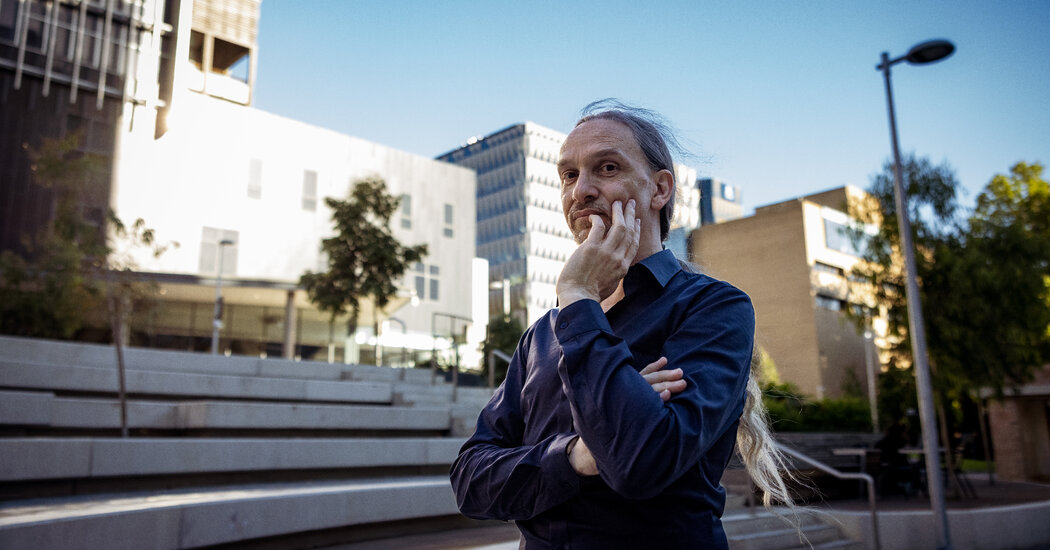

Jefa Greenaway will never forget the first time he heard his father’s voice. It was in 2017, when he was watching a documentary about Indigenous Australians’ fight to be recognized in the country’s Constitution.
“It was poignant, surreal,” Mr. Greenaway recalled. “In one word: emotional.”
In the film, his father, Bert Groves, an Indigenous man and a civil rights activist born in 1907, recounts how he was prevented from pursuing an education because of the size of his skull, a victim of phrenology, the pseudoscience that lingered in Australia into the 20th century.
Now 53, Mr. Greenaway, was just a baby when his father died, leaving him to be raised in Australia by his German mother. Yet his father’s values — like championing Indigenous rights and valuing education —- were inculcated in the young boy.
Mr. Greenaway is today one of what he estimates to be fewer than 20 registered Indigenous architects in Australia. He’s also a leading proponent of what is known as “Country-centered design,” which brings an Aboriginal worldview to building projects.
“People like Jefa are rare,” said Peter Salhani, an Australian architectural journalist who has admired Mr. Greenways’ work in Melbourne for some years. His projects, Mr. Salhani said, “are unquestionably of the Indigenous voice — we need that now more than ever.”
For many Indigenous Australians, the land they were born on or belong to holds a spiritual importance. When people talk of “Country,” they do not mean just physical land and waterways, but a belief system in which everything is animate and there is no division between humans, animals, buildings, plants, rocks, water and air.
One goal for the design approach that embraces this worldview is to reveal what was found on a site before European settlement and to do so in a way that puts the environment first.
One of the best examples of a Greenaway project reflecting these values is an amphitheater and plaza connecting the University of Melbourne, where the architect studied, with Swanston Street, regarded as the city’s civic spine. Taking a seat under a baby gum tree, Mr. Greenaway pointed to mudstone tracery on the ground of the amphitheater that snaked around clusters of native plants and into the interiors of buildings.
“This represents a creek that was once here,” Mr. Greenaway said. For millennia, it was an aquatic highway for migrating eels, before it was channeled into a storm water drain. Today, the occasional eel is found disoriented in ponds at the university, lost as they seek to continue their migration route.
Less an aesthetic and more of a different approach to the building process, Country-centered design starts with an Indigenous architect leading the project and collaborating with the local Indigenous community. Mr. Greenaway described it as “codesign.”
Country-centered design also puts sustainability at the fore, seeking to give back to the land, not take from it. “It’s how we’ve always done it,” Mr. Greenaway said, referring to Indigenous cultures.
Indigenous Australians are better represented across much of the creative sector, from music to the visual arts to theater and literature, than they are in architecture, which remains, according to Mr. Greenaway, “something of a last bastion.”
“There is a residual feeling that architecture is not for us because it has been complicit in colonization,” he continued. “Now that we have more voices contributing to this space, in the next few years, we’re going to really shift the idea of what design and architecture can do for the community.”

A short tram ride away from the amphitheater is the first project where Mr. Greenaway tested his design ideas: Ngarara Place, at the Royal Melbourne Institute of Technology.
What one notices first is the small scale. Ngarara Place is made of a segmented garden bed with native plants, each section representing one of the six or seven seasons observed by the Kulin Nations, the Aboriginal people who inhabited the area. It also has a fire pit for smoking ceremonies, a timbered amphitheater and an installation of contemporary Indigenous art.
Ngarara means “gathering” in the language of the traditional custodians of this land, and the site is “activated,” Mr. Greenaway said, when used in ceremonies or even when students are just sitting about.
“It still surprises me that this little place accelerated interest in these concepts,” Mr. Greenaway said as he looked over the site. “It sort of changed the conversation and had this ripple effect.”
Before Ngarara Place, his firm, Greenaway Architects, which he founded with his wife, Catherine Drosinos, worked almost exclusively on residential projects. Today, he’s involved in larger public projects, reflecting a growing appetite for this design in mainstream Australia.
In the state of New South Wales, major infrastructure projects must now have Indigenous design considerations, and there are mandatory credits in Indigenous design to earn an architecture degree in Australia.
“We have reached a level of cultural maturity where we can now have these conversations,” Mr. Greenaway said.
Asked about the referendum last year that failed in its effort to give Indigenous Australians a voice in Parliament in the form of an advisory body, Mr. Greenaway said there were still reasons for optimism.
“I’m encouraged because there is a very strong appetite to engage with Indigenous culture and to find pathways towards reconciliation,” he said.
In Melbourne’s central meeting point, Federation Square, stands the Koorie Heritage Trust, a cultural center celebrating southeast Australia’s First Nations heritage. Mr. Greenaway recently finished an interior fit-out of the building, spread over three levels. The overhead lighting layout speaks to Indigenous astronomy, nearby concrete columns evoke scar trees, and graphics on walls symbolize a smoking ceremony.
Many items in the cultural collection were housed in drawers that invited people to open them, but there was a lack of informational panels. When this seeming omission was pointed out, Mr. Greenaway smiled.
“You’re coming at it from this Western mind-set of what a cultural collection should be,” he said. “What this is is an invitation to be active, not passive, to go up and start a conversation” with museum staff members.
When Mr. Greenaway was a student, he was the only Indigenous person in his class studying architecture at Melbourne University. Today, he estimates there are between 70 to 80 Indigenous students enrolled in design and architecture degrees across the country.
Many of these students know Mr. Greenaway as an accessible mentor.
He co-founded a nonprofit — Indigenous Architecture and Design Australia — to support Aboriginal people pursuing design careers, and to help them navigate an industry still adapting to Indigenous design thinking. He also recently co-wrote the International Indigenous Design Charter, a global blueprint for working with Indigenous knowledge in commercial design practice.
His focus on Aboriginal ecological and ancestral narratives makes him a pioneer whose projects are “inherently political,” said Alison Page, a Dharawal and Yuin woman and the co-author of “First Knowledges Design,” a book that discusses Indigenous architecture in contemporary Australia.
His approach, Ms. Page said, has helped pave the way for other projects to grapple with the legacy of injustices stemming from the history of Indigenous and colonial encounters.
“Designing in this way, you start to reveal stories and narratives,” she said. “Some of them can be hard to face, but they’re part of the truth of a place. That sort of truth telling is not too far away now.”
Up next for Greenaway Architects will be a national first: a college at the University of Technology Sydney designed specifically for First Nations students.
From the steps of Melbourne’s war memorial, the Shrine of Remembrance, the views over the city are dramatic. While the cityscape from this vantage is dominated by skyscrapers rising over Victorian-era boulevards, Mr. Greenaway’s projects lay subtly and intimately at ground level.
Mr. Greenaway said his goal had been to create places “encoded with meaning, but never showy” and to “embed a layer in Melbourne’s urban fabric that gave agency to First Nations Peoples.”
Asked about his future aspirations, he said: “My hope, really, is that through our practice, we’ve started to chart a new direction around design equity, to ensure that the voice of the voiceless is normalized within design practice in Australia, but also beyond. It’s starting now, but we’ve got to keep up the momentum.”