
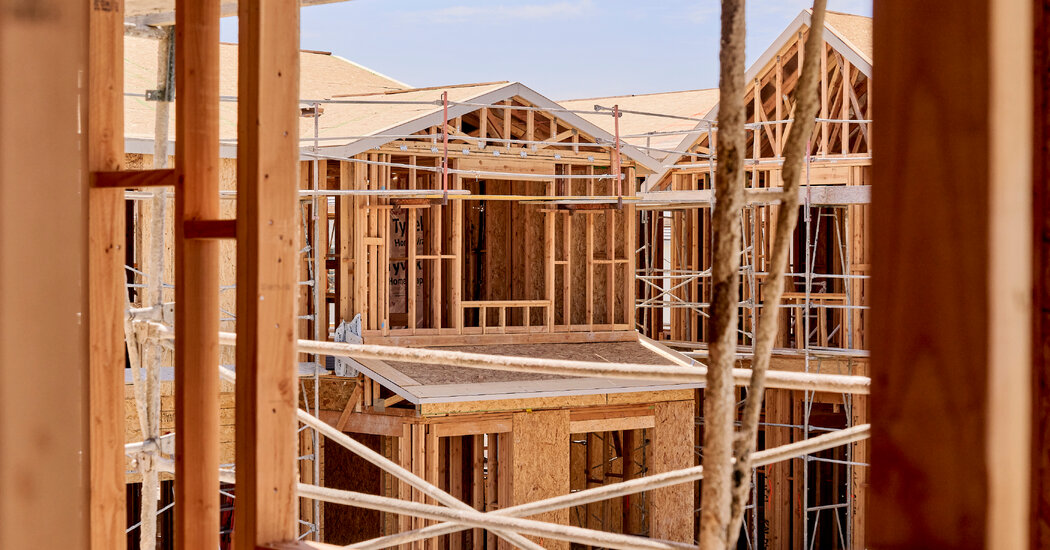

For the first time in more than 30 years, members of Congress have secured a major legislative package that could make housing more affordable, one that primarily aims to touch off a new boom in construction nationwide.
It is a widely lauded proposal, the byproduct of long and winding negotiations between Democrats and Republicans, who rarely find much reason for compromise these days. But for all the potential benefits, the new law is also dogged by an important question: Can it do enough, fast enough, to be seen as a real victory in the eyes of families who have been struggling with high costs?
With less than five months before voters head to the polls, mortgage rates are rising, rents are still fairly high and prices continue to climb broadly as a result of the war with Iran. The roughly 380-page bill, known as the 21st Century ROAD to Housing Act, in contrast, proffers a set of longer-term solutions to one of the country’s most intractable affordability problems.
The measure, which cleared the final hurdle in Congress on Tuesday, would adjust a slew of federal rules in an effort to make it easier and cheaper for developers to build more housing. Coupled with a new prohibition on large investors that snap up single-family residences, the legislative package takes the position that more housing supply can eventually drive down prices for homeowners and renters.
The approach has broad support from economists and housing policy experts, including groups that represent low-income renters and the powerful associations that lobby in Washington on behalf of homebuilders. The White House has also praised the bill, and President Trump had intended to sign it on Wednesday, until abruptly announcing that it was canceled until lawmakers took action on an unrelated bill that would impose new voting restrictions.
That move left the immediate fate of the measure in limbo. Once enacted, though, even its supporters acknowledge that the true effects of the housing package may not be apparent for years.
“You can’t oversell the impact of the bill, but I think it is going to have a positive impact over time,” said Dennis Shea, a housing policy expert at the Bipartisan Policy Center, who agreed that the best way to reduce costs was to build more housing.
Mr. Shea cited a range of outside estimates showing a national housing shortfall between one million and nearly six million homes. He said that voters had long clamored for Congress to take some action, and that lawmakers had delivered in time for the midterm elections.
“These bills would give members of Congress of both political parties an opportunity to talk about what they’ve done, and what they’re trying to achieve,” explained Mr. Shea, who added that the work to carry out the legislation was nonetheless “going to take some time.”
For many families, rent or mortgage payments are their single largest expense in a given month, amounting to a major source of financial stress. But the cost of housing has become particularly burdensome as prices across the economy are increasing at their fastest clip in three years, outpacing workers’ wages.
Rents are no longer rising at the meteoric rate seen during the Covid-19 pandemic, yet are still up nearly 38 percent from the start of that public-health crisis, according to the real estate hub Zillow. The situation is similarly tough for buyers, with national prices for single-family homes averaging about five times the median household income, according to 2025 data analyzed last week by Harvard’s Joint Center for Housing Studies.
Adding to the difficulties, the average interest rate on a 30-year mortgage is around 6.5 percent, deterring many current owners from selling or refinancing while keeping new owners out of the market entirely. Nor do those conditions appear likely to ease through the remainder of the year, with the Federal Reserve expected to hold interest rates steady or perhaps raise them, a move that could steer mortgage rates higher as well.
“This is the level of mortgage rates you probably should expect if you’re in the market for the next couple of years,” said Michael Fratantoni, the chief economist at the Mortgage Bankers Association.
Taken together, the data reflect a significant if insurmountable burden for many Americans, who increasingly say they are frustrated with the nation’s economic trajectory. They have directed their ire at times toward Mr. Trump, who has frequently responded to the criticism by describing the debate around affordability as a “hoax” or “con job.”
“I think the American people are running low on patience broadly on this issue, and that has been true for years,” said John Lettieri, a founder of the Economic Innovation Group, which bills itself as a bipartisan think tank.
Mr. Lettieri said the bill was not “the magic fix-it-all button” on housing “that people would love to see pushed here.” But he said the measure was still a rare and significant achievement that would “show demonstrable progress.”
The newly approved bill would relax federal regulations on new housing development, including environmental reviews, so that work could begin more quickly and construction could cost less. The measure would also have the federal government create model zoning plans, which local officials could then adopt as their own. And lawmakers looked to retool billions of dollars in federal grants sent to states and localities, primarily aiming to reward communities that construct new residences.
The sum of those provisions could encourage more development as new construction is lagging, said Ken Wingert, the chief advocacy officer of the National Association of Home Builders. Housing starts in May fell 15 percent from the previous month, according to federal data, which is seasonally adjusted. That was a nearly 9 percent decrease from the previous year.
“The current conditions, whether it’s interest rates, whether it’s uncertainty around energy prices, are certainly going to factor into builders’ decisions of whether to start new projects,” Mr. Wingert said. He added that “regulatory overhang” was a significant factor that Congress had now sought to tackle.
The work to build those new homes is likely to take years, said Ben Metcalf, the managing director at the Terner Center for Housing Innovation at the University of California, Berkeley. He estimated that the nation’s overall housing shortfall was between four million and six million homes, saying the package adopted by Congress reflected the view that “new supply helps everybody.”
But he likened the dynamic to the period shortly after 2021, when Congress adopted billions in new infrastructure spending. That law was also strongly bipartisan, but it took years to parcel out the money, making it hard for policymakers to sell the spending to voters who demanded quicker improvements.
As a result, Mr. Metcalf said of the bill, “basically nothing in here is going to be felt change on the ground come November,” in time for the elections. He added: “What else can you do? I think they’re trying to do the best they can with the tools they have.”
Sensing the political pressure, Mr. Trump previously tried brute force in an effort to push down housing costs rapidly. But his series of maneuvers — particularly a directive in which Fannie Mae and Freddie Mac snapped up mortgage bonds this year — had little lasting effect on mortgage rates.
Mr. Trump has described rates as the most important element in housing policy. In April, he appeared to dismiss the emerging compromise between the House and Senate because it might not influence those costs. Mr. Trump told The Washington Examiner that he supported the bill but added, “We have other things we’re pushing that are bigger and, right now, more important.”
It will be up to the Trump administration to carry out and fully fund broad swaths of the new housing law. The success or failure of its efforts may also hinge on the administration’s ability to work with local officials, who possess the greatest control over housing construction and zoning. Congress ultimately opted against imposing stiff new mandates on localities, and it did not provide significant new funding for affordable housing, which might have helped to command more housing development.
Chad Maisel, a senior fellow at the Center for American Progress, a left-leaning advocacy group that supported the bill, said lawmakers had sought to “gently, gently nudge localities to do more,” recognizing the role of cities and states. That, too, would take time, underscoring that the housing package comprised a “set of medium- and longer-term policies,” he said.
“That’s really always been the challenge with housing policy,” Mr. Maisel continued. “If your rent is going up $1,000 a month, you’re not really interested in hearing solutions about building more supply in a decade or two.”