

Most men own sharp clothes they barely see. Swap the hiding spots for prime real estate, flood your sightlines with the good stuff, and fresh outfit ideas will appear before the coffee finishes brewing.
“Hi Andrew, do you have anything that talks about the best way to organize a closet? What to hang, what to fold, how it should be laid out, etc? I want to redo my closet and I have no idea where to start.” – Primer reader Chris S.
What you’ll hear most often: hang what wrinkles, fold what stretches. This approach has been recommended for generations by fathers and professional cleaners.
Their logic is simple: shirts, suits, jackets, and items made from linen or rayon are best hung to avoid wrinkling that looks like they were stored in a clenched fist. Heavy sweaters and thick knits are folded because hanging them can distort the shoulders and cause them to lose shape. T-shirts? Folded. Tossed in drawers. Forgotten. Replaced with more t-shirts. It’s the circle of life, but with worse music.
That system works if the goal is to preserve the garment. But sometimes preservation is only half the equation. The other half is actually wearing the thing.
Here’s what I’ve come to believe: a closet functions as a compact visual catalog. The more you see, the quicker your mind can see patterns and latch onto ideas. The less you see, the easier it is to forget what you own.
This problem is specifically an issue in a community you might not expect to be on the cutting edge of wardrobe planning: people with ADHD, myself included. ADHD brains, according to every article that features a cheerful graphic of a cartoon brain juggling clocks, are wired for “out of sight, out of mind.” Meaning, if they can’t see it, it doesn’t exist. Not metaphorically. Literally. They don’t own it. Never did. Never saw it. Who are you?
Organization experts who specialize in ADHD-friendly design say you need to hang the things you need to see to make decisions. Use clear bins instead of solid drawers. Maintain general categories, keep items visible. Scan-ability is the new sacred metric.
This, it turns out, is a good system for everyone, even the neurotypical men with six identical pairs of pants and a sincere confusion about what the big deal here is. When visibility goes up, mental friction goes down.
You waste less time hunting. You wear more of what you already own. You stop buying duplicates because you thought you lost something that was actually just behind a stack of hoodies from college.
To apply this practically, rethink the priorities:
- You want to be able to see your foundational pieces immediately, and ideally grouped by what they are. Shirts with shirts. Pants with pants. Group and hang similar types together and by dressiness level.
- Items that require no decision like socks, undershirts, or gym shorts can be out of sight in drawers. Same for belts and other items you will grab regardless of mood. Drawers are suited for items that you select quickly and routinely.
- Cut down on visual chaos. Use one color of hanger. Group items by category or color within their type. It’s calming. Like looking into a well-behaved crayon box. The advantage, like crayons, is you know exactly where something is supposed to be based on already seeing where everything else is.
These priorities will shift what you hang:
I now hang things like jeans, chinos, casual button-ups, and graphic tees. The kind of things clothing care experts would gasp about with a pinky up over a Chardonnay spritzer. But the alternative is letting them languish in a drawer like cast members of a buried alive horror movie.
What’s worse: slightly stretched denim or never wearing half your pants? I’ve made my peace with my choice prioritizing utility.

Folding still has its place. However, traditional stacked folding allows you to see only the top item. This limits visibility of the remaining items. File folding, where garments are folded and stand vertically in a drawer like file folders, greatly improves visibility. You see everything and you pick without digging.
Now for the crown jewel: Hot and Cold Zones.
Most men have never heard of this. It sounds like something a pickup artist uses to divide and conquer a club. But it’s actually a brilliant way to organize your closet based on visibility and effort.
Hot zones are the parts of your closet that are easy to see and reach. These are the areas you access daily. Cold zones include high shelves, floor corners, and that strange pocket in the back behind your partner’s ski gear, among other areas.
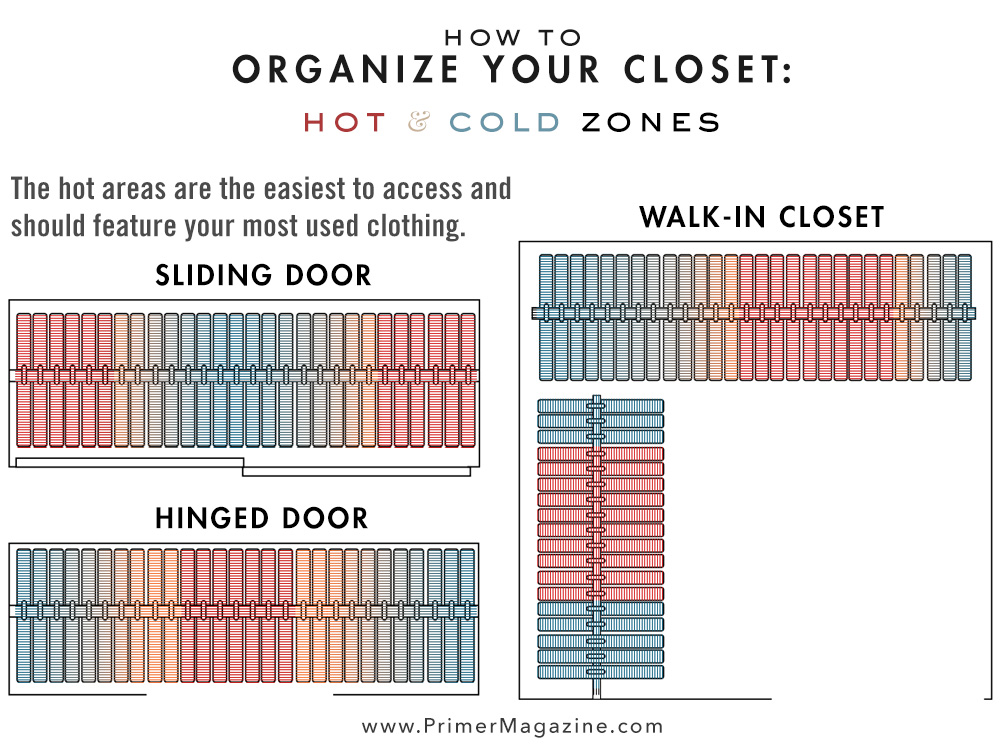
The trick is to use the physical shape of your closet to define these zones. The idea is to give your best real estate to the core items you’re choosing when building an outfit and place everything else into less prime areas. This is how your closet becomes a tool instead of a storage unit you paid up for in advance and forgot about.
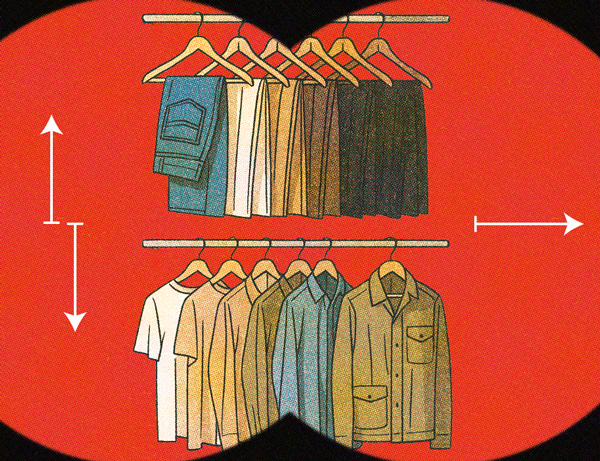
For me, my hot and cold zones proved to be opposite of what I assumed them to be. I used to keep shirts and jackets on the top rod and pants on the bottom, the default approach for most people. Flipping them, shirts and jackets below and pants above, made the whole rack easier to read. Looking down, collars, patterns, and pockets present themselves clearly, looking up colors and fabric weight line up in a way that makes comparisons quick.
The change was noticeable for me, it sped up choices and broadened what I reach for, and it’s an easy experiment to run in your space (your eye height and lighting may steer a different result).
A few more practical upgrades:
Start with category, not color. Put like with like. Jackets with jackets. Pants with pants. Once you’ve done that, then you can group by dress level (casual button ups together then dress shirts) and finally a loose ordering by color. It helps you see combinations. You go from “What do I wear?” to “Ooh, that works.” Which, in adult life, is a kind of luxury.
Next, hangers. Toss the wiry free ones and the rainbow-colored plastic ones from your college move-in day. Get a matched set like wood. It reduces unnecessary visual distraction when scanning, and will help your clothes last longer, which is the least we could do for the screaming clothing care experts.

Use double rods if you’re short on space. Install a valet hook to stage outfits. Move seasonal stuff to high shelves. Use clear bins or baskets for small items. Label them if it helps.
And once you’ve got it all set up, maintain it. I do a 5 minute reset weekly. Turn the hangers the right way. Re-stack what’s toppled. Move neglected items forward.
There’s also the reverse hanger trick: start with all hangers backward, then flip them after you wear something. By the end of the season, you’ll know exactly what to keep and what to donate.
All of this adds up to something bigger than just a neat closet. It builds a dressing environment that encourages readiness. You start your day faster. You feel more put together. You stop wearing the same three shirts repeatedly.
So try one thing this week: identify your hot and cold zones or hang your jeans. File-fold your t-shirts. See if getting dressed feels just a little less like a pop quiz and more like a win. That’s the goal. And if not, you can always wear the same three shirts again. No one’s judging. Except maybe your closet.