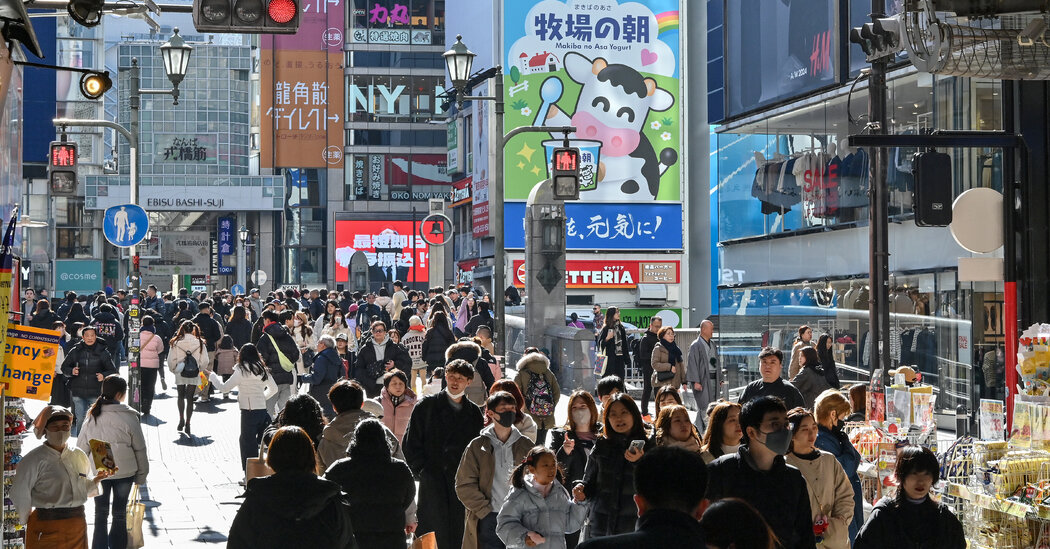

In a number of ways, Japan’s economy seems to have gone back in time.
Inflation and wage growth are mostly back where they were in the early 1990s, just before the spiral of price deflation and economic stagnation that became known as “the lost decades.”
That prompted the Bank of Japan on Friday to raise interest rates by a quarter point, to 0.5 percent, another step in its pivot away from the ultralow rates officials long used to try to jolt the economy back to life.
Friday’s increase, which brought rates to their highest level since 2008, was the third in just under a year, a pace of policy tightening not seen in Japan since 1989. After raising rates in March and July last year, the Bank of Japan had held steady at recent policy meetings as it waited to see whether the inauguration of President Trump would rattle markets.
As other major central banks move to cut the high interest rates they had used to curb inflation, Japan is, as usual, bucking the trend. After encouraging a period of rising prices, the Bank of Japan is just now raising rates above zero.
Economists say that with the return of inflation and positive interest rates, Japan is starting to resemble a more conventional economy.
Breaking away from a deflationary mind-set — why buy something today when it will be cheaper tomorrow — could help bolster spending and investment. Raising interest rates typically cools an economy by making borrowing more expensive, but economists suggest that in Japan’s case, tightening monetary policy could help in the long term. Higher rates could weed out “zombie” companies kept afloat by years of cheap borrowing and make room for more growth-focused businesses that are better positioned to take advantage of Japan’s limited labor supply.
“There were many areas of inefficiency and a world with inflation brings those out into the open,” said Ayako Fujita, the chief economist at JPMorgan Securities Japan. Raising interest rates was in some ways like “opening Pandora’s box,” she said, “but ultimately we believe Japan will be left with new, more productive economic growth.”
For now, though, it is not just inflation, base pay and stock prices that have returned to early 1990s levels. Japan is grappling with an overall economy that has grown very little over the past three decades. In 2024, Japan’s gross domestic product, adjusted for inflation, is expected to have grown by about a quarter since 1994, while in the United States, the economy more than doubled in size over the same period.
In Japan, inflation started to cool in the early 1990s after the collapse of enormous real estate and stock market bubbles. By the late 1990s, Japan had fallen into full-fledged deflation, a broad and sustained decline in the general price of goods and services, leading businesses and consumers to delay making big investments and purchases.
To try to pull Japan out of this cycle of falling prices, wages, and spending, the Bank of Japan began buying more government bonds and corporate debt — flooding markets with money that officials hoped would be spent or lent out. In 1999, the central bank adopted a zero-interest-rate policy, and in 2016, it went a step further by implementing negative interest rates. But even these unconventional tactics did little to spur economic activity.
In the past few years, as pandemic supply chain snags and geopolitical shocks produced a spike in prices around the world, officials in Japan seized the opportunity to turn elevated import costs into lasting inflation.
Instead of raising rates to tame a spike in prices like the Federal Reserve and virtually every major central bank in the world did, Japan remained steadfastly committed to its ultralow rates. Hoping to generate an upward spiral of rising salaries and inflation, officials encouraged companies to pass on higher import prices and give wage increases to employees.
The cycle appears to be kicking into gear. As of last month, inflation in Japan has remained above the Bank of Japan’s 2 percent target for 33 consecutive months, with core consumer prices rising 3 percent in December. Base pay in recent months has accelerated to a new post-1990s high. During last year’s spring labor negotiations, known as shunto, Japan’s largest business group agreed to the biggest wage increases since 1991.

With elevated prices spreading beyond imports to domestic industries such as services, “inflation is, at last, embedding itself into the economy,” Société Générale wrote in a recent report. “In a little over two years, Japan appears to have put three decades of deflation decisively behind it,” the French bank declared.
Still, a big remaining concern is whether reflating Japan’s economy will be able to help shake the country out of its prolonged period of feeble economic growth. Japan’s population is declining, productivity is lagging and it remains unclear whether wages are increasing enough to prop up spending as households face higher prices.
Because inflation has outpaced wage growth for much of the past three years, spending in Japan has remained relatively weak. Private consumption — which makes up most of Japan’s gross domestic product — picked up in recent quarters, but this was after a prolonged slump that stretched across the previous four quarters.
The International Monetary Fund estimated in a report this month that Japan’s economy shrank by 0.2 percent in 2024. It forecast 1.1 percent growth for the country this year — a figure in line with its prediction of 1 percent growth for Europe, but well below its expectation of a 2.7 percent increase in the United States.
While this year’s spring labor negotiations are likely to repeat the record pay gains seen in previous years, recent data suggests that the increases led by Japan’s biggest companies “do not translate into economywide wage improvements the way they did in the past,” said Stefan Angrick, the Japan economics head at Moody’s Analytics.
“Wage growth is lacking oomph,” Mr. Angrick said. And that, coupled with sticky inflation, “suggests household budgets will be strained in early 2025 as well,” he added.