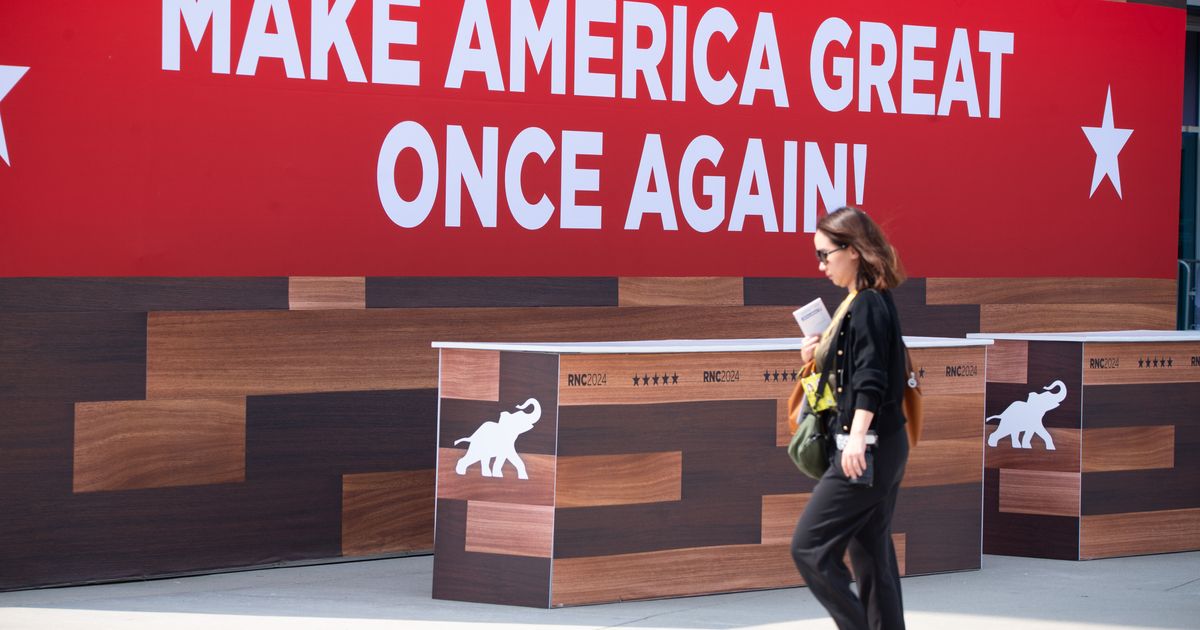

Former President Donald Trump and his newly selected running mate, Sen. JD Vance of Ohio, got all the attention Monday on the opening night of the Republican National Convention in Milwaukee. But the official theme for the evening was the economy ― something that Republicans hope to keep making a focus of the campaign.
The prime-time hours included a video and some speeches highlighting the real-life effects of high consumer prices. Among the speakers was Sara Workman, who identified herself as a single mother in Arizona working two jobs to support her family. “I know that Americans can relate when I say that every time I fill up my gas tank, go to the grocery store and try to pay the bills, I think, ‘Who doesn’t miss the Trump days?’” she said.
You can see why she and others feel this way. For the first two years of Joe Biden’s presidency, prices rose at rates not seen in decades, with year-over-year inflation eventually peaking near 10% in the middle of 2022. If you didn’t notice it at the supermarket, then you might have seen it at the pump, when gas prices nationally hit nearly $5 a gallon.
Since then, inflation has actually come back down. Most analysts believe the driving forces behind the price spikes were global factors like supply chain issues during the pandemic ― issues that, under Biden, the U.S. handled better than most peer countries. Unemployment reached historic lows last year, and now it looks like wages (measuring from before the pandemic) have risen even faster than prices.
Surveys bear this out: Most Americans think their personal financial situation is good. Even so, their economic outlook remains glum. It could be that high borrowing costs have downstream effects on housing, or that higher prices have a notoriously big psychological effect. It could be that media coverage and people’s own partisan leanings reinforce negative perceptions. It could be all of those factors.
Whatever the explanation, it’s been a winning issue for Trump.
But if you were paying attention Friday, you may have noticed something missing from the convention speeches: details about what policy levers Trump and the Republicans plan to pull in response. And although that kind of silence befits a nominee who famously prefers that his advisers keep policy briefings to a single page, it belies an agenda of tariffs and tax cuts raising alarms from a loud, politically diverse chorus of economists.
“The economy will be significantly weaker if Mr. Trump’s economic proposals are adopted,” a June report from Moody’s Analytics predicted. That report came one month after an analysis from the Peterson Institute for International Economics offered an even more dire assessment ― that Trump’s plans would inflict “massive collateral damage on the US economy.”

Tom Williams via Getty Images
The Tax Foundation, a nonpartisan think tank with a more conservative tilt, said in June that Trump’s tariffs would be the equivalent of raising taxes by $584 billion a year, shrinking the economy by “at least 0.8 percent.” Last week, a group of 16 Nobel-winning economists weighed in with a joint letter of their own, writing: “We believe that a second Trump term would have a negative impact on the U.S.’s economic standing in the world, and a destabilizing effect on the U.S.’s domestic economy.”
Economists can be wrong, of course, even if they have Nobel Prizes on their shelves. But in this case, they are making some highly plausible arguments that have gotten little in the way of serious pushback from Trump and his team.
Math Is Hard
The main basis for economists’ alarm is a 10% tariff that Trump wants to apply to all imported goods, in what is arguably the centerpiece of his economic agenda. Clothing, electronics, cars, you name it ― if it comes from another country, Trump would add a 10% levy. The exception would be goods from China, which Trump would slap with an even higher 60% tariff.
Trump has cast these proposals as a way to protect American industry and jobs ― the equivalent of a “ring around the country,” he has said.

This kind of thinking isn’t as unfashionable as it was a generation ago. Nowadays, many mainstream economists are open to some tariffs (as part of a broader economic strategy) because they recognize that unfettered trade can punish certain workers in certain regions, like steelworkers in Pennsylvania or textile workers in the Carolinas.
Biden’s approach to trade actually reflects that kind of thinking. He has kept some of Trump’s earlier, smaller tariffs in place, and just imposed a new 100% levy on electric vehicles from China.
But Biden’s China EV tariff is designed for the narrow, specific purpose of helping U.S. automakers catch up to Chinese competitors. The idea is that it’s in the U.S.’s interest to support an EV industry here (for reasons of both energy independence and competitiveness), and to balance the scales following decades of Chinese companies receiving support from their own government.
The kind of across-the-board tariff Trump has in mind could have much larger, economy-wide implications.
Overall, according to the Peterson Institute analysis, Trump’s tariff would cause the prices of consumer goods to increase, reducing incomes by 3.5%. And as report authors Kimberly Clausing and Mary Lovely note, the impact would fall disproportionately on lower- and middle-income Americans, because they spend proportionally more of their incomes on goods rather than services. For a typical American household, Clausing and Lovely predicted, the tariffs would mean more than $1,700 in costs.

NICHOLAS KAMM via Getty Images
Trump’s supporters have argued that tax cuts will make up for the higher prices. His plan includes not just an extension of the 2017 tax cuts that Republicans enacted in Trump’s first term, but also a new round of reductions. And while he’s been less specific about those, Trump has floated the idea of eliminating the income tax altogether, on the theory that tariff revenue would replace it.
That theory is difficult to take seriously, because the math simply doesn’t work.
As Clausing and Lovely explain, total U.S. incomes last year came to around $20 trillion, of which the U.S. government collected about $2 trillion as income taxes. Getting that much revenue out of tariffs on imports, which were barely $3 trillion last year, would require raising levies on those goods to what Clausing and Lovely described as “implausible levels.”
“It is literally impossible for tariffs to fully replace income taxes,” they wrote.
In a world where Trump got his tariffs and then eliminated the income tax, they and other mainstream analysts say, the federal government would almost certainly have to make up the difference with borrowing, which could lead to yet more inflation.
And that’s before taking into account other elements of Trump’s agenda, like mass deportations, that could further increase inflation by removing so many people from the labor force.
Policy Is Hard
If you’re looking for reasons to disbelieve the projections, the best is probably that Trump would struggle to enact his plans.
Even if Republicans were to get control of both chambers of Congress, their ranks would include members who are philosophically more skeptical of tariffs and more supportive of free trade ― and more beholden to businesses whose bottom line depends on easier access to the global marketplace.
A big reason they’re so gung-ho on Trump anyway is that they like other parts of his economic agenda ― namely, lower taxes and lower regulation ― and they figure the proposed tariffs are in many ways just a threat to get better trade terms from overseas. That certainly makes it sound more palatable.
But Trump’s record on getting such concessions isn’t exactly impressive. After a 2020 bilateral deal intended to lower tensions over trade, China was supposed to buy $200 billion worth of U.S. goods, in what Trump at the time called a “momentous step.” But China never followed through on that promise, according to subsequent analysis, while multiple analysts concluded that Trump’s prior efforts to restrict Chinese imports actually hurt the U.S. economy.
And even scaled-back versions of Trump’s proposals could have serious costs. The Moody’s analysis, whose lead author is economist Mark Zandi, considered what might happen if Congress enacted only parts of Trump’s agenda, or lesser versions of his proposals.
“The upshot of Mr. Trump’s economic policy positions under almost any scenario is that the U.S. economy will be more isolated and diminished,” the report concluded.
The findings of think-tank analysts may not matter a lot in Trump’s world. The whole premise of his populism (and Vance’s too) is that America has paid too much attention to credentialed experts, financial titans and other elites who don’t understand how the economy works for everyday Americans ― or, in some cases, don’t especially care.
“The globalists who push false claims of economic disaster have been proven wrong time and again,” Jason Miller, a Trump spokesperson, told The Washington Post last year, after Trump first sketched out his proposal and economists started criticizing it. “No amount of fearmongering from special interests and establishment hacks in Washington will stop him from defending American workers and fighting to return millions of manufacturing jobs to the USA.”
It’s certainly true that projections are often wrong, especially when it comes to issues like trade with so many interacting, unpredictable variables. But it doesn’t take sophisticated analysis to see why Trump’s agenda could so easily hurt the very people he claims to be helping ― or to see parallels to his first term, when he signed tax cuts that disproportionately benefited the wealthy and very nearly succeeded in taking health insurance away from millions of low- and middle-income Americans.
Talking about the economic challenges facing average Americans has never been a problem for Trump. But the hard part of governing is finding and enacting solutions. That may help explain why his GOP allies had so little to say on the matter Monday ― and why they’re probably going to stay silent unless somebody forces the conversation on them.