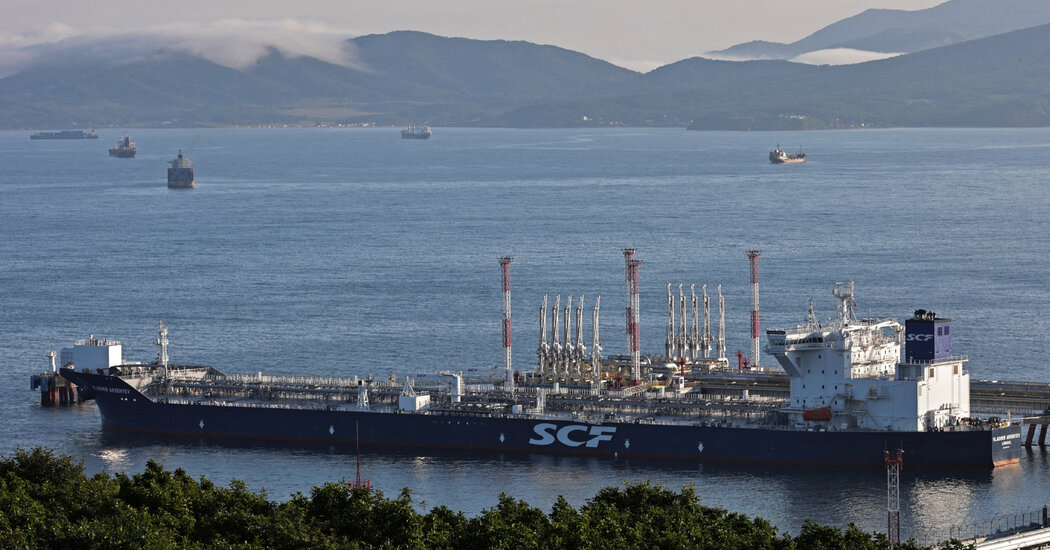

Officials in President Biden’s Treasury Department have proposed new actions aimed at crippling a fleet of aging oil tankers that are helping deliver Russian oil to buyers around the world in defiance of Western sanctions.
Their effort is aimed at punishing Russia but it has stalled amid White House concerns over how it would affect energy prices ahead of the November election.
In an attempt to drain Russia of money needed to continue fighting its war in Ukraine, the United States and its allies have imposed penalties and taken other novel steps to limit how much Moscow earns from selling oil abroad. But Russia has increasingly found ways around those limits, raising pressure on the Biden administration to tighten its enforcement efforts.
Treasury officials want to do that, in part, by targeting a so-called shadow fleet of oil tankers that is allowing Russia to sell oil above a $60-per-barrel price cap that the United States and its allies imposed in 2022.
That cap was intended to restrict Moscow’s ability to profit from its energy exports while allowing its oil to continue flowing on international markets to prevent a global price shock. But Russia has largely circumvented the cap, allowing it to reap huge profits to fund its war efforts.
While Treasury officials want to knock Russian tankers out of commission, economic advisers inside the White House worry that would risk inflaming oil prices this summer and push up U.S. gasoline prices, which could hurt Mr. Biden’s re-election campaign. They have not signed off on the proposals, even as current and former Treasury officials present them with analyses suggesting the risks of a major effect on the oil market are low.
The debate reflects a tension that has always been at the core of the administration’s novel effort to restrict Russian oil sales: How to weaken the Moscow war machine without the political backlash that could come from inflicting pain on American drivers.
The dispute is a rare public instance of internal administration disagreement over inflation and Ukraine policy. It pits Treasury officials against aides on the White House National Economic Council, which is led by Lael Brainard.
White House officials privately describe the process as routine and stress that no decisions have been made. But the delays have confounded officials elsewhere in the administration, who have been unable to get a straight answer from Ms. Brainard and her team about what is holding up the proposed action.
For now, according to multiple people familiar with the discussions, who spoke on condition of anonymity because they were not authorized to speak publicly, the proposed penalties on the Russian shadow fleet remain under review, and are not imminent.
Ms. Brainard declined to speak on the record about the process. White House officials refused to answer direct questions about oil-price concerns and the Treasury proposal.
Instead, the White House issued a statement from Amos Hochstein, a senior adviser to Mr. Biden.
“Our actions to enforce energy sanctions are focused on exacting a price on Russia, Iran, and other bad actors while preventing a spike in the price of energy, which would not only hurt American consumers but increase the revenues of the same bad actors we are trying to hold accountable,” he said.
The White House is under pressure from inside and outside the administration to do more to enforce the oil price cap, which Treasury Secretary Janet L. Yellen and her team drew up two years ago in the months after Russia invaded Ukraine.

After the invasion, the United States and Europe moved to ban imports of Russian oil, in an effort to reduce revenues for one of the world’s largest oil producers. But Ms. Yellen and other leaders of wealthy democracies against Russia’s invasion realized that the European ban, when fully implemented, risked knocking millions of barrels of oil off the global market — and triggering a price shock that could send gasoline as high as $7 per gallon in the United States.
Their alternative plan was to use the maritime industry, including shipping companies and insurance carriers, to effectively allow Russia to only sell oil at a discount: $60 per barrel, which is about $25 a barrel less than the price on the global market.
The so-called price cap proved successfully initially, but Russia soon found workarounds — including delivering oil to buyers via a group of aging Sovcomflot tankers, operating without western insurance, that has come to be known as the shadow fleet.
The fleet of tankers along with alternative forms of maritime insurance have allowed the Kremlin to continue generating robust revenues from oil exports, helping it to finance its war against Ukraine.
Critics of the price cap have argued that the $60 per barrel limit is too high and that the Biden administration has been too lenient in certain aspects of enforcing the cap. Some have called for the Treasury Department to impose more stringent oil sanctions on Russia akin to those on Iran’s oil sector.
In an interview with The New York Times last month, Ms. Yellen defended the price cap, arguing that Russia’s work to circumvent it still imposed costs and made it harder for Russia to sell its oil.
“We’ve made it very expensive for Russia to ship this oil to China and India in terms of acquiring a shadow fleet and providing insurance,” Ms. Yellen said. “We still think it’s working.”
Still, current and former Treasury officials want the administration to go further, and target the shadow fleet tankers with specific penalties that could restrict their sales or force them out of commission. European officials moved last month to penalize Russian ships evading sanctions by carrying liquefied natural gas to market, an effort that could be complemented by Treasury’s proposal for oil tankers.
Treasury officials have privately produced and circulated an economic analysis that contends, based on a history of enforcement actions under the price cap, that the proposed shadow-fleet penalties would be unlikely to knock Russian oil off the market, and would instead force Moscow back to selling much of its oil for lower prices under the cap.
Robin Brooks, a senior fellow in the Global Economy and Development program at the Brookings Institution, and former top Treasury official, Ben Harris, who is now vice president and director of the Economic Studies Program at Brookings, released a similar analysis publicly late last month. It argues that historical evidence suggests efforts to shut down shadow-fleet tankers are “unlikely to have even a modest impact on global oil prices.”
Twenty shadow-fleet tankers are currently under sanction, out of a fleet of about 120. Mr. Brooks and Mr. Harris write that the administration could penalize the additional 100 tankers in waves, in order to minimize price disruptions. They chart evidence from previous enforcement actions to show none of them have had large impacts on the oil market.
“While this is far from causal, we think it validates the notion that further sanctions on the Sovcomflot fleet are unlikely to cause oil price spikes,” Mr. Brooks and Mr. Harris write.
White House officials have recently argued that the price cap — and related enforcement measures — has thus far hurt Russia, but not American drivers.
“Energy analysts — and even Russian officials themselves — have linked our increased enforcement activities to the increased discount on Russian oil. At the same time, Russian export volumes have remained high, avoiding the price spike that many feared in 2022,” Daleep Singh, a deputy national security adviser for international economics, said at Brookings in late May.