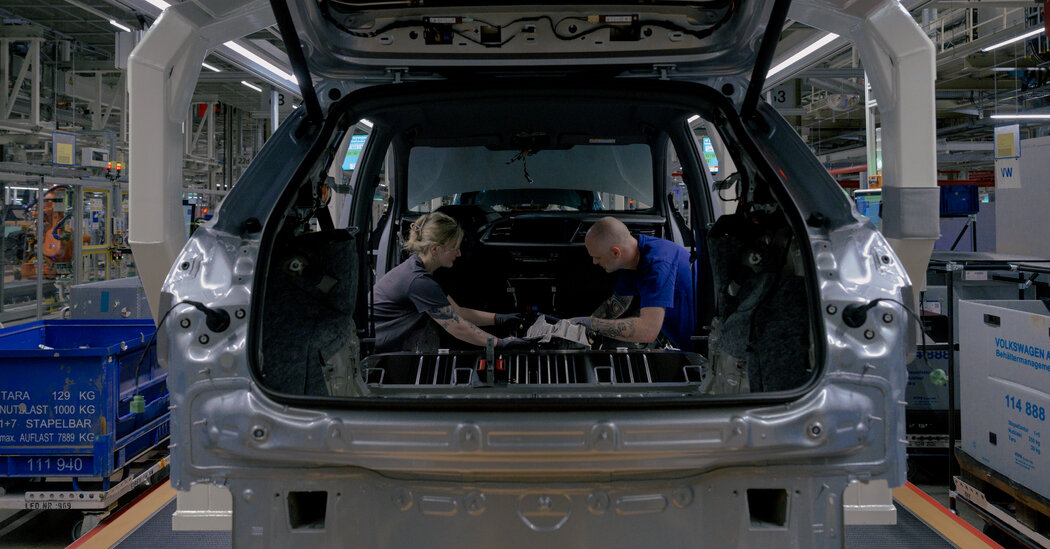

Zwickau, a city in Germany’s east, may not be as famous as Detroit, but its economy has revolved around internal combustion engines since August Horch established Audi here at the beginning of the 20th century.
So when Volkswagen announced in 2018 that it would convert its Zwickau factory, the largest private employer in the area, to manufacture nothing but electric vehicles, it was a big deal.
“A lot of people were skeptical,” said Michael Fuchs, who has worked at the factory for more than a quarter century. They wondered, “What’s going to happen?” he said.
Volkswagen shut down assembly lines churning out its popular Golf hatchbacks and converted the factory, which has its own exit on the autobahn, to make six electric models. The remodeled plant can produce a car a minute, shipping them out by train.
It was a rare case of a major car plant’s switching completely from internal combustion to battery power, making Zwickau a case study for a big question confronting the auto industry.
Electric vehicles have far fewer parts than gasoline cars — no radiators, exhaust pipes, fuel tanks, fan belts or complicated gearboxes. As a result, many autoworkers, executives and politicians have hypothesized that such cars would require fewer workers, leading to mass unemployment in factory towns and cities worldwide.
Zwickau, where more than 10,000 people work for Volkswagen and tens of thousands more for suppliers, appears to have avoided those dire consequences. Employment hasn’t fallen off a cliff, and suppliers of combustion vehicle parts haven’t been forced into bankruptcy en masse. Its experience offers some hopeful lessons for other places that depend on the auto industry.
Yet people in Zwickau, with its immaculate but sleepy downtown, are still uneasy.
While Zwickau’s experience suggests that conversion to electric vehicles will not itself lead to economic misery, this and other new technologies are shaking up the industry in ways that could still be very painful for established companies and their workers.
One big change already visible in Germany and the rest of Europe is the fast growth of young Chinese electric carmakers like BYD and SAIC, which are increasingly luring customers away from established rivals like Volkswagen, the world’s second-largest automaker after Toyota.
“The question is: How much will mobility change overall?” said Thomas Knabel, who leads the Zwickau local of IG Metall, the union that represents Volkswagen workers. “In the future, will Volkswagen still be present?”
The best-selling electric car in Europe is Tesla’s Model Y sport utility vehicle, built at a factory around 145 miles north of Zwickau near Berlin. Last year, Volkswagen sold fewer than half as many of its equivalent S.U.V., the ID.4, according to Schmidt Automotive Research.
Disappointing sales have prompted Volkswagen to cut a shift on one of its two assembly lines in Zwickau, where the company makes the ID.4, the ID.5, two Audi models and two small electric cars. The decision illustrated the downside of going all-in on electric vehicles. Other established carmakers have hedged their bets, producing electric vehicles and fuel-burning cars in the same factories, allowing them to adjust to fluctuating sales.
“It’s a much more ambitious project than anything I know about in North America,” said Ian Greer, a research professor at Cornell University who has studied the region around Zwickau. “VW has taken a much bigger risk.”

With the factory operating below capacity, some people in Zwickau wonder whether Volkswagen’s electric vehicles are appealing enough.
Max Jankowsky, president of the regional Chamber of Commerce, said he was disappointed that he hadn’t seen any Volkswagens during a recent trip to Dubai. “It was just Teslas, Teslas, Teslas,” said Mr. Jankowsky, who is also the president of a company that makes cast iron parts for Volkswagen suppliers and other manufacturers.
Volkswagen’s executives say they expect sales to pick up this year as it begins selling new models, including a station wagon and a van, targeting market segments that Tesla does not play in.
“We are aware of our current challenges and are tackling them rigorously,” Oliver Blume, the Volkswagen chief executive, said last month in a statement.
In the short term, at least, the pain to the local economy caused by the Zwickau factory’s conversion was surprisingly mild, local officials, business leaders and worker representatives say.
Increased demand for workers to manufacture electronic components largely compensated for job losses from production lines that made parts for combustion cars, according to a study by AMZ Saxony, a suppliers’ group.
“All in all,” said Dirk Vogel, chief executive of AMZ, “not that much happened.”
Volkswagen, local businesses and officials coordinated an effort to prepare workers and businesses, blunting the impact.
The carmaker expanded its training institute in Zwickau to teach employees about electric vehicle technology. To generate enthusiasm, Volkswagen allowed workers to borrow battery-powered cars for a few days. The West Saxon University of Applied Sciences in Zwickau, a state college that already had a strong focus on the auto industry, expanded courses related to electric vehicle technology.
Suppliers developed new components for electric vehicles to replace products in danger of becoming obsolete. Eberspächer, a German supplier that has a factory 60 miles east of Zwickau, near Dresden, began offering temperature-control systems for electric vehicles in addition to emission systems for conventional cars.
A few suppliers have suffered. GKN Driveline, which makes drive shafts not needed in most electric cars, is closing a factory in Zwickau and shifting production to Hungary. But GKN did not supply Volkswagen, and the closure appears to be a reaction to broader trends in the industry and German labor costs. GKN did not reply to requests for comment.
New technology has also created jobs, including 175 at FDTech, based in the nearby city, Chemnitz. The firm, partly owned by Volkswagen, is one of five companies in the area developing autonomous driving technology.
Zwickau benefits from some unique good fortune. Many local suppliers make seats, dashboards, painting equipment or other products that electric vehicles need just as much as gasoline cars.
Because of a shortage of electricians, engineers and other skilled workers, the unemployment rate in the state of Saxony, which includes Zwickau, has increased only modestly. It was 6.6 percent in March amid an overall economic slowdown, up from 6.3 percent a year earlier.
“There will be suppliers that disappear,” said Karsten Schulze, the managing director of FDTech. “But the skilled workers will be immediately sought after elsewhere.”
Volkswagen workers had some control because German law requires them to be consulted on changes that affect working conditions. The IG Metall union extracted a promise from the company not to lay off any full-time employees in Zwickau until 2030 at the earliest. The guarantee does not apply to temporary workers, however, and the company let 270 of them go after their contracts expired.
In the United States, unions are relatively strong in the Midwest and East, but most automobile factories in the South are not unionized. The United Automobile Workers is trying to change that. But even if the union is successful, U.S. companies will have no obligation to consult workers about changes that will affect their jobs, or to retrain them for new jobs. And there is no guarantee that new jobs making batteries, for example, will pay as well as jobs in factories where cars are assembled.
Residents note with pride that Zwickau has survived many upheavals. After Germany’s defeat in World War II, Soviet occupiers confiscated Audi’s manufacturing equipment. The carmaker moved to Bavaria and was later acquired by Volkswagen.
The Communist government that ruled East Germany converted the Zwickau factory to produce no-frills Trabant vehicles. The cars spewed blue exhaust and had a body made of plastic because of steel shortages. They could not compete with Western cars after the reunification of Germany in 1991. Thousands of Trabant workers lost their jobs. By the end of the 1990s, unemployment in the region exceeded 20 percent.
Volkswagen acquired the Zwickau factory after reunification and gradually expanded it into one of the company’s biggest production sites. The conversion to electric cars was momentous enough that Angela Merkel, the German chancellor at the time, attended a dedication ceremony in 2019, when the first battery-powered model rolled off the assembly line.
Not everyone in Zwickau is a fan of electric cars. The far-right Alternative for Deutschland party, which has 11 of 48 seats in the Zwickau City Council, has complained that Germans are being forced to buy electric vehicles, echoing comments from former President Donald J. Trump and other Republicans.
The national government, led by Chancellor Olaf Scholz, a Social Democrat, angered many in Zwickau when it abruptly slashed subsidies for electric vehicles last year to deal with a budget crisis. Sales of electric vehicles in Germany slumped 14 percent during the first three months of the year, though they still accounted for 12 percent of new cars.
Still, few people in Zwickau are pushing for Volkswagen to go back to building gasoline cars.
“With a transition to a new technology, the question is always: Are you the first or the last?” said Constance Arndt, the lord mayor of Zwickau. “I think it’s always better to be first.”