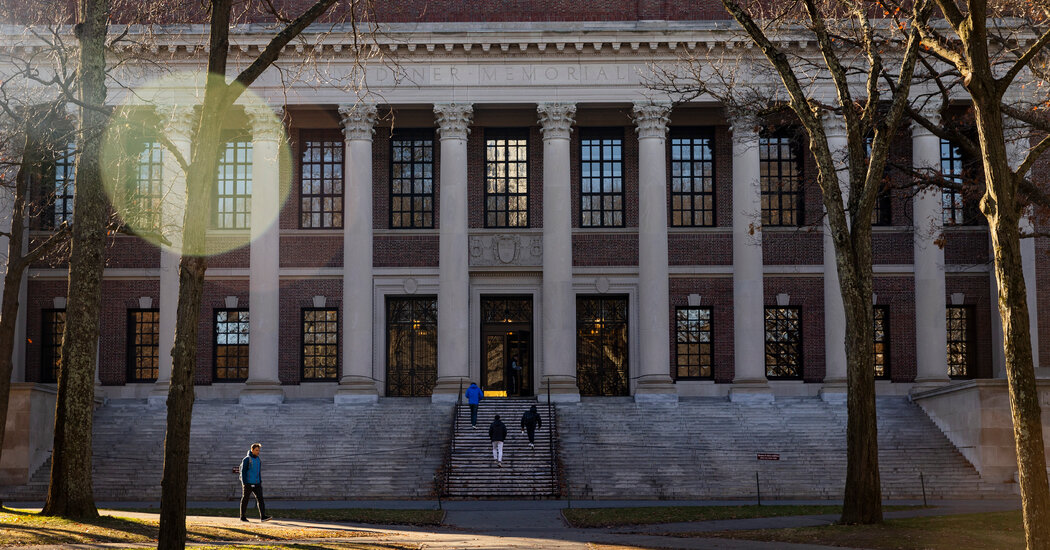

When 70 university presidents, gathered for a summit at the end of January, the topic on everyone’s mind was the crisis at Harvard.
The hosts of the summit treated the university, battered by accusations of coddling antisemitism, as a business-school case study on leadership in higher education, complete with a slide presentation on its plummeting reputation.
The killer slide: “Boeing & Tesla Have Similar Levels of Negative Buzz as Harvard.”
In other words, Harvard, a centuries-old symbol of academic excellence, was generating as much negative attention as an airplane manufacturer that had a door panel drop from the sky and a car company with a mercurial chief executive and multiple recalls.
Jeffrey Sonnenfeld, a professor at Yale’s School of Management, organized the summit. “Despite near 400 years of history, the value of brand equity is nowhere near as permanent as Harvard trustees think it is,” he said in an interview. “There used to be a term in the industry of something being the Cadillac of the industry. Well, Cadillac itself is, you know, sadly not the Cadillac of the industry anymore.”
Many of the presidents attending the summit saw the erosion of Harvard’s brand as a problem not only for the school, but also by extension for the entire enterprise of higher education. If Harvard could not protect itself, then what about every other institution? Could Harvard’s leadership find an effective response?
There was a hint of a more assertive approach by Harvard on Monday, when the university announced that it was investigating “deeply offensive antisemitic tropes” posted on social media by pro-Palestinian student and faculty groups. The groups had posted or reposted material containing an old cartoon of a puppeteer, his hand marked by a dollar sign inside a Star of David, lynching Muhammad Ali and Gamal Abdel Nasser.
Harvard took the action at a time when the House Committee on Education and the Workforce has begun to scrutinize its record on antisemitism. On Friday, the committee issued subpoenas to Harvard’s interim president, the head of the school’s governing board and its investment manager, in a wide-ranging hunt for documents relating to the university’s handling of campus antisemitism claims. The threat of the subpoenas led PEN America, a writers’ group that defends academic freedom, to warn against a fishing expedition.
There is also a lawsuit against Harvard, calling the university “a bastion of rampant anti-Jewish hatred and harassment,” as well as federal investigations into charges that the university ignored both antisemitism and Islamophobia on campus.
Corporate executives and major donors, including the hedge fund executive Ken Griffin, have threatened to withhold money and to refrain from hiring Harvard students who defended atrocities committed by Hamas in attacking Israel on Oct. 7. Right-wing media outlets and anonymous researchers continue to make plagiarism claims against university officials, as part of an attack on diversity, equity and inclusion programs.
There is already evidence of reputational damage: a 17 percent drop in the number of students applying to Harvard for early admission decisions this year. Other Ivy League schools saw increases.
The attacks “have obviously unsettled Harvard, in terms of its highest leadership,” said Randall Kennedy, a Harvard law professor. “They have undermined morale. It has been a very effective attack.”
Inside Harvard, faculty members and students are looking for some signal from university officials, including the main governing board, the Harvard Corporation, about its future direction.
In an interview last week with Harvard magazine, Alan Garber, the university’s interim president, outlined some efforts to relieve the tension by enforcing rules against disruptive demonstrations and offering a series of events meant to encourage dialogue rather than conflict among students and faculty members.

Those are good moves, said Dara Horn, a novelist who served last year on a committee to advise Harvard’s president on how to combat antisemitism. She had observed that many students did not engage with people they disagreed with, and did not know how.
“That attitude is the end of education,” said Dr. Horn, who has published an article about her experience at Harvard in The Atlantic. “To me, that’s sort of like the baseline thing.”
Alex Bernat, a Harvard junior and board member of Chabad, a Jewish student group, said on Tuesday that the university’s swift response to the antisemitic posts this week was a good sign. But he worried that some members of a pro-Palestinian faculty group that reposted the antisemitic material had power over Jewish and Israeli students’ academic careers.
The groups that had posted the material removed it on Monday and said their apparent endorsement of antisemitic imagery was inadvertent.
Even so, the Harvard Corporation has been relatively quiet, other than to confirm that its leader, Penny Pritzker, a philanthropist and former Obama administration official, would stay on and conduct a new presidential search, just as she led the one that chose the previous president, Claudine Gay.
The Corporation has drawn criticism for its selection and support of Dr. Gay, who resigned on Jan. 2 after an uproar over her testimony to Congress that calling for the genocide of Jews was not necessarily a violation of Harvard’s code of conduct, depending on the context.
The Corporation has been faulted for not acting more quickly to address the matter, “letting the university twist in the wind,” as Steven Pinker, an outspoken psychology professor, put it in an interview. (He was quick to note that he had not called for Dr. Gay’s ouster.)
Among some members of the faculty, though, there is a sense that the university may go too far in appeasing its critics.
At the December congressional hearing that doomed Dr. Gay, Virginia Foxx, a North Carolina Republican, singled out a class at Harvard, “Race and Racism in the Making of the United States as a Global Power,” as an example of “ideology at work.”
The teacher of that class, Khalil Gibran Muhammad, said the charge was “absurd,” and that the class includes readings on the history of antisemitism in the United States. He said he was concerned that new conduct rules adopted in September, prohibiting discrimination by “political beliefs,” would lead students to complain if, like Dr. Foxx, they objected to the content of his classes.
“Prominent Black folks at this university do have reasons to worry” that their credentials will be questioned, he said.
In the fraught atmosphere, good intentions have sometimes led to problems.
Harvard’s decision to create task forces on antisemitism and Islamophobia on campus — usually the most anodyne of institutional responses — ran into trouble in late January, after Derek Penslar, a prominent scholar of Jewish studies, was tapped to co-chair the antisemitism task force.
Critics objected to his appointment, citing an open letter signed by Dr. Penslar and other academics and published before the Oct. 7 attacks, accusing Israel of being “a regime of apartheid.” The critics scoffed at his remarks, quoted in the Jewish press, saying that the degree of antisemitism at Harvard had been exaggerated.
Harvard’s failure to anticipate the skeptical response to Dr. Penslar’s appointment points to a leadership that is too insular, according to David Wolpe, a prominent rabbi and visiting scholar at Harvard’s divinity school.
“There’s an inability of the university to see how it would be seen, and there’s a maladroitness that is dispiriting to many of the Jewish students and faculty and staff,” Rabbi Wolpe said.
Dr. Penslar, who remains co-chair of the task force, declined to comment for this article. His supporters bristled at what they saw as facile criticism of a respected scholar.
“For him to be vetoed, from the outside, for expressing his views — particularly given that they’re pretty mainstream views — is just a terrible, terrible precedent,” said Steven Levitsky, a professor of Latin American studies and government at Harvard. Contrary to the public portrayal, Dr. Penslar is “a self-avowed Zionist,” Dr. Levitsky said.
Some alumni are trying to shake things up. Several independent candidates mounted a campaign for seats on Harvard’s Board of Overseers, the university’s second governing body. The candidates failed to gather enough petition signatures to get on the ballot, but have vowed to keep pushing.
One of those candidates, Sam Lessin, a 2005 Harvard graduate and venture capitalist, said the election process itself exposed the issues with leadership.
Harvard’s governance system is “almost like a peacetime organization,” not suited to navigating troubled waters, he said. Candidates for the Board of Overseers are normally nominated through the alumni association, and the position is often perceived as “a glorified reward for being a booster.”
Some faculty members are also organizing. About 170 Harvard professors have joined a council on academic freedom, co-founded last spring by Dr. Pinker, to counter what he describes as “an intellectual monoculture.”
Dr. Pinker believes that if Harvard had adopted a policy of institutional neutrality and refrained from taking stands on vexing issues of the day, some of the agony of recent months might have been avoided.
“Universities should get out of the habit of giving mini-sermons every time there’s an event in the news,” he said.
Dr. Pinker has made a puckish hobby of collecting headlines and cartoons that make fun of Harvard’s reputational troubles. A bumper sticker in his collection says, “My son didn’t go to Harvard.”
For all that, though, Harvard “still has the brand, it has the legacy,” Dr. Pinker said. “Whether it’ll get back on track, I don’t know. I suspect it will.”
Stephanie Saul contributed reporting. Sheelagh McNeill contributed research.