
India is quietly grabbing from China more manufacturing of Apple’s iPhones and other electronics gear.
It is happening in South Indian industrial areas on muddy plots that were once farmland.
In Sriperumbudur, people call Apple “the customer,” not daring to say the name of a company that prizes its secrets.
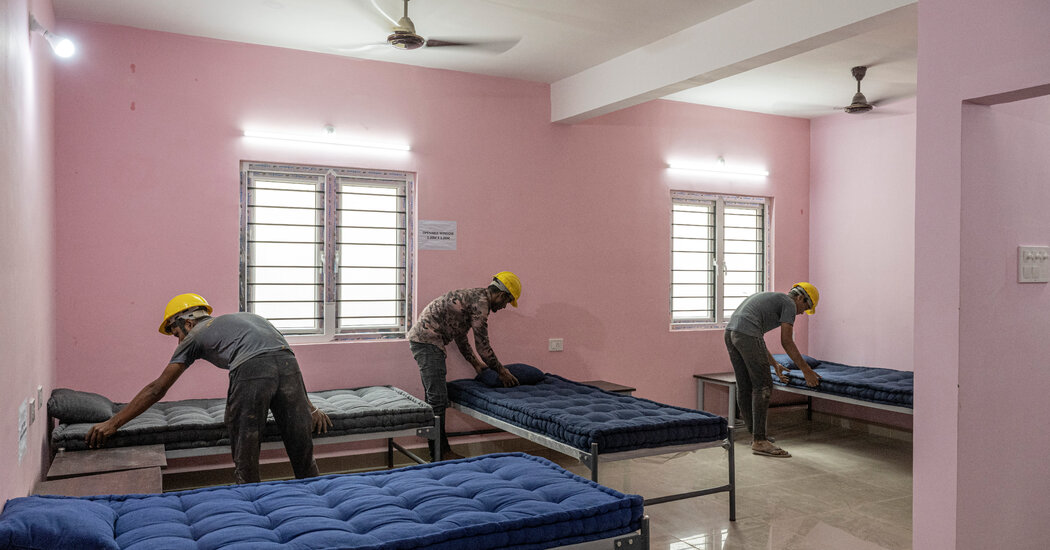
But some things are too big to hide. Two gigantic dormitory complexes are springing up from the earth. Once finished, each will be a tight block of 13 buildings with 24 rooms per floor around an L-shaped hallway. Every one of those pink-painted rooms will have beds for six workers, all women. The two blocks will house 18,720 workers apiece.
It’s a ready-made scene from Shenzhen or Zhengzhou, the Chinese cities famous for their iPhone production prowess. And it’s no wonder.
Sriperumbudur, in the state of Tamil Nadu, is the home of the expanding Indian fortress of Foxconn, the Taiwanese-based company that has long played the largest role in producing iPhones. And as recently as 2019, about 99 percent of them were made in China.
India, as part of a national manufacturing drive, is chipping away at that dominance, when many companies are looking to spread their work to countries other than China. An estimated 13 percent of the world’s iPhones were assembled in India last year, and about three-quarters of those were made in Tamil Nadu. By next year, the volume produced in India is expected to double.
But despite almost 10 years of a “Make in India” initiative promoted by the country’s powerful prime minister, Narendra Modi, manufacturing as a share of the economy has stalled out. At about 16 percent, it is a shade lower than when Mr. Modi took office in 2014, and far lower than that of China, or of Japan, Taiwan and South Korea when those Asian tigers took off.
India desperately needs more skilled jobs, and factory work creates them like nothing else. Last year, India overtook China to become the world’s most populous country, and its working-age population is speeding ahead. But turning that demographic bulge into an actual advantage means making India’s workers more productive. Half of them still depend on small farming.
Tamil Nadu might point the way forward. The state of 72 million people is now succeeding in ways that have eluded India as a whole. The national government started subsidizing electronics manufacturing across the country in 2021, setting off a gold rush in places like Noida, next to New Delhi.
But for Tamil Nadu, that incentive is not an essential lure. T.R.B. Rajaa, Tamil Nadu’s minister of industries, can rattle off the state’s inbuilt advantages: schools, transport, engineering graduates.
“We never compare our growth with other Indian states,” he said. “We chart ourselves to the growth of Scandinavian countries and how we can beat that.”
Mr. Rajaa and other boosters of Tamil Nadu are proud of the human capital their state has built up, and especially of its women. Many of them work in formal jobs, while few women in other states do: 43 percent of all Indian female factory employees work in Tamil Nadu, which is home to 5 percent of the national population.
Parts of Tamil Nadu are already working as industrial champions. A long belt of car and car-part manufacturers stretches down the coast from its capital, Chennai. In the western Coimbatore valley, factories specialize in die-casting and pump manufacturing. There is a knitwear cluster in Tiruppur, and the country’s biggest maker of matchsticks is in Sivakasi.

It is striking that India is plunging into such high-end goods as the iPhone. India has never become internationally competitive making things like T-shirts or sneakers, getting its clock cleaned by smaller and formerly less developed countries like Bangladesh and Vietnam.
This is not the first time this century that India was expected to move up the ranks of high-value electronics manufacturing. Nor the first time that Tamil Nadu seemed like the best launchpad for it. In 2006, Finland’s Nokia, then a cellphone colossus, built a big factory at the center of Sriperumbudur’s government-planned industrial estate. It was supposed to make millions of phones a year, for India and the rest of the world. The smartphone, and the global financial crisis in 2009, knocked down those dreams.
But the roots never died. Sriperumbudur was initially attractive because of its experience in auto manufacturing. Hyundai had set up shop in 1996, soon after India opened up its economy to more foreign investment and Tamil Nadu formed its first state development agency. Glassmaking and basic electrical goods followed. After a lull, the old Nokia site was built over by Salcomp, a local company that makes high-end power chargers, now for companies like Apple. The plants of a dozen other known and rumored Apple suppliers have sprouted around it, along with Samsung, Dell and most other big multinational electronics companies.
On Friday, India’s Republic Day, Young Liu, the chief executive of Foxconn, was in New Delhi to be awarded the Padma Bhushan, the country’s third-highest civilian honor. “Let’s do our part,” he said, “for manufacturing in India and for the betterment of society.”
A flourishing network of small, medium and large businesses contributes to Tamil Nadu’s success. One of them is Sancraft Industries in Sriperumbudur, a company with about $5 million in revenue that makes molded plastic parts for a handful of companies that feed the iPhone machine.
A company founder, Amit Gupta, said that Nokia had “brought the ecosystem here” and that its Finnish engineers had done a lot to usher in global standards. His experience working with an early client, Schneider Electric, a French company, taught him how to integrate his operations with more recent arrivals from South Korea, Taiwan and China.
As host to an international supply chain, Tamil Nadu has drawn restaurants and grocery stores catering to Western and East Asian tastes. “It’s like a small version of China here,” said Mr. Gupta, who worked in Shenzhen 15 years ago.
In India and abroad, there is no shortage of excitement about the prospect of India’s supplanting China in at least some part of global supply chains. By last year, Tim Cook, Apple’s chief executive, was showing up in India with his palms pressed in namaste and a vermilion mark on his forehead, inaugurating the country’s first Apple stores.
All told, more than 130 Fortune 500 companies are doing business in Tamil Nadu.
The electronics campuses in Sriperumbur look remarkably alike. Gardened grounds and parking lots filled with dozens of white buses separate low-slung assembly plants. The buses shuttle thousands of workers to and from their homes, in villages 30 to 60 miles away.
Inside one Apple supplier, blue-smocked workers in surgical masks walked past banks of white-aluminum-cladded machinery on paths marked by yellow arrows stuck on the floor. Low ceilings, long clear sightlines and placards exhorting good behavior in English and Tamil completed the effect.
There are more to come. Corning, the American glassmaker, is setting up a factory that could produce iPhone’s Gorilla Glass screens, and Vietnam’s VinFast Auto has announced a $2 billion facility to make electric vehicles.
Mr. Rajaa, the state industry minister, isn’t stopping at $1,000 smartphones, either. He and other officials in Tamil Nadu are trying to attract more businesses making cheaper things, too, in greater volume. If the rest of the country could follow Tamil Nadu, India might be able to produce enough of the less-skilled jobs its young and growing population needs.
Mr. Rajaa spent the first week of January regaling foreign investors with plans that included a budding new industrial cluster, focused on non-leather footwear. About 140 miles south of Sriperumbudur, Nikes, Adidases and Crocs are just starting to roll off the lines in Perambalur.