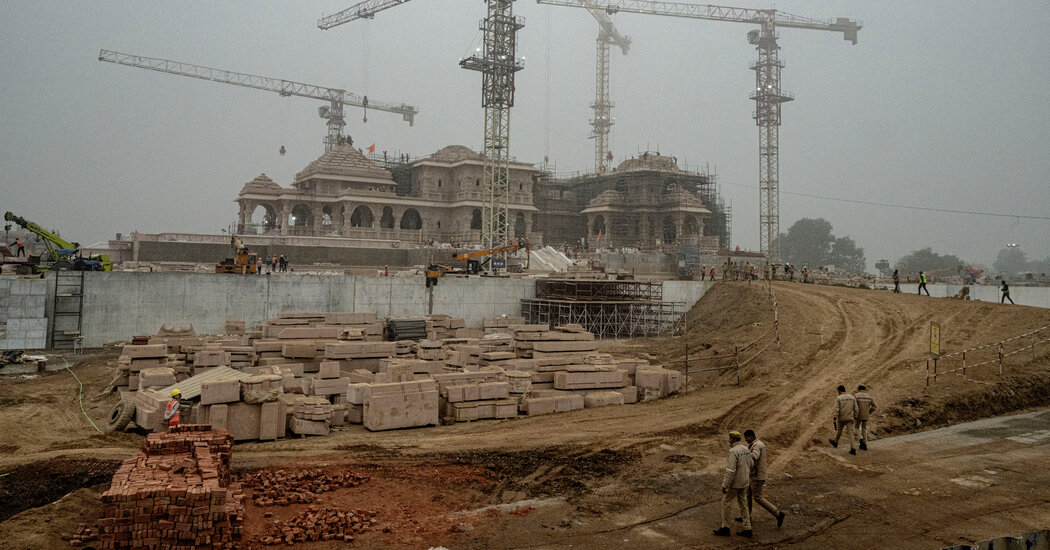

They fanned out across the vast country, knocking on doors in the name of a cause that would redefine India.
These foot soldiers and organizers, including a young Narendra Modi, collected millions of dollars to be socked away for a long fight to build a grand Hindu temple in Ayodhya, in northern India. Across 200,000 villages, ceremonies were arranged to bless individual bricks that would be sent to that sacred city, believed by Hindus to be the birthplace of the deity Ram.
The bricks, the campaign’s leaders declared, would not just be used for the temple’s construction on land occupied for centuries by a mosque. They would be the foundation for a Hindu rashtra, or Hindu nation, that would correct what right-wing Hindus saw as the injustice of India’s birth as a secular republic.
Nearly four decades later, the cornerstone of that sweeping vision has been laid.
Mr. Modi, now the country’s prime minister, inaugurated the Ram temple in Ayodhya on Monday — the crowning achievement of a national movement aimed at establishing Hindu supremacy in India by rallying the country’s Hindu majority across castes and tribes.
“Today, our Ram has come. After centuries of patience and sacrifice, our Lord Ram has come,” Mr. Modi said during the ceremony. “It is the beginning of a new era.”
The moment is both one of triumph for Hindu nationalists and one of jubilation for many others who care little for politics. Ram has a wide following in India; excitement around the temple’s consecration had been building for weeks, with saffron-colored pennants strung across a million streets and markets, and posters of Ram advertising the event everywhere.
But for the country’s 200 million Muslims, the Ram temple has reinforced a sense of despair and dislocation.
The Babri Mosque, which once stood on the site, was destroyed in 1992 by Hindu activists, unleashing waves of sectarian violence that left thousands dead. The manner in which the mosque was razed set a precedent of impunity that reverberates today: lynchings of Muslim men accused of slaughtering or transporting cows, beatings of interfaith couples to combat “love jihad” and — in an echo of Ayodhya — “bulldozer justice” in which the homes of Muslims are leveled by officials without due process in the wake of religious tensions.
The Hindu right wing has ridden the Ram movement to become India’s dominant political force. The opening of the temple, built over 70 acres at a cost of nearly $250 million, marks the unofficial start of Mr. Modi’s campaign for a third term, in an election expected in the spring.
That it was Mr. Modi who was the star of the inauguration of the temple in Ayodhya — which Hindu nationalists have compared to the Vatican and Mecca — captures the right’s blurring of old lines.
India’s founding fathers took great pains to keep the state at arm’s length from religion, seeing it as crucial to the country’s cohesion after the communal bloodletting wrought by the 1947 partition that cleaved Pakistan from India. But Mr. Modi has unabashedly normalized the opposite.
After completing the consecration rituals alongside priests on Monday, Mr. Modi prostrated in front of the Ram idol, carved with a warm smile and lucid eyes in black stone and bedecked in jewels. The prime minister then emerged at the edge of the temple steps in his signature style for big moments: the powerful leader, alone in the frame, striding forward and bowing to the thousands of handpicked guests — celebrities, seers and business leaders — seated below.
Mr. Modi’s public image is simultaneously one of statesman and god-man. His party chief recently described him as “the king of gods.” Ahead of the inauguration, the town was covered in posters and billboards, of Ram and of Mr. Modi.

Just as they did in the 1980s, volunteers from right-wing Hindu organizations went door to door across hundreds of thousands of villages in the days before the temple’s consecration. This time, the effort was a reminder of the immense network Mr. Modi has at his disposal, one that the political opposition can come nowhere close to matching.
In preparation for his role in Ayodhya, Mr. Modi embarked on an 11-day Hindu purification ritual. The prime minister was seen temple-hopping across the country, and when his office put out pictures of him at his residence feeding cows, which are seen as holy by many Hindus, fawning television channels ran them as breaking news.
In between his expressions of religious devotion, Mr. Modi attended to the work of the state, inaugurating huge projects that perpetuate his image as a champion of development.
The omnipresent leader, in mixing religion and politics and tapping into the vast resources at his service, has achieved what his predecessors could not: turning a diverse and argumentative Indian society into something resembling a monolith that falls in line behind him. To question him is to question Hindu values. And that is akin to blasphemy.
Manoj Kumar Jha, an opposition lawmaker, said that while Mr. Modi’s Bharatiya Janata Party, or B.J.P., might be toppled someday, the transformation of the state and society would take decades, at least, to undo.
“Winning elections could be arithmetic. But the fight is in the realm of psychology — the psychological rupture, the social rupture,” Mr. Jha said. Just as Muslim Pakistan was founded as a state for one religious group, India is “now emulating Pakistan, a little late.”
“The toxic mix of religion and politics is idealized,” he added. “Nobody is bothered to see what such a toxic mix has done.”
In many ways, India’s birth as a secular republic was an idealistic project undertaken by its founding leaders, including Mohandas K. Gandhi and the country’s first prime minister, Jawaharlal Nehru. With India’s diversity in mind, they defined a secular state not as one that keeps out religion, but as one that keeps an equal distance from all religions.
Muslims who remained in India after the creation of Pakistan amounted to the world’s third-largest Muslim population. There were also millions of Christians, Sikhs and Buddhists. Hinduism itself contained multitudes, distinguished not just by devotion to 30 million distinct deities, but also by rigid caste hierarchies and regional cultural identities.
Members of the Hindu right were appalled that the departure of the British had left Muslims with a nation of their own in Pakistan but had not afforded the same for Hindus in India. It was, to them, just the latest inequity for the religious majority in a country that had endured several bloody Muslim invasions and was ruled for centuries by the Mughal Empire.
Initially, these Hindus struggled to turn the anger over partition into a political movement not just because of the event’s trauma, but also because of the taint from a grave act of terrorism. In 1948, one of their foot soldiers, Nathuram Godse, assassinated Gandhi, who had amassed a huge following as an icon of nonviolence and an advocate of India’s diversity.
Gandhi’s last plea, after receiving three bullets from close range during his morning prayer meeting, was to the same deity that the Hindu right would later rally around at Ayodhya.
“O Ram,” he said as he collapsed.
The founders’ secular vision remained in place largely because of Nehru’s nearly two decades in power. But it rested on a thin foundation. There was no major project of historical reconciliation between Hindus and Muslims, said Abhishek Choudhary, the author of a recent book on the ascent of the Hindu right, as Nehru — “a terribly overworked politician” — focused on the immense work of ensuring the country’s immediate survival.
The opening for the right wing came in the decades after Nehru’s death. When his descendants — first his daughter, Indira Gandhi, and then his grandson Rajiv Gandhi — toyed with majoritarian sentiments in the 1980s to keep themselves in power, they walked into a game for which the Hindu right was much better prepared.
The right’s fountainhead, the Rashtriya Swayamsevak Sangh, or R.S.S., which will be 100 years old next year, has many offshoots, all working closely for the same goal. When one sibling in the R.S.S. faced a state crackdown, the others could continue organizing.
But what the right wing lacked was political power. One group related to the R.S.S. had already been agitating around the issue of a Ram temple. The B.J.P., the political arm of the R.S.S., got on board.
The Babri Mosque had been built by a military commander of the Mughal Empire in the 16th century after the destruction of a Ram temple, the Hindu right argued. The movement to build a temple for Ram at the same spot was not just about the return of a deity with crosscutting popularity as a just ruler and moral exemplar, but also the toppling of a symbol of conquest.
After turning the Ram movement into a participatory affair across the country, the B.J.P. saw its political fortunes shoot up in elections in 1989, and again in 1991. There was no turning back.
The campaign gained such confidence that even as the dispute over the plot was being heard in court, tens of thousands of foot soldiers gathered at the spot in December 1992 and, in the presence of top right-wing leaders, destroyed the mosque with ropes, sledgehammers and their bare hands.
Alok Kumar, the president of the Vishwa Hindu Parishad, the R.S.S. offshoot that has led the decades-long temple movement, said the destruction of the Mughal structure — which he asserted the Muslim rulers had erected to drain Hindu “willpower and self-respect” — and the building of the temple were crucial to a Hindu revival.
“I believe that when that structure in Ayodhya was brought down,” Mr. Kumar, a soft-spoken lawyer, said in an interview, “the inferiority complex of the Hindu race went away.”
As the court case dragged on, the issue remained a communal tinderbox. When more than 50 Hindu activists returning from Ayodhya in 2002 were burned to death in a train fire in Gujarat, it unleashed days of brutal violence that left more than 1,000 people dead in the state, a majority of them Muslims.
Mr. Modi, who was then the chief minister of Gujarat, was accused of complicity in the riots, though the courts later cleared him of wrongdoing.
Twelve years later, he would become prime minister. While he campaigned first on the economy and then, in his re-election bid five years later, on national security, his focus remained on the Hindu right’s priorities. Victory in the temple fight was sealed with a Supreme Court ruling in 2019.
Mr. Modi has continued the uphill task of uniting Hindus into a powerful monolith, through outreach to lower castes and welfare handouts that expand his base. In the process, secularism has been redefined as the suppression of public expressions of other faiths, while Hinduism has increasingly been displayed as the religion of the state.
Ziya Us Salam, who documented patterns of violence and marginalization against India’s Muslims in a recent book, said the right-wing campaign had reduced Muslims to the worst deeds of Mughal rulers from long ago while overlooking Muslims’ contributions.
“What matters to you is to project the Muslim as a villain in the past, and to pass off that villainy to the modern contemporary Muslim who is supposed to atone for what happened in the 13th and 14th century,” Mr. Salam said.