

Each January, this strategy offers a reset—a way to refocus and set the tone for the year ahead. What you take from it evolves each time, shaped by where you are and what you need most right now.
There’s always talk of resolutions and life changes at the start of the year. For many, the holidays are a prime time to drift off course—whether it’s with fitness goals, creative projects, or career plans. Family gatherings, endless shopping, and the Q4 sprint can drain any energy you might have had for long-term ambitions.
And let’s be honest, once-a-year holiday meals tend to win out over calorie counting.
Now it’s January, and the “New year, new me” chorus begins.
Alongside it comes a rising tide of scorn. Cynics are quick to write off resolutions, predicting most will be abandoned by February. Gym regulars complain about the newcomers crowding the squat racks. Then there are those who pride themselves on recalibrating year-round, dismissing the idea of a calendar-defined reset with an air of superiority.
The tradition of making New Year’s resolutions goes back nearly 4,000 years to the Babylonians, who used the start of the year to make promises to their gods. Over time, those promises were made to the gods in our head as practice of self-improvement.
The flip of the calendar is a reminder to pause and refocus—a moment to take stock of what truly matters.
New Years Reflection = Meditation
Reflecting on a new year isn’t so different from meditation. Mindfulness meditation, for instance, asks you to focus on your breath. Distractions will creep in—sometimes immediately. The key is noticing when you’ve wandered off and gently bringing your attention back.
Some use guided apps like Waking Up, other traditions use the sound of a gong. Either way, the goal is the same: to create moments that prompt you to check if you’ve become distracted and help you refocus.
But just like meditation, in life it’s easy to come to and realize, oh wow, I’ve been distracted from what’s important, for like, a long time. In both situations it can be incredibly disheartening and frustrating. “I’ve tried to make goals before, and look, I got nowhere with them. What’s the point?”
To do this is to miss the point of the process.
The following 3 frameworks will serve as the mindset for determining what will create a fulfilling life for you and result in meaningful change. Over the course of the Begin Again series, we’ll build on that mindset with tools and new ways of thinking.
Framework 1: Resilience Can Be Effortless –
When You Get Away from Your Goals & Habits, “Simply…Begin Again”
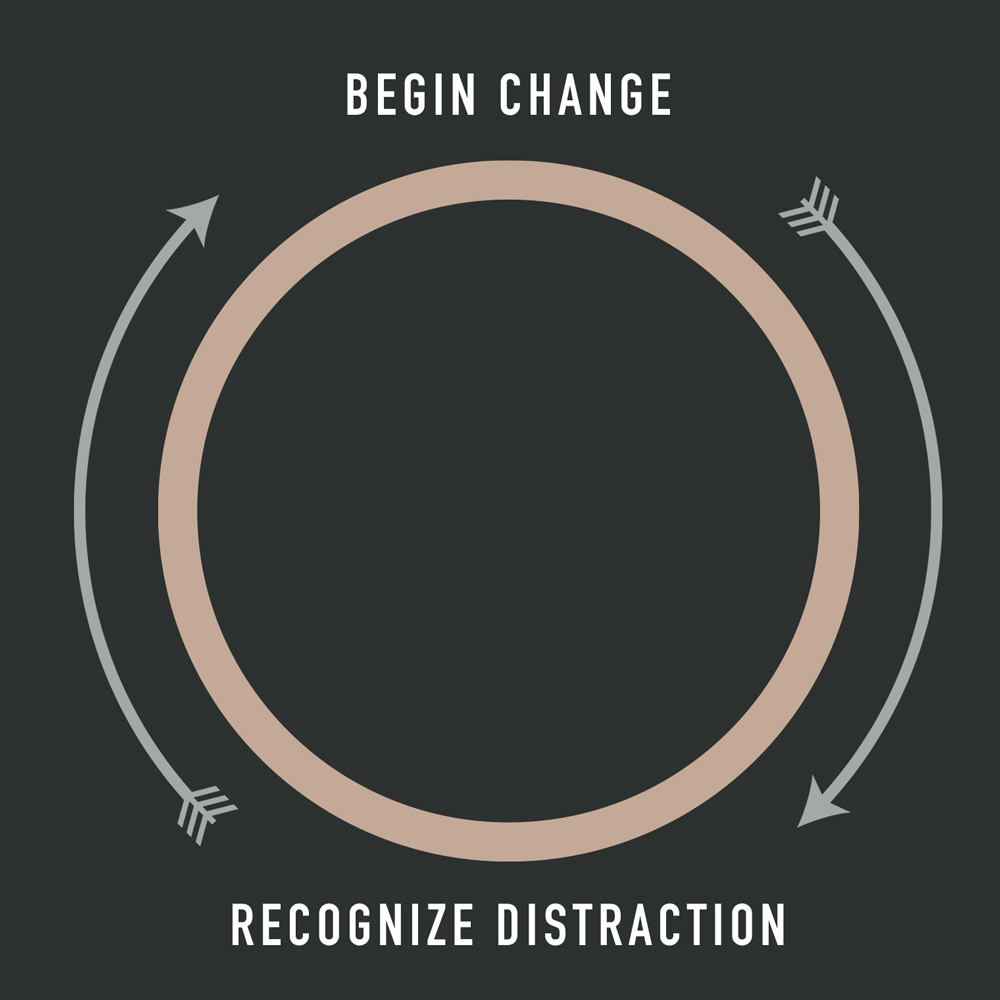
Meditation teachers like Sam Harris and Joseph Goldstein offer a simple tip for moments when you’ve lost focus: don’t dwell on the frustration or waste time beating yourself up. Just refocus your attention and begin again.

This idea also applies to daily life and New Year goal-setting. Realizing you’ve veered off course—whether with fitness, nutrition, or just your daily to-do list—can feel discouraging. But embracing the operating procedure of “just begin again” shifts the perspective, helping you reconnect with what matters and move forward.
It’s a practice rooted in resilience, recognizing that personal growth isn’t linear. Progress comes with distractions and setbacks, but each one is a chance to start fresh. As Harris puts it, this process is about letting go of the past and returning to the present.
But even when you wake up from distraction, how do you determine what’s important? Or what if you’re not emotionally connected to what you’re focusing on? What if you lack the drive to formulate what changes you want to make?
→ Have you downloaded our end of year reflection free printable workbook? It’s fantastic to do any time if you’ve never done an exercise like that. It will provide a lot of clarity, and our free workbook makes the process simple and straightforward.
Framework 2: The Centuries Old Ground Rules for Change
When it comes to defining what matters and building meaningful change, starting with a set of foundational principles can make all the difference. An ancient Tibetan practice called Lojong, or “Mind Training,” offers a framework worth considering.
At the heart of Lojong are the “Four Preliminaries.” Despite the name, these ideas are anything but basic. They’re foundational—providing a clear, unflinching view of reality that helps ground future decisions about what truly matters.
These principles offer a refreshingly honest lens for shaping the changes you want to make this year. Reinterpreted through a modern, secular perspective, they can serve as guiding tenets for your goals and priorities moving forward.
First Preliminary: It’s Incomprehensible That You Even Exist
It’s easy to let life’s demands—work obligations, family routines, and cultural expectations—pull you into autopilot, letting the flow of daily tasks define what your life is or could be.
But consider the staggering odds of your existence. Among the billions who came before you and the countless who will follow, the chance that life’s building blocks formed into you is almost unfathomable. In a universe where matter can neither be created nor destroyed, the atoms that make up your body could have become anything else: a cluster of space dust, a rodent scurrying through the Pleistocene, or my monstera plant that never stood a chance.
Yet, here you are—the result of an inconceivable culmination of billions of years of cosmic events. Literally everything that has ever happened in the universe had to happen just as it did for you to find yourself right here, reading this, probably on your phone, while using the bathroom.
And since matter isn’t destroyed, after you’re gone, parts of you may end up as space gas, a rodent, or some other writer’s dead plant. You’re here, in the face of improbable odds, only temporarily.
→ As we begin again, refocusing from distraction, the initial Lojong preliminary reminds us to get out of the flow of the apathy river prompted by the essential question: “What will I do with this rare human life?”
Second Preliminary: You’re Going to Die—Stop Ignoring It
Humans are wired in a weird way—we go through life acting as if death is something that happens to other people. We have a knack for sticking our fingers in our ears and going “lalalalalala” when it comes to thinking about our guaranteed death. It’s an uncomfortable, even taboo subject, one we all, culturally and individually, avoid.
Each of us will face our mortality, and how much time we have left can never be known. This second preliminary serves as a flag boldly planted proclaiming the impermanence of everything. Anything that can die, will die.
To suggest thinking about this could easily be described as morbid in our culture and that only drives home the point. Your inevitable death is science, not bad luck. Just because you feel uncomfortable when you think about it, doesn’t make avoiding it helpful.
Facing the reality of death unveils insights and benefits that transcend the fear or avoidance it often instills. As we grasp the impermanence of everything, including our own bodies, it becomes clear that excess money, possessions, and even the companionship of friends cannot provide solace when we inevitably face our death.
Think of the way a looming deadline can jolt you into action, surprising you with how much you can accomplish when time feels scarce. Embracing mortality works the same way. Understanding how little time we really have can bring urgency to the present, turning idle moments into opportunities.
Unfortunately for many people this acceptance only comes at the end of life, reflecting on how life could have been lived, if only they could have understood what’s at stake: One day, it will be the last day.
→ You can embrace this in every moment, from here on.
Third Preliminary: Your Actions – or Inactions – Have Consequences
In pop culture, karma often gets miscast as some mystical force, a cosmic referee ensuring bad deeds get punished. But at its core, karma is simply the law of cause and effect—a reminder that what you do (or don’t do) shapes the reality you’ll face later.
As a framework for starting again, this preliminary reinforces an obvious but often overlooked truth: your future self will live in the world created by your actions today. Joining a gym or starting a business won’t guarantee success, but between the version of you who tries and the one who doesn’t, only one has a shot at the outcome they’re after.
The same logic applies to self-sabotaging thoughts. No matter how real or convincing they may feel, they don’t excuse inaction. The truth is simple: inaction only leads to outcomes dictated by inaction.
→ If there’s something you want to change, no one else can set the wheels in motion for you. The third preliminary calls this out plainly—you are the cause that creates the effect.
Fourth Preliminary: Dedicating Your Life to Only Materials Goals is Unfulfilling
When we hear about goals in modern media, they often revolve around familiar aspirations: launching a business to amass wealth, climbing the corporate ladder to secure a prestigious position, purchasing a home that exudes pride and investment potential, or getting shredded to be more attractive to potential partners.
The fourth preliminary challenges us to look deeper. While these aspirations aren’t inherently wrong, they can’t stand alone. Pursuing possessions, status, or validation as the ultimate aim creates a never-ending loop of desire and fleeting fulfillment.
As we refocus, it’s essential to embrace that while it’s acceptable to set goals that yield these outcomes, they alone will not break the desire-fulfillment cycle.
→ Think of the emptiness of short-term pleasures, such as binge-watching TV shows or indulging in excessive eating. Focusing only on superficial goals like wealth, status, and image across a lifetime create the same result.
Framework 3: Rethink Your Entire Approach with First Principles
Now that we’ve let go of ego and embraced a clean slate, it’s time to focus not just on the why behind our goals, but the how. Enter first principles thinking—a concept rooted in philosophy and championed by figures like Aristotle and, more recently, tech leaders.
At its core, first principles thinking breaks complex, sometimes unknowable, problems down into their most basic truths, allowing for innovative solutions that aren’t constrained by conventional approaches.
In business, this method has led to breakthroughs by abandoning traditional practices and reconstructing problems from the ground up.
A well-known example is the office building plagued by complaints about slow elevators during peak hours. The building owners initially considered costly upgrades or replacements, but structural constraints made that impractical.
Instead, they simplified the problem:
- People are upset because the wait feels too long.
- The speed of the elevator cannot be changed.
With this clarity, the solution turned out to be both simple and affordable. Mirrors and televisions were added to the lobby, providing distractions like news, sports, and reflections. The wait times didn’t change, but the complaints stopped entirely.
The real issue wasn’t the speed of the elevators—it was the riders’ awareness of waiting.
This same approach can transform personal goals. Instead of defaulting to old methods that never quite worked—whether for fitness, relationships, or career growth—break your goals down to their most fundamental truths. Start fresh and build strategies that address the real problem, not just the symptoms.
→ Ask yourself, “What is the true purpose behind this goal? What do I know is true and what am I actually trying to achieve?”
Over the course of the Begin Again series, we will be exploring tools and strategies that will help to begin again and refocus on what is actually important to you, using the ideas of these 3 frameworks as a foundation for dramatic and meaningful direction:
- Simply begin again: When you realize you’ve become distracted from your habits or goals, don’t get demotivated. Clear your head and begin again.
- All decisions and brainstorming should reflect the four preliminaries:
- Your life is unfathomably rare, make use of it.
- You will die. Your life is shorter than it seems, act with a sense of urgency while you still can.
- The universal law of cause and effect. If you want change, you must take continual action.
- Fulfillment is not possible from buying things or being seen as important alone. Don’t forget to anchor your ambitions to things that are not based on acquiring money, things, or status.
- Don’t just blindly continue on a path that may not be working. Break your ambitions, goals, or problems down to their base ideas and create previously unknown, innovative solutions using first principles thinking.