

You’ll never know what content works — and why — unless you regularly track and evaluate its metrics against your business goals. However, just as content performance doesn’t remain static, best measurement practices, definitions, and tools don’t either.
In this mad world of measurement musical chairs, your best defense is to stay on top of the latest terms and how to apply them. To help, I’ve compiled 27 critical definitions and simple explanations of how they may fit into your content’s performance strategy.
Content measurement definitions:
Analytics
Marketo defines analytics as managing and studying metrics data to determine the return on investment of marketing efforts like calls to action, blog posts, channel performance, and thought leadership pieces, as well as to identify opportunities for improvement.
Attention metrics
Attention metrics gauge how well your content retains your audience’s interest. They can include biometrics (e.g., eye tracking, facial recognition), explicit emotional feedback (e.g., focus groups, interactive surveys), or a combination of data signals such as dwell time, scroll speed, cursor location, and completion rates.
As the need for more precise and predictive audience insights grows, these metrics play a central role in multiplatform content measurement. However, because no universally accepted standards exist, decisions on which data points to focus on — and how to calculate them — may differ from brand to brand.
Attribution/attribution models
In calculating marketing ROI, attribution determines how much credit to assign to a content channel or touchpoint when a desired outcome is achieved. It’s critical for performance measurement because a direct line can’t always be drawn from content consumption to business impact.
Depending on your use cases, you can choose from various attribution models (i.e., methodologies) to track a user’s progression through your customer journey and their actions at each step. You’ll find a list of commonly used models, use cases, and definitions here.
Bounce rate
Prior to Google Analytics 4 (GA4), bounce rate referred to the percentage of single-page visits in which the user had no further interaction on the site. However, Google now defines the bounce rate as the percentage of sessions that fail to meet its “engaged session” criteria — a session that lasts 10 seconds or longer, has one or more key events, or has two or more page or screen views.
Click-to-open rate (CTOR)
The click-to-open rate is an email metric that quantifies the percentage of recipients who clicked on a link within an email campaign they opened. It’s calculated as the total number of unique opened emails divided by number of unique clicks multiplied by 100.
Click-through rate (CTR)
Click-through rate refers to the number of recipients who clicked on a link compared to the number of people who received the asset. It’s calculated as the number of clicks divided by total recipients (or impressions) multiplied by 100.
It’s commonly used to gauge success for email campaigns and newsletter-driven website visits. Still, it can also apply to other content formats and platforms (e.g., display ads served on websites, social ads, or native advertising campaigns), where the total number of recipients can be specified rather than estimated.
Conversion/conversion rate
Generally speaking, a conversion happens when a consumer takes a desired action upon engaging with the content. The action is what your organization designates as meaningful — purchasing a product, registering for an event or a gated asset, subscribing to a blog or newsletter, or joining a social media community.
Calculate the conversion rate by dividing the number of those who took action by the total interactions with that piece of content.

Customer acquisition cost
Customer acquisition cost is how much the company spends to obtain that customer. Calculate all the expenses — including product research, development, manufacturing, marketing, and advertising. Divide that total by the number of customers gained within a designated time frame.
Downloads
The download metric is commonly used to gauge performance for lead-magnet content assets like white papers, e-books, and infographics. It indicates a deeper level of engagement and interest than a view or visit because the user found the content valuable enough to add to their files and explore in more detail or share with others in their networks.
The metric also is applicable to podcasts to indicate listening interest.
Engagement
Engagement is both a fundamental content metric and a content marketing goal. As a metric, it’s broadly defined as an act of interaction — opening an email newsletter, reading a blog article, clicking on an ad or an interactive asset, or liking/commenting on a social media post.
While engagement indicates at least a passing interest in your content, it’s not an informative indicator of why the content captured audience interest or its value over time. Engagement is often best used to contextualize other metrics rather than as a definitive decision-making tool.
Entrances/exits
Entrances are the number of times users enter your site through a page or set of pages. Likewise, exits indicate how often users end their website visit on that page. A page with a high entrance rate could indicate it’s well-optimized for search.
However, neither entrance nor exit rates are clear indicators of content success (or failure). It’s a good idea to correlate this data with other insights — such as bounce rates, dwell time, user flow, and referral traffic sources — to better understand what these data points mean for your content performance.
Events
GA4 considers every interaction a trackable event — including site page visits, clicks on a link, PDF downloads, video views, and purchases. This more flexible approach allows marketers to designate any triggered event as a conversion goal, and every instance of that event gets counted — even if the same event is recorded multiple times during a single session.
Goals
Broadly speaking, goals are the desired business outcomes achieved through your content marketing strategy. While the stated goal of content marketing is to ultimately drive a profitable action, your goals should be more specific and quantifiable with an established time frame, such as increasing sales conversions by 10% in three months, saving the company $100,000 in a year, building a subscribed audience to hit 10,000 in six months, or driving greater customer loyalty and brand satisfaction as measured by repeat purchases over 12 months.
From a web analytics standpoint, Google’s shift to tracking interactions as events changed how it configured and tracked goals in the Universal Analytics era.
KPI
Key performance indicators are agreed-on measurements for assessing progress against your content marketing goals. Potential KPIs include average conversion rates, number of leads, quality of leads, or revenue per new customer.
Marketing-qualified lead (MQL)
MQLs are leads generated by the marketing team that satisfy the criteria to get passed along to the sales team for further outreach.
Metrics
In contrast to KPIs, metrics are the business-as-usual measurements for things that add value to your organization but aren’t focused on the most critical goals. They might include website page views or likes on social media posts. These numbers can help you achieve or optimize your KPIs.
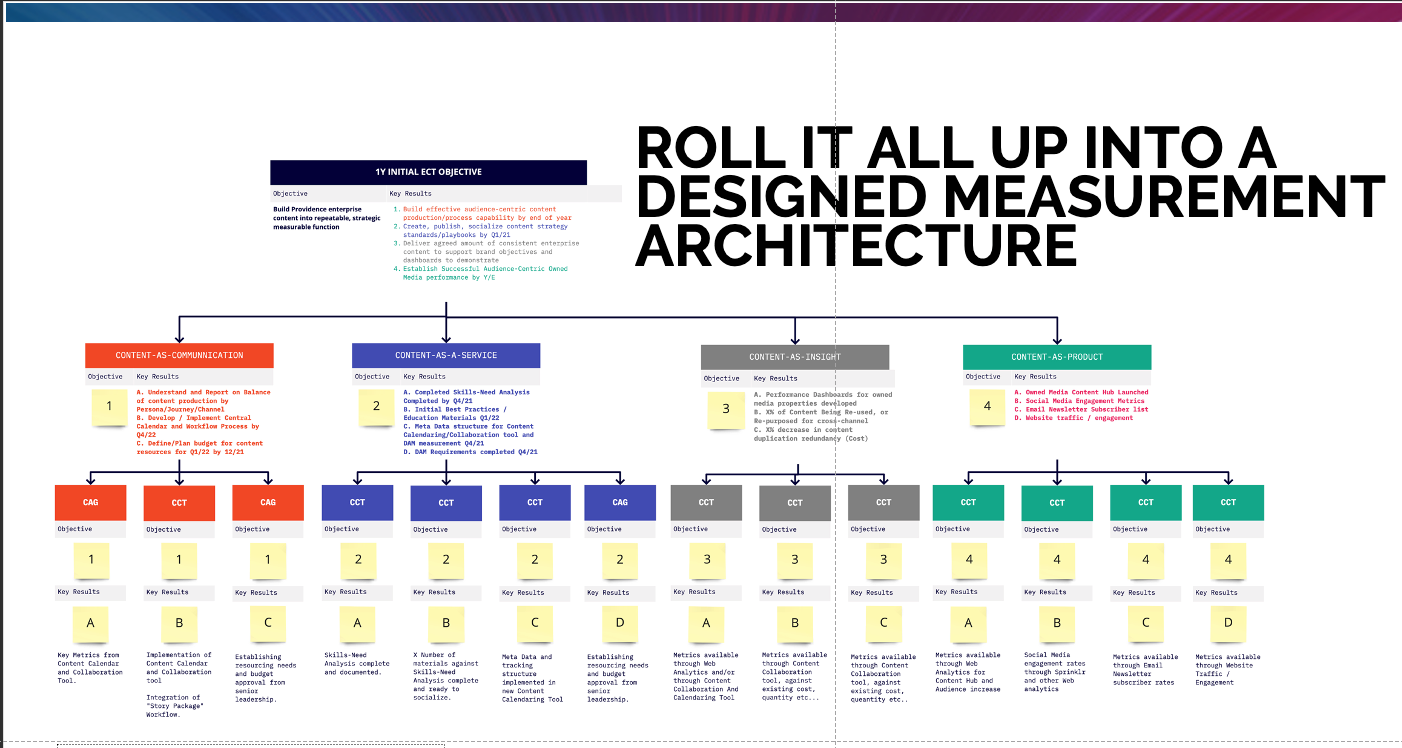
Objectives and key results (OKR)
Objective and key results can help determine which metrics best gauge performance against your goals. The method starts with designing a measurement pyramid that includes goals, key performance indicators, and metrics.
CMI’s chief strategy advisor, Robert Rose, details the OKR process here. The end result should be your business mission segmented into strategic objectives. Each segment connects to the OKR pyramid and serves as a source tool for each metric in it.
Open rate
Open rate is the percentage of recipients who opened an email sent to them. It is calculated as the number who opened the email divided by the total number of email recipients multiplied by 100.
The open rate does not measure whether any recipients clicked on links in the email content. Already limited in value due to its narrow focus, its reliability has come into question even further as email platforms evolve their privacy controls and new regulatory requirements emerge.
Referral traffic
When a user reaches your domain through a third-party link (e.g., search engine, link from an article published off your site), it’s tracked as referral traffic by Google. As a metric, it’s a useful indicator of brand awareness and thought leadership.
In GA4, click the Reports link in the left-side menu, navigate to Acquisition >Traffic Acquisition, type “referral” in the search box, and hit enter for a focused view of referral traffic stats.
On the main Traffic Acquisition report, you can select “session source” from the Session Primary Channel Group dropdown to see the top referral sources to your site, the number of sessions for each referral, and data on the visitor’s behavior after arriving on your site.
The more sources that send traffic your way, the more Google and other search engines highly regard your domain — an outcome that may lead to better domain authority and rankings of your content on search.
Registrations/subscription count
These terms refer to the total number of people who provided their contact information to gain access to your content — attending an event, downloading a lead-magnet asset, receiving email newsletters, or joining your brand community.
Growing a subscribed audience is among the top goals for content marketing. Subscriber/registrant data can also gauge progress against other desired outcomes in the marketing funnel. For example, when registrants or subscribers renew, that renewal rate is an additional metric that can be used to gauge brand loyalty.
Return on investment (ROI)
Return on investment in marketing is a broad term describing the financial impact on the business of marketing initiatives. Knowing the ROI for content campaigns enables marketers to determine budget allocations, maximize the efficiency of each marketing expense, and demonstrate the impact of their efforts to their executive stakeholders.
Though it’s (arguably) the most critical measurement of a marketing technique’s effectiveness, the complex nature of attributing conversions to a content asset makes calculating a definitive ROI challenging.
Sales-qualified lead (SQL)
A sales-qualified lead is a prospect active in the market from a sales perspective. These leads are more likely to become customers than MQLs.
Sessions/users
In GA4, a user (called a visitor in previous analytics) is a user who arrives on your website and app. Seems simple, right? But characterizing that act and how it gets factored into content measurement is more complicated.
GA4 labels these website and app page visits as “sessions” — the designated period during which a user interacts with a website or app. The default session timeout period is 30 minutes (though you can reconfigure your settings), and sessions reset each day at midnight (local time). GA4 counts each visit from a single user as one session regardless of the source.
However, the user must have enabled tracking cookies for your business to track a session. (This is why the end of third-party cookies was feared to be the end of digital marketing.)
Share of model
With the advent of generative AI tools comes the need for a new marketing metric — share of model — to gauge the perception of your brand and the likelihood of its content being cited in a relevant AI query.
MarketingWeek defines a share of model as the number of mentions of a brand by one or multiple large language models (e.g., ChatGPT, Meta’s Llama, Microsoft’s CoPilot, Google’s Gemini, Anthropic’s Claude) as a proportion of the total mentions of brands in the same category.
Time on site/time on page
These metrics indicate how long a user spends on the site (web or mobile). Sessions exceeding the average time on page or site indicate higher interest and engagement with that content. However, when using this metric alone, it is challenging to determine whether the user actively engaged with the content all that time or simply left it open on their browser.
Video views/duration
Video views measure how many times a video asset is watched, and duration indicates the length of time the average viewer watches that video. However, just because a video was viewed in its entirety does not mean the viewer actively engaged with all of it.
Views
Views (known as page views in Google’s earlier analytics) are the total number of times users load a site page or app screen over a session. If a user views the same page three times during a session, total views increase by three.
In GA4, you can find the views count under Reports > Engagement > Pages and Screens. However, you’ll need additional configurations to view data by page URL instead of the page title.
Know what’s in the measurement name
Every content marketing program requires a solid measurement strategy. By knowing the terms and how they fit with your brand’s content marketing, you can arrange those measurement musical chairs to create a melodic evaluation of your content’s effectiveness.
Updated from a May 2022 article.
HANDPICKED RELATED CONTENT:
Cover image by Joseph Kalinowski/Content Marketing Institute