
In 2017, Louisiana overhauled its criminal justice system with broad bipartisan support, all in an effort to lose the distinction of having the nation’s highest incarceration rate. Sentences were reduced. Opportunities for parole were expanded. Alternatives to prison were introduced.
But seven years later, the state is sending a very different message: Those days are over.
Lawmakers, urged on by a new Republican governor, rushed through a special session last month to roll back the 2017 changes. Bills were passed to lengthen sentences for some offenses, to strictly limit access to parole, to prosecute 17-year-olds charged with any crime as adults and to allow methods of execution beyond lethal injection. The latter change is meant to allow the state to bring back capital punishment after more than a decade.
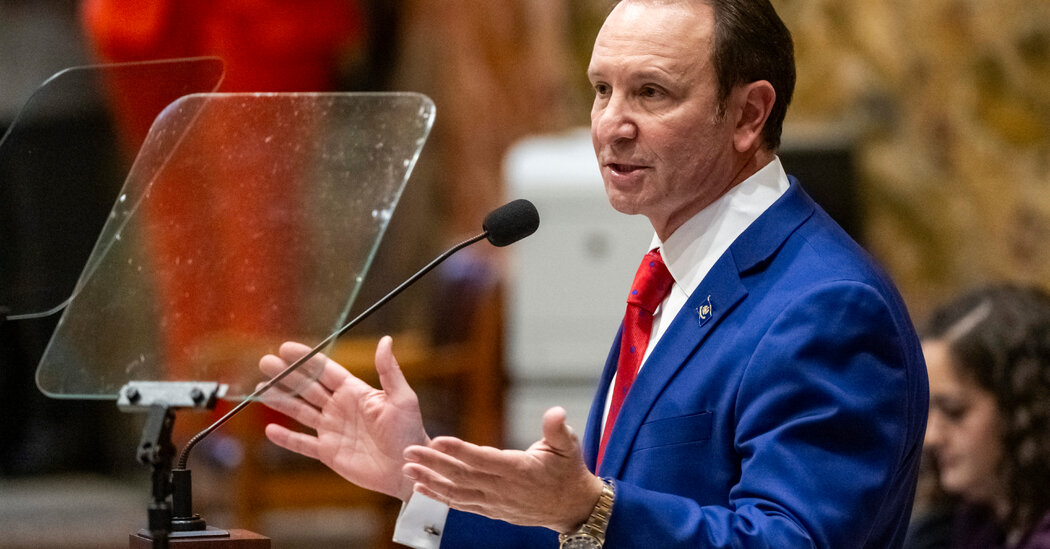
“I promised the people of this state, if elected governor, I would do everything within my power to improve the safety of our communities,” Gov. Jeff Landry said as he declared victory when the session concluded last week. “I can proudly say we have kept that promise.”
Mr. Landry, who took office in January, and his supporters argue that the new stringent measures are necessary to crack down on violence and crime, which soared in parts of the state during the pandemic. But critics contend that the new laws are variations of flawed past policies and would have the same consequences: punishing people of color disproportionately, obliterating hope and pathways to rehabilitation for prisoners, and foisting a staggering cost onto taxpayers.
“None of these bills are going to do anything to increase public safety or reduce crime in our communities,” said Sarah Omojola, the director of Vera Louisiana, a nonprofit group focused on reducing incarceration and preventing violence. “All these bills do is expand incarceration at a really high cost for Louisianans.”
While Louisiana has been particularly aggressive, other states have also dialed back efforts to experiment with new approaches to criminal justice. Lawmakers in Oregon, which had tried to decriminalize hard drugs, passed legislation last week to reimpose criminal penalties for possession of some drugs after public drug use and overdose deaths increased.
In Louisiana, Mr. Landry, a onetime police officer and sheriff’s deputy who had served two terms as the state attorney general, centered his campaign for governor on tackling crime.
He was responding to anxiety over public safety amid a surge in violent crime and other offenses during the coronavirus pandemic, mirroring a national trend. The murder rate soared in New Orleans, reaching levels that had not been seen in decades and was the highest in the nation in 2022. Carjackings were also rampant. The city’s Police Department was depleted of officers and morale.
Over the past year, crime rates have steadied. In New Orleans, murders plummeted in 2023 by some 25 percent compared with the year before, outpacing a nationwide decline.
Even so, almost immediately after taking office, Mr. Landry called for a special session in February dedicated to crime, arguing that more could be done. “We will defend and uplift our law enforcement officials and deliver true justice to crime victims who have been overlooked for far too long,” he said as the session began.
The Legislature, which has a Republican supermajority in both houses, rapidly advanced a flood of bills.
The measures raise the sentence for carjackings to no less than five years in prison; impose harsher penalties for distributing or marketing fentanyl in child-friendly packaging; and allow the concealed carry of a handgun without a license. “This is a testament to our commitment to the Second Amendment and the right of law-abiding citizens to protect themselves and their families without undue government interference,” State Senator Blake Miguez, the bill’s sponsor, said in a statement.
The Legislature also passed bills that would eliminate the possibility of parole for most prisoners convicted of a crime after Aug. 1 and would force prisoners to serve 85 percent of their sentences before they could be released for good behavior.

Lawmakers also approved using electrocution and nitrogen gas for executions, and shielding information about the companies that manufacture and supply the drugs for lethal injection. The state has not carried out an execution in 14 years, primarily because of the difficulty obtaining those drugs.
Opponents say that the policies will saddle the state with the astronomical costs that come from housing more prisoners for longer while providing little benefit. “The ‘lock them up and throw away the key’ approach does not work,” Matthew Willard, the Democratic leader in the State House of Representatives, said. “These new laws do nothing to prevent crime before it happens.”
But elected officials backing the measures argue that the laws will create a safer environment that will spur economic growth. “Crime certainly has a cost,” said Laurie Schlegel, the Republican representative who sponsored the bills for stiffer sentences for carjacking and distributing fentanyl.
The assertive approach to the session illustrated just how much Republicans in Louisiana have been itching to dismantle the legislative legacy of Gov. John Bel Edwards, the two-term Democrat who preceded Mr. Landry, and to adopt policies that Mr. Edwards would have thwarted.
“I’m not surprised we’re seeing the results we’re seeing,” Edward E. Chervenak, the director of the University of New Orleans Survey Research Center, said. “The Republicans can just roll over the Democrats in both houses, and they have a kindred spirit in the governor’s mansion.”
Before Mr. Landry took office, Mr. Edwards was a frequent impediment to Republicans who otherwise controlled state government. He issued 319 vetoes as governor, and just two were overturned by lawmakers.
Mr. Edwards, the last Democratic governor in the Deep South, exasperated many in his own party with his conservative stances on abortion and gun rights. Still, he notched some victories that had been championed by progressives; the overhaul of the justice system — known as the Louisiana Justice Reinvestment Act — was one of them.
Many states were enacting similar changes. There was widespread agreement at the time that taking a less punitive approach to low-level offenders and treating the causes of crime, like drug addiction, could make the criminal justice system more effective and free up resources that could be directed at pursuing violent offenders.
In Louisiana — long regarded as the “world’s prison capital” — the legislation felt like a monumental achievement.
“The political stars were aligned in a way we had never seen before in Louisiana and will never see for some time,” Alanah Odoms, the executive director of the American Civil Liberties Union of Louisiana, said. “It was like a solar eclipse.”
Supporters of the reinvestment act recognized that the changes would be vulnerable to attack, but they were startled by the swiftness with which lawmakers moved to reverse the act over the last month.
“I think the thing we didn’t anticipate is that these rollbacks would happen in such a concerted and quick way,” Ms. Omojola said, “regardless of the facts and the data and the research that said they were a bad idea.”
But Mr. Landry had made clear that his sights were set on a severe approach.
In a recent opinion essay published in Gannett’s Louisiana newspapers, Mr. Landry and one of the state’s Republican U.S. senators, John Kennedy, argued that the package of laws in 2017 had fueled a rise in crime and “prioritized the comfort of violent criminals over the safety of Louisiana families.”
“This special session,” they wrote, “was the first step to taking back our streets and empowering our citizens.”
Critics said that they had no doubt the new legislation would have deep repercussions, and that it would not address the root reasons behind crime; doing so, they believe, would make communities safer.
“It’s not about being ‘tough on crime,’” Ms. Omojola said. “It’s about getting serious about safety.”