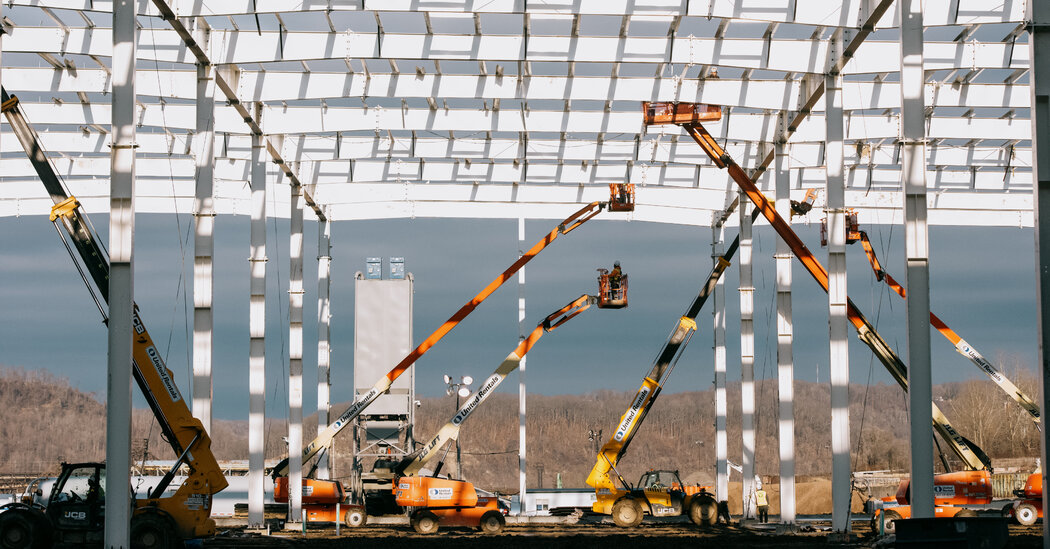

American manufacturing has been in the doldrums for years, battered by high borrowing costs and a strong dollar, which makes exports less competitive. But there has been a bright spot: billions of dollars flowing into factory construction, signifying that a potential rebound in production and employment is around the corner.
The flood of investment has been driven by two major categories of subsidies provided under the Biden administration. One offered incentives for the construction of several enormous semiconductor plants set to begin operation in the coming years. The other supercharged the production of equipment needed for renewable energy deployment.
This second category is in jeopardy as the Trump administration and the Republican-led Congress seek to roll back support for low-carbon energy, including battery-powered vehicles, wind power and solar fields.
One option to raise money to offset the cost of their desired tax cuts is truncating credits for renewable power generation.
“If it ends up that the timeline for these credits is shortened, then the incentives to develop an onshore manufacturing facility obviously go down,” said Jeffrey Davis, a lawyer with White & Case who specializes in renewable energy incentives. “If you’re looking at the prospect of sales and revenue over a three-year period instead of an eight-year period, the manufacturing facility may not pencil out.”
The Biden administration’s strategy relied on a push and a pull. First, push the supply of clean energy products through tax breaks, loans and direct grants to manufacturers. Equally important was pulling demand along: rebates for buying electric cars, tax credits for producing renewable power, and subsidies for states and individuals to install solar arrays. Companies contemplating manufacturing investments took both sides into account when planning where to build or expand a plant.
And there were big bets on the electrified, sun- and wind-powered future — $89 billion in private investment went into clean energy manufacturing in the two years that ended in September, according to the Rhodium Group, an economic research firm. Auto companies have retooled production lines for electric vehicles and entered into joint ventures to make batteries, while mines and processing facilities are under development to supply the minerals that go into them.
Some of those facilities are operating, and some are under construction. But plenty are still just planned. And those companies are mulling whether to move forward, especially with the winds against them in Washington.
“Are we going to compete or not? That’s the question automakers are going to be asking themselves,” said Harrison Godfrey, head of federal investment and manufacturing at Advanced Energy United, an industry association. “Is there enough of a demand-side market here to help me continue this investment?”
For several parts of the renewable energy supply chain, the economics were already challenging. Some projects were halted before the November election. For others, President Trump’s victory was the final straw.
“President Trump campaigned on dismantling the Green New Scam, and that’s precisely what he’s doing,” a White House spokesman, Harrison Fields, said.
Take hydrogen, which is envisioned as an energy source both for truck freight and for industrial facilities. Nel, a Norwegian company that makes electrolyzers needed for hydrogen production, thought the Inflation Reduction Act would drive enough demand in North America to add a manufacturing facility in Michigan.
Together with federal tax breaks and additional funding from the state, Nel gathered nearly $200 million in state and federal money to build the plant, which would have employed about 500 workers. But the regulations governing the tax credit for hydrogen producers didn’t come out until last month, delaying any solid orders.
“It was like a cookie jar and then you’re not allowed to eat that cookie,” said Hakon Volldal, Nel’s chief executive. That, plus fluctuating power prices and doubts about whether the Trump administration would change the rules, persuaded him to put the Michigan facility on ice.

“It’s not down to one single thing — there’s just too much uncertainty, and that prevents boards and steering committees from approving business cases,” Mr. Volldal said. “You’re making an investment decision, and you need to live with that decision once you’ve committed the capital. It’s a 20-year investment. What if you don’t get the money?”
Then there is the electric vehicle market, which started to slow down last year. The chief executive of Ford Motor, which has poured billions into battery plants, said the company might be forced to cut jobs if the Trump administration withdrew subsidies for purchases. For the auto industry especially, the prospect of tariffs on steel, aluminum and all products from Canada and Mexico is chilling.
The impact ripples down the supply chain. The German parts manufacturer ZF, which had received a $157.7 million grant to retrofit a factory to produce electric vehicle parts in Marysville, Mich., scotched the plan in December, though it said the decision wasn’t due to the election.
“In North America, the market for e-mobility products has moved slower than anticipated when ZF applied for this grant,” said Tony Sapienza, a ZF spokesman.
The wind industry has been particularly hard hit, with Mr. Trump halting permits for onshore and offshore wind development. An Italian company dropped plans for a plant in Somerset, Mass., that would have supplied undersea cables for new offshore wind turbines.
Some manufacturers are teetering on the edge. Cummins, for example, received a grant to add an electric vehicle production line to its facility in Columbus, Ind., and state subsidies for a battery cell manufacturing plant in Mississippi, which is under construction. A Cummins spokeswoman would not say whether the company was committed to following through.
“It’s difficult for companies like ours to plan amid shifting possibilities,” said the spokeswoman, Melinda Koski. “However, we remain focused on our long-term goals and are continuing to assess the path forward for our investments.”
Several companies counting on tax credits either did not respond to requests for comment or declined to comment.
Some components of the supply chain are still relatively optimistic. That includes miners and processors of so-called critical minerals needed to make batteries — an industry sector dominated by China. For this sector, White House statements have been encouraging.
Some tariffs, for example, could be a plus. The Commerce Department has opened the door to imposing tariffs of up to 920 percent on graphite. That buoys companies like Syrah Resources, which is moving forward with a processing facility in Louisiana supported by an Energy Department loan.
Mr. Trump has floated the notion of stockpiling critical minerals, and indicated support for mining activities; permits could become easier to get. There are also military applications, and the domestic industry has emphasized its importance in the event that China curtails its exports of materials like lithium, nickel and cobalt.
“There’s risk that at any moment, getting an export ban, like has happened on rare earths, it would be really bad,” said Ajay Kochhar, the chief executive of Li-Cycle, which received an Energy Department loan to build a processing hub in Rochester, N.Y. “You’d have a whole supply chain that’s thrown in the deep end, and massive dislocation because the U.S. is a disproportionate user of these materials versus a producer.”
But volume is important in bringing down costs. Producing critical minerals for car batteries and utility-scale battery storage is a way of ensuring a robust supply for American troops without having to be propped up entirely by the Pentagon.
“It’s going to be more expensive if we are relying exclusively on defense,” said Abigail Hunter, executive director of the Center for Critical Mineral Strategy at SAFE, an energy security think tank.
Some energy executives have drawn confidence from the fact that most clean-energy manufacturing investments are being made in conservative states, and a small coalition of Republicans have argued that scrapping demand incentives could lead to the waste of money already spent supporting supply.
But even if the Inflation Reduction Act survives largely intact, the Trump administration is taking steps that inject more uncertainty into renewable energy deployment that could chill new orders. Interruptions to permitting for solar and wind projects could stretch out project timelines, staff cuts at federal agencies could slow tax credit processing, and rolling back new standards on tailpipe emissions allows the auto industry to stick with gas-powered vehicles longer.
Jigar Shah, who ran the Loan Programs Office at the Energy Department under the Biden administration, puts an optimistic spin on the state of the industry. He estimates that more than half the new manufacturing facilities that his office supported are under construction, and that most of their executives remain confident in the business case for completion, because the industry fundamentals even without subsidies remain strong.
“So then you’ll find 455 of them that are probably waiting or thinking or whatever, but those 500 manufacturing facilities is greater than the number that we built in the last 10 years,” Mr. Shah said. “Will some of the projects not move forward? Yes. But will we hit these grand milestones that we set for ourselves in 2021? Unequivocally, yes.”