
Driverless cars are often marketed as a safe and convenient means of travel that allows customers to watch movies, scroll through TikTok or nap — all without worrying about taking over control. Whether it’s in a personal vehicle (which to remind everyone, there are currently no personal autonomous cars for sale) or ride-hailing service like Cruise or Waymo, the big sales pitch is you don’t have to drive.
Halo has a different approach. The Las Vegas car-sharing startup is working toward fleet vehicle autonomy. The rub is that customers will not have access to self-driving features. Instead, the technology is only being used as a valet service for people looking for a short-term rental.
Halo is like Car2go, ZipCar, Gig Share and other car-sharing services with the extra benefit of the vehicle being delivered to a customer’s destination via a teleoperations system that lets a human pilot the vehicle through city streets from a remote location.
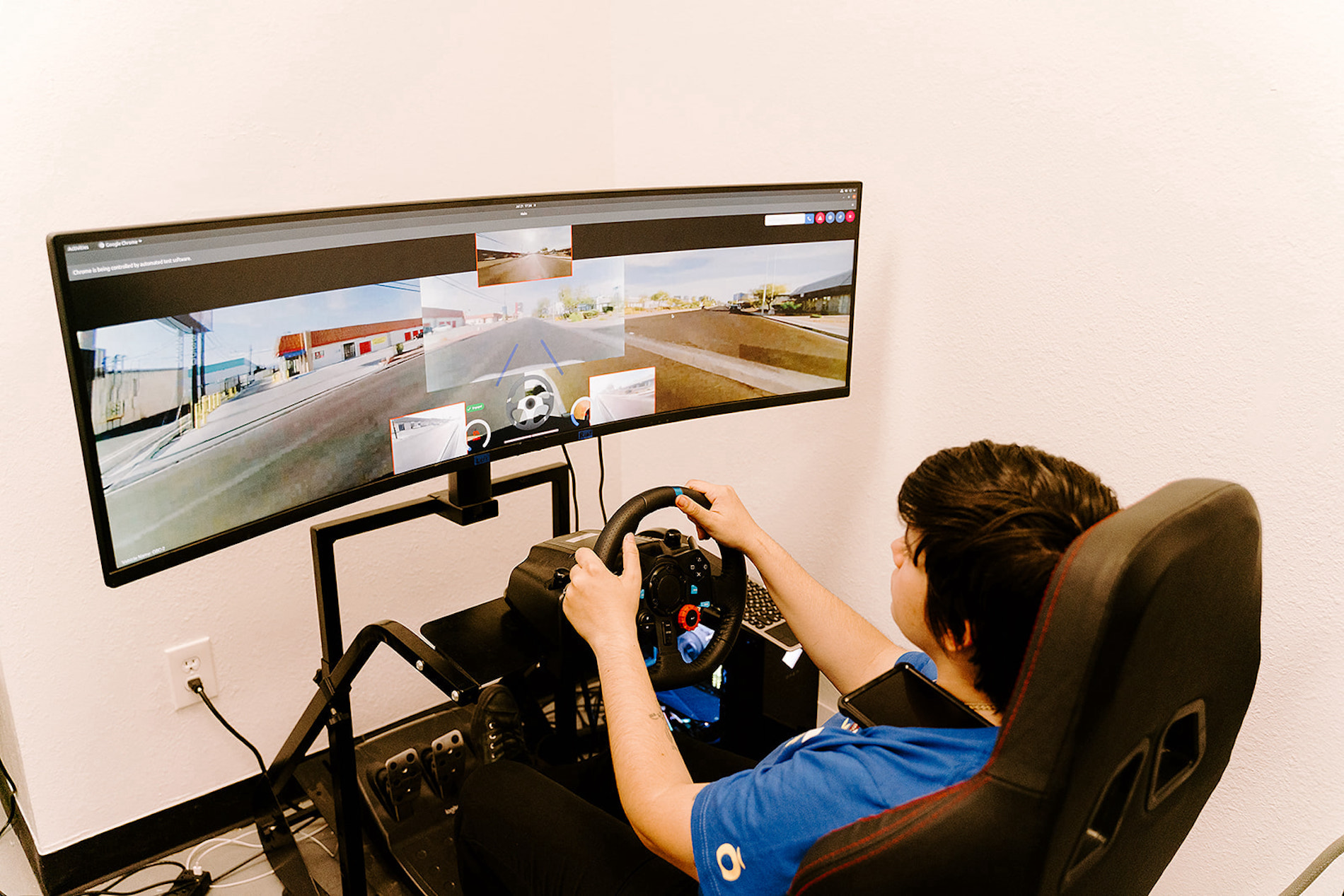
Image Credits: Halo
Well, eventually. Currently, most vehicles in the fleet are being delivered to customers by human drivers. But the company is testing its remote-driver system with a small subset of vehicles in Vegas and hopes to expand that pilot to customers in June or July of this year. (The company had previously planned to remove the human safety operator from behind the wheel and only use its remote driver system by the end of 2022.)
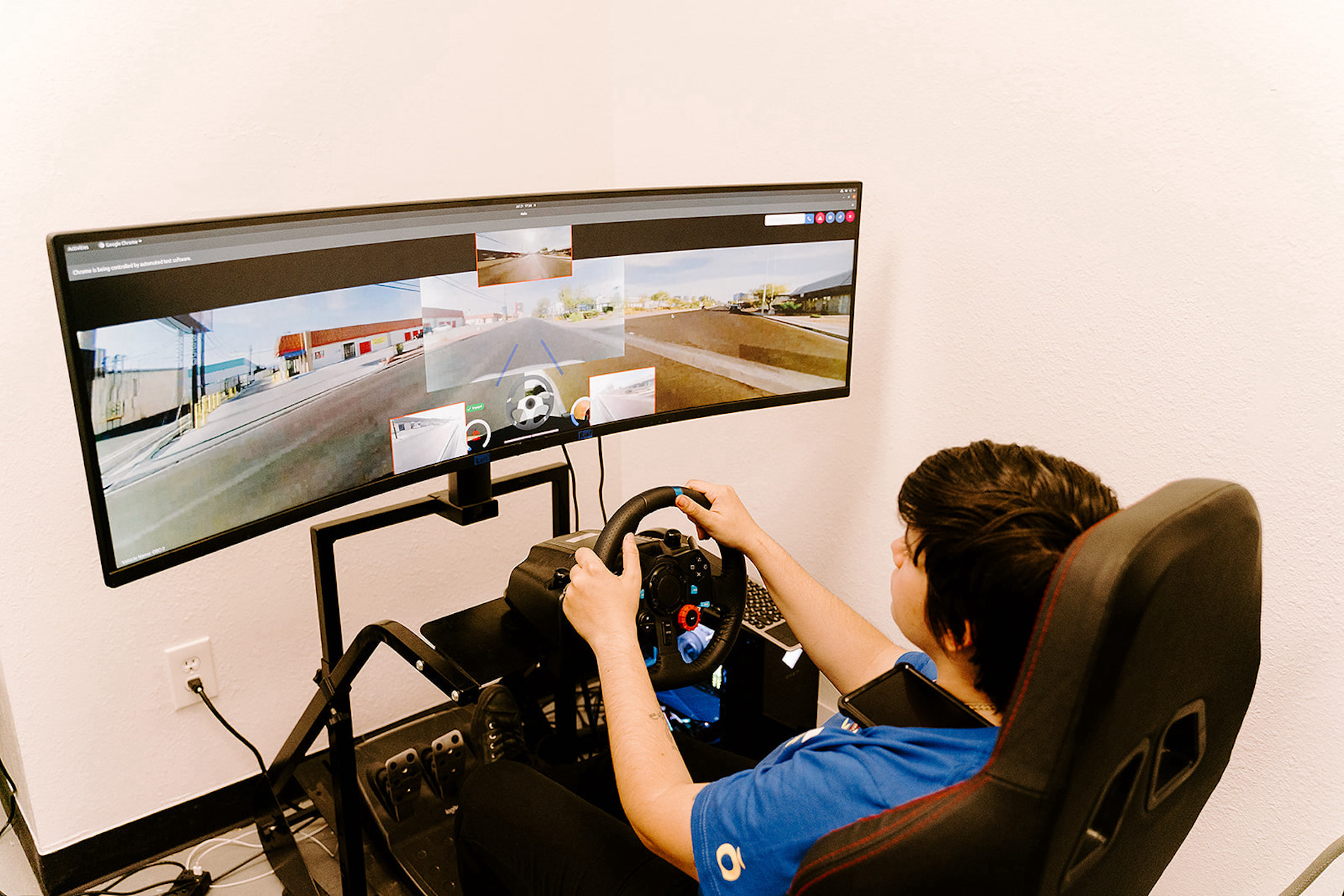
To handle human-free (sort-of) deployments Halo has built its own remote driving system. A person back at the office pilots a vehicle in a rig similar to what high-end iRig gamers use but with a real car at the other end that has a top speed of 25 miles per hour.
Navigating toward profitability
Self-driving vehicles have been the core of many failed endeavors. One of the largest disasters was when Uber invested heavily in the technology before eventually selling off its autonomous division to Aurora. Autonomous Ubers were supposed to be the path to profitability for the company. Instead, it proved too difficult and costly.
Halo CEO founder Anand Nandakumar is under no illusion that the tech is right around the corner.
“What I found was autonomous (technology) is going to take another 15 years to be commercially ready as a real, commercial-ready viable product,” Nandakumar told TechCrunch.
Delivering EVs to customers is less about showcasing what the company can do and more about streamlining the business over the long term. Currently, a driver handles about four to five in-person deliveries a day. Once these drivers go remote, that number jumps to 10 deliveries a day.
The idea is that Halo will lose money while delivering the vehicle, but then recoup those losses and more when the customer drives the car around for $12 an hour. That’s cheaper than offerings from Uber or Lyft and delivery times should be on par with those ride-hailing services.
By distributing its vehicles around a metropolitan area (in partnership with local authorities) Halo aims to deliver a car to a customer in six to seven minutes. After that, “the car is kept by the customer for several hours. So we make a good chunk of margin in the time the customer keeps the car,” Nandakumar said. At that point, the vehicle can be remotely navigated to where it’s needed next or deployed to a parking space.
In the future, to bring Halo even closer to ride-hailing services it hopes to introduce one-way rentals. Currently, all rentals are round trip. Delivery and pick-up happen in the same location. Picking up the vehicle in one spot and dropping it off at another means the customers don’t need to find parking. They can theoretically just get out of the car and let it drive off on its own.
“What we’re saying is people don’t mind driving their own cars,” Nandakumar said.

A fiscally sane new world
Halo is attempting to grow while avoiding some of the pitfalls — like runaway costs and parking restrictions — that have plagued other ride-hailing and car-sharing companies.
Nandakumar notes that the company has been running lean since its inception four years ago. They have a small crew and instead of expanding quickly, Halo has been laser-focused on making sure what they’re selling works well in Las Vegas. The remotely piloted vehicles will be deployed in downtown Vegas with a small fleet.
Nandakumar believes Halo can launch with a fleet that’s 1/10th the size of what a traditional car-sharing company needs. It’s also working closely with the city to secure parking spaces — a seemingly small but critical detail that has upended the ambitions of car-sharing companies in the other cities.
And don’t expect Halo to evolve into a self-driving ride-hailing service. The company’s revenue comes from customers driving the vehicle on their own. Nandakumar notes that a robotaxi business plan wouldn’t be profitable. Instead, the self-driving and remote-driving tech can be used to move the vehicles remotely around the city for optimal deployment.
The hardware and aftermarket
A quick ride in one of the company’s remotely piloted Kia Niro EVs is mostly uneventful. Sitting behind the wheel communicating with the actual driver in Las Vegas, Nandakumar only takes control once to navigate around a bollard. With a self-imposed top speed of 25 miles-per-hour for all remotely piloted vehicles, it’s a mostly very slow, very boring experience.
The EV itself is outfitted with six cameras mounted to the roof delivering a 360-degree view of the world. The front of the vehicle uses five cameras for a 210-degree view of the world. Essentially, the remote driver can see more of the world than the people inside the SUV.
Everything is bolted on including the antennas from three of the major cellular networks. The idea is to have network redundancy. If one connection goes dark, there are two more to fall back on. Halo has also partnered with T-Mobile to give the vehicles higher-priority access to the carrier’s network. This should — in theory — help keep the vehicles running during moments of high network usage.
Halo plans on adding the Chevy Bolt to the fleet. Of course, it’ll need to hurry since GM has decided to end production of that vehicle at the end of the year.
As for future vehicles, Nandakumar talks about adding EV pickups. Most people only need the hauling capability of a truck for a few hours, he mused. Why not offer them one that’s delivered to their house and then drives away after the trip to Home Depot?
What’s really interesting is that all these hardware additions to the vehicle can be removed. No wires are cut, and there’s no drilling involved. Essentially Halo’s EVs can be returned to their original condition without much fuss, allowing Halo to sell the vehicles when they’re done with them.
Another way in which Halo is being fiscally responsible in a highly volatile market. All of these car-related businesses have been a gamble. Halo’s approach is using what works now instead of waiting for what’s on the horizon. Plus, if you’re going to gamble on car-sharing, it might as well happen in Vegas.
Why Halo is betting on a remote-operated car-sharing service by Roberto Baldwin originally published on TechCrunch
Originally published at techcrunch.com