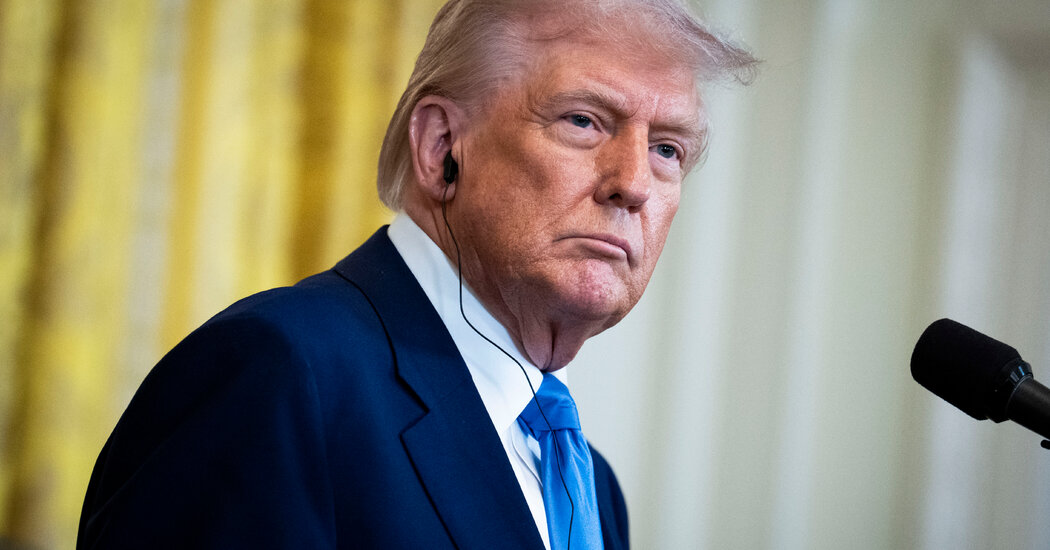

President Trump has issued an unremitting stream of tariff threats in his first month in office, accompanied by nearly as many reasons for why they should go into effect.
Tariffs on Canada, Mexico and China are a cudgel to force those countries, America’s largest trading partners, to crack down on the flow of drugs and migrants into the United States. Levies on steel, aluminum and copper are a way to protect domestic industries that are important to defense, while those on cars will prop up a critical base of manufacturing. A new system of “reciprocal” tariffs is envisioned as a way to stop America from being “ripped off” by the rest of the world.
Those goals are almost always followed by another reason for hitting allies and competitors alike with tariffs: “Long term, it’s going to make our country a fortune,” Mr. Trump said as he signed an executive order on reciprocal tariffs this month.
Mr. Trump maintains that tariffs will impose few, if any, costs on the United States and rake in huge sums of revenue that the government can use to pay for tax cuts and spending and even to balance the federal budget.
But trade experts point out that tariffs cannot simultaneously achieve all of the goals that Mr. Trump has expressed. In fact, many of his aims contradict and undermine one another.
For instance, if Mr. Trump’s tariffs prod companies to make more of their products in the United States, American consumers will buy fewer imported goods. As a result, tariffs would generate less revenue for the government.
Mr. Trump’s use of tariffs as leverage in international negotiations could also chip away at his rationale. If other countries meet his demands to crack down on border crossings, reduce drug flows or rectify other issues that he finds problematic, the president will be expected to drop his threat of tariffs. As a result, no additional revenue would be raised and companies would not have a reason to move production to the United States.
“All of these tariffs are internally inconsistent with each other,” said Chad Bown, a senior fellow at the Peterson Institute for International Economics, a Washington think tank. “So what is the real priority? Because you can’t have all those things happen at once.”
Treasury Secretary Scott Bessent said during his confirmation hearing in January that the president was deploying tariffs for several different reasons. He outlined three main goals: remedying unfair trade practices, raising revenue and encouraging other nations to negotiate on terms favorable to the United States.
Mr. Trump’s use of tariffs breaks with decades of precedent. The United States hadn’t seen tariffs proposed in this volume since nearly 100 years ago when the Smoot-Hawley Tariff Act raised tariffs on thousands of products and, historians argue, helped deepen the Great Depression, said William A. Reinsch, the Scholl Chair in International Business at the Center for Strategic and International Studies, a Washington think tank.
For Mr. Trump, tariffs have become an all-purpose tool, Mr. Reinsch said.
“It doesn’t matter what the crime is, the answer is tariffs,” he said.
Tariffs and Taxes
The conflicting rationales behind Mr. Trump’s tariffs are perhaps most important when it comes to revenue. The president has at times floated the idea of replacing income taxes with tariffs in order to fund the government.
Some House Republicans have cheered tariffs as a way to help pay for extending Mr. Trump’s 2017 tax cuts, which are expected to cost $4 trillion over a decade. One of the president’s first executive orders called for the creation of an External Revenue Service to take in money from tariffs, an agency that his commerce secretary has said should replace the Internal Revenue Service.

The I.R.S. collected $5.1 trillion in taxes last fiscal year, and both liberal and conservative economists have said replacing that amount with tariffs is mathematically impossible. The United States imported roughly $3.3 trillion worth of goods last year, so the average tariff on all U.S. imports would need to exceed 150 percent to cover the hole.
Such high duties would drastically raise prices for imports, likely prompting Americans to buy far fewer of them — reducing the revenue from the tariffs.
Mr. Bessent acknowledged this dynamic this month in an interview with Larry Kudlow on Fox Business, implying that tariffs would not be a reliable revenue source.
“In theory, tariffs would be a shrinking ice cube,” Mr. Bessent said. He added, “I think tariffs are a means to an end, and that end is bringing the manufacturing base back to the U.S.”
Mr. Trump said he planned to impose steep tariffs on Canada and Mexico because he wanted them to halt immigration and drug trafficking on their borders with the United States. He prepared to put the duties in place last month, before reaching an agreement to delay them, but Mr. Trump now says he will enforce them next week.
Both Canada and Mexico have been feverishly working to reach a deal on the border issues and delay the tariffs — a back-and-forth that could eventually mean the United States does not collect new import taxes.
“There’s tension between wanting to use tariffs for negotiation, getting other countries to lift their barriers and us lifting our barriers, and then wanting to have tariffs generate revenue,” Erica York, an analyst at the Tax Foundation, a think tank that generally favors lower taxes. “If you want revenue, some tariffs are going to have to be in place permanently.”
Mr. Trump’s arguments about using tariffs as a negotiating tool to force other countries to lower their own levies against the United States also seem to be creating confusion about whether his ultimate goal is to raise tariffs or lower them.
Free-traders within the Republican Party appear to be crossing their fingers that Mr. Trump will use tariffs to open up international markets rather than close them off — although, in practice, many countries have responded to them with retaliatory levies on U.S. exports.
Goals for the Economy
There are also potential contradictions between Mr. Trump’s plans for tariffs and his goal of igniting an economic boom that would lift American jobs and keep growth high and prices low.
On Thursday, as he met with the British prime minister, Mr. Trump praised tariffs for helping U.S. companies.
“We’re going to bring our car industry back,” he said. “We’re going to bring our chips back. We’re going to bring so many things back to our country, including pharmaceuticals and drugs. And the thing that’s going to get us there is tariffs.”
But many economists warn that tariffs can have negative effects on the economy, including raising prices for consumers and slowing growth. While Mr. Trump insists that foreign governments pay for tariffs, economic research has shown that American consumers often bear the brunt.
Other economic research has found that tariffs reduced U.S. manufacturing jobs overall, as some manufacturers faced higher input costs and as other countries pursued retaliatory tariffs.
“People are really underestimating the growth effect from tariffs,” said Tom Porcelli, chief U.S. economist at PGIM Fixed Income. “Tariffs are a tax, and you feel the effects of a tax.”
A Different Environment
Mr. Trump has experience with trade wars. During his first term, he threatened to impose tariffs on Mexican imports and to shut the border entirely, and imposed tariffs on nearly $400 billion of imported metals, solar panels and goods from China.
That uncertainty encouraged U.S. businesses to put expansion plans on hold and to cut spending on large investments. Inflation was less of a concern then for the Federal Reserve, given that consumer price growth was consistently below the central bank’s 2 percent target. The prospects of a weakening economy and scant inflation concerns compelled the Fed to lower interest rates by 0.75 percentage points in 2019.
This time, the U.S. economy is in solid shape, but there are signs that consumers are bracing for a less benign outcome. A survey released by the Conference Board this week showed that consumer sentiment fell sharply in February as expectations about future inflation rose. A similar picture is taking shape in a closely watched survey by the University of Michigan.
The combination of higher prices and slower growth has a “whiff of stagflation,” Mr. Porcelli said, warning that “the longer this uncertainty lingers, the greater the risk that you do see this deterioration.”
Mr. Trump has brushed off any criticisms about the economic impact of tariffs.
“WILL THERE BE SOME PAIN?” he wrote on social media in early February. “YES, MAYBE (AND MAYBE NOT!). BUT WE WILL MAKE AMERICA GREAT AGAIN, AND IT WILL ALL BE WORTH THE PRICE THAT MUST BE PAID.”