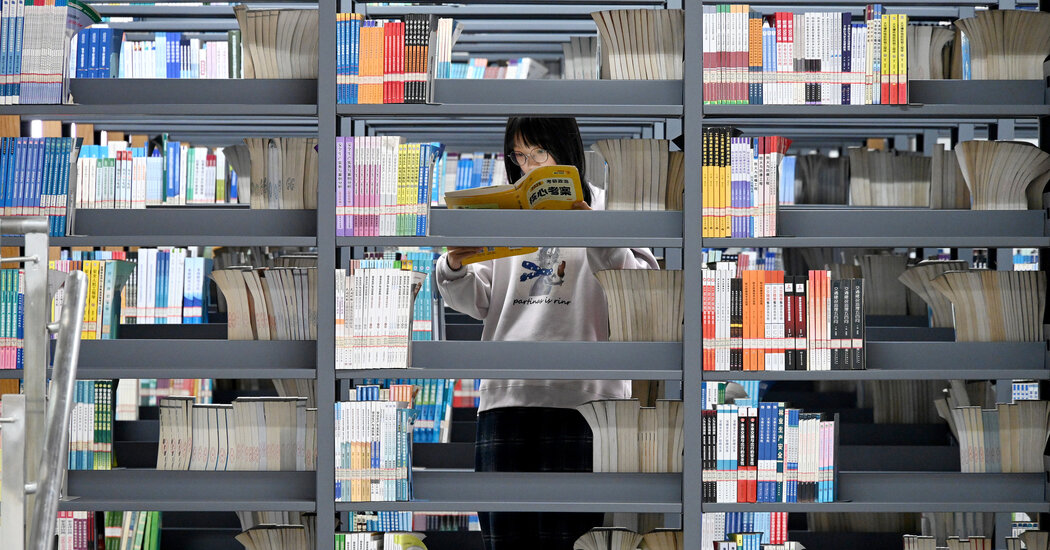

To many Chinese, DeepSeek’s success is a victory for China’s education system, proof that it equals that of the United States or has even surpassed it.
The core team of developers and scientists behind DeepSeek, the Chinese start-up that has jolted the A.I. world, all attended university in China, according to the company’s founder. That’s a contrast with many Chinese tech companies, which have often sought talent educated abroad.
As Chinese commenters online basked in Americans’ shocked reactions, some pointed to the high number of science Ph.D.s that China produces annually. “DeepSeek’s success proves that our education is awesome,” read one blog post’s headline.
Acclaim has even poured in from overseas. Pavel Durov, the founder of the messaging platform Telegram, said last month that fierce competition in Chinese schools had fueled the country’s successes in artificial intelligence. “If the U.S. doesn’t reform its education system, it risks ceding tech leadership to China,” he wrote online.
The reality is more complicated. Yes, China has invested heavily in education, especially in science and technology, which has helped nurture a significant pool of talent, key to its ambition of becoming a world leader in A.I. by 2023.
But outside of the classroom, those graduates must also contend with obstacles that include a grinding corporate culture and the political whims of the ruling Communist Party. Under its current top leader, Xi Jinping, the party has emphasized control, rather than economic growth, and has been willing to crack down on tech firms it deems too influential.
DeepSeek has managed to evade many of those pressures, in part because it kept a low profile and its founder declared his commitment to intellectual exploration, rather than quick profits. It remains to be seen, though, how long it can continue doing so.
“There are many young, energetic and talented researchers and engineers inside China. I don’t think there’s a big gap in terms of education between China and the U.S. in that perspective, especially in A.I.,” said Yiran Chen, a professor of electrical and computer engineering at Duke University. “But the constraint is really from other parts.”
For many in China, the strength of its education system is closely tied to the nation’s global status. The government has invested heavily in higher education, and the number of university graduates each year, once minuscule, has grown more than 14-fold in the past two decades. Several Chinese universities now rank among the world’s best. Still, for decades, China’s best and brightest students have gone abroad, and many have stayed there.
By some metrics, that is starting to change.
China produced more than four times as many STEM graduates in 2020 as the United States. Specifically in A.I., it has added more than 2,300 undergraduate programs since 2018, according to research by MacroPolo, a Chicago-based research group that studies China.
By 2022, nearly half of the world’s top A.I. researchers came from Chinese undergraduate institutions, as opposed to about 18 percent from American ones, MacroPolo found. And while the majority of those top researchers still work in the United States, a growing number are working in China.
“You’re churning out all this talent over the last few years. They’ve got to go somewhere,” said Damien Ma, MacroPolo’s founder.
Washington has also made it harder for Chinese students in certain fields, including A.I., to obtain visas to the United States, citing national security concerns.

“If they’re not going to go abroad, they’re going to start some company” or work for a Chinese one, Mr. Ma said.
Some have criticized China’s educational system as overly exam-oriented and stifling to creativity and innovation. The expansion of China’s A.I. education has been uneven, and not every program is producing top-tier talent, Mr. Ma acknowledged. But China’s top schools, such as Tsinghua University and Peking University, are world-class; many of DeepSeek’s employees studied there.
The Chinese government has also helped foster more robust ties between academia and enterprises than in the West, said Marina Zhang, a professor at the University of Technology Sydney who studies Chinese innovation. It has poured money into research projects and encouraged academics to contribute to national A.I. initiatives.
Yet government involvement is also one of the biggest potential threats to Chinese innovation.
Beijing has blessed the A.I. sector — for now. But in 2020, after deciding that it had too little control over major companies like Alibaba, it launched a sweeping, yearslong crackdown on the Chinese tech industry. (DeepSeek’s founder, Liang Wenfeng, pivoted to A.I. from his previous focus on speculative trading, in part because of a separate government crackdown there.)
The resulting layoffs at tech companies, combined with the uncertainty of the sector’s future, helped diminish the appeal of a sector that once attracted many of China’s top students. Record numbers of young people have opted instead to compete for civil service jobs, which are low-paying but stable.
A.I. has been somewhat shielded from the brain drain so far, in part because of its political imprimatur, said Yanbo Wang, a professor at the University of Hong Kong who studies China’s tech entrepreneurship. He added that he expected more successful Chinese A.I. start-ups to emerge soon, driven by young people. But it is impossible to say what China’s A.I. landscape would have looked like if Beijing had been more tolerant toward big tech companies in recent years, he added.
“China’s long-term A.I. competitiveness hinges not only on its STEM education system, but also on its handling of private investors, entrepreneurs and for-profit companies,” he added.
Even within private companies, employees often must contend with a focus on quick results. That has led to a widely accepted stereotype, including within China, that Chinese engineers are better at improving on other people’s innovations than at coming up with their own.
Mr. Liang, DeepSeek’s founder, has lamented as much, noting last year that “top talents in China are underestimated. Because there’s so little hard-core innovation happening at the societal level, they don’t have the opportunity to be recognized.”
DeepSeek’s success may hinge as much on how it differed from other Chinese tech companies as on how it shared their strengths. It was financed by the profits from its parent hedge fund. And Mr. Liang has described hiring humanities graduates in addition to computer scientists, in the spirit of fostering a freewheeling intellectual atmosphere.
Since DeepSeek’s breakout success, some voices have urged more Chinese firms to emulate its model. An online commentary from the Communist Party committee of Zhejiang Province, where DeepSeek has its headquarters, declared the need to “trust in young talent” and give leading companies “greater control over innovation resources.”
But the best way for China to capitalize on its well-educated, ambitious A.I. work force may be for the government to get out of the way.
“Innovation requires as little intervention and management as possible,” Mr. Liang said in another interview. “Innovation often comes by itself, not as something deliberately planned, let alone taught.”
Siyi Zhao contributed research.