

An AI agent doesn’t just respond to customers; it resolves their problems independently, without human involvement.
About one-third of service calls are already handled by AI, according to Salesforce’s November 2025 State of Service report, and that number will hit 50% by 2027. But what percentage of those calls are–or could be–resolved by AI without human intervention? That is an entirely different question.
AI agents are no longer just for enterprise. SMBs are adopting them to reduce costs, handle volume, and compete with larger players on service quality.
This guide is for the SMB owner or operator evaluating these tools for the first time.
What Is an Agentic AI Agent for Customer Service?
Originally, AI agents were non-agentic, similar to chatbots and AI-powered support platforms. But the term gets used loosely, and the differences matter when you’re deciding what to buy:
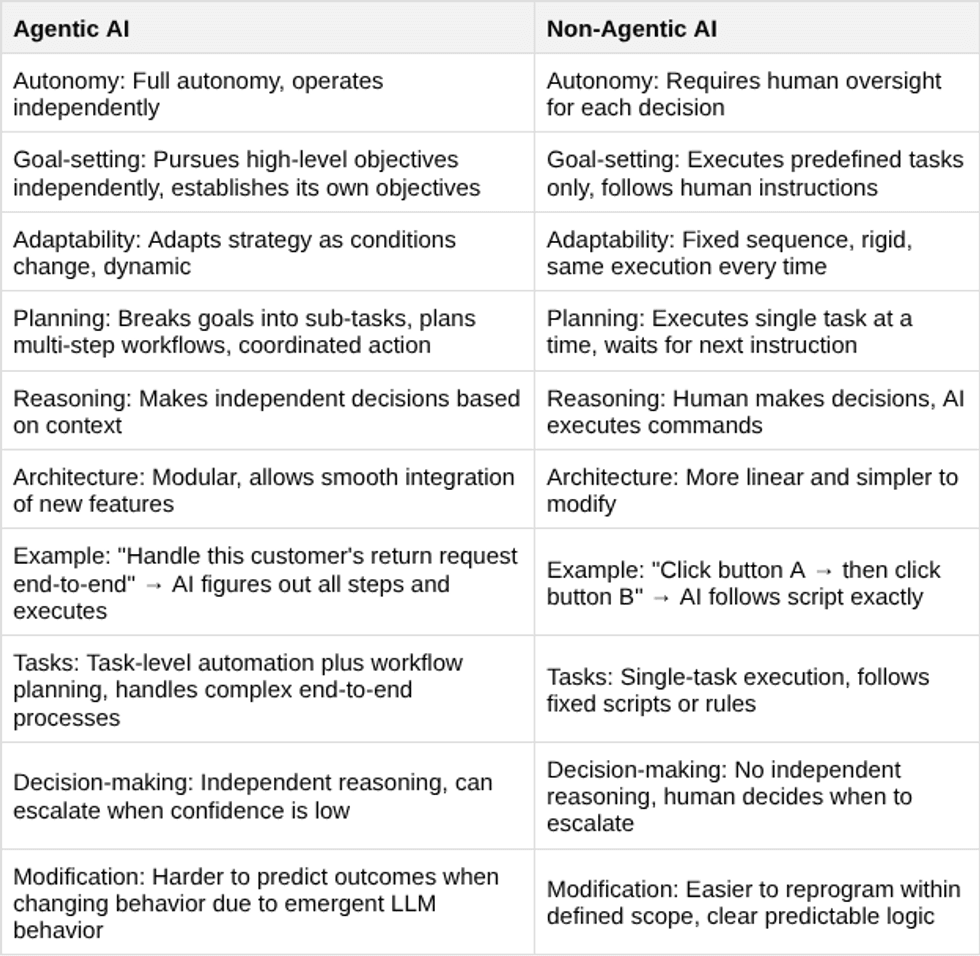
Differences Between Chatbots, AI-powered Support Platforms, and AI Agents
The term “AI agent” has a precise meaning in the industry, but you would not know it from browsing the market. True AI agents can reason through problems, take independent action, and complete multi-step tasks without a human directing each move.
Most of what gets sold under that label cannot do any of that. Instead, it is AI-powered customer service software, which can be genuinely useful, but it is not the same thing.
The distinction matters because if you search for “AI agent” and buy the first thing that comes up, there is a good chance you are buying something far less capable than the name implies.
This table explains the differences:
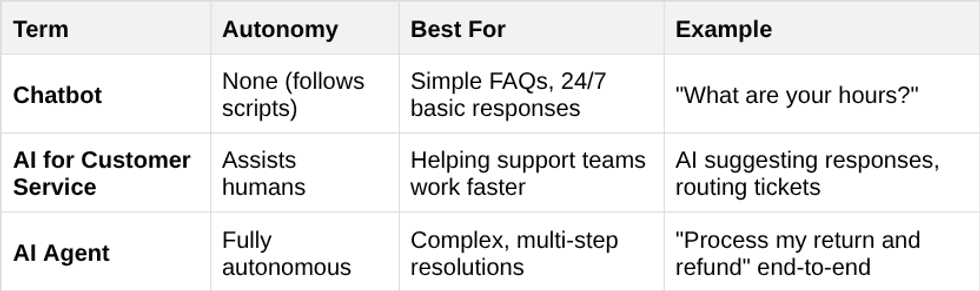
True AI agents typically cost 2-3x more than a chatbot, but a chatbot that can’t resolve the issue just moves the cost to your support team.
Why SMBs Are Adopting AI Agents Now
Two-thirds of businesses that have already adopted AI agents report measurable productivity gains, according to PwC’s AI Agent Survey. More than half say they’re seeing real cost savings and faster decision-making. And 54% credit AI agents with improving the customer experience.
Customers today expect fast answers wherever they reach out, whether that’s chat, email, or social. Hiring enough staff to cover all those channels around the clock isn’t realistic for most small businesses. Basic chatbots are affordable, but anyone who’s used one knows how quickly they hit a wall. AI agents are a different thing entirely. They can handle complex, multi-step conversations across channels without the overhead of a full support team.

Nearly three-quarters of executives surveyed expect their AI agent strategy to be a significant competitive advantage within the next 12 months, and 46% are already worried they’re falling behind. That’s not just enterprises competing with other enterprises. SMBs are going to feel this too, competing with other SMBs who move faster.
What to Look for When Choosing an AI Agent Platform
Knowing AI agents deliver results is one thing. Choosing the right platform is where most SMBs get stuck. Not all AI agent platforms are built the same, and the wrong choice can mean paying for capability you can’t use or getting locked into something you’ll outgrow. These six factors are worth evaluating before you commit to any platform:
1. Resolution Capability
The most important question to ask any vendor is whether their agent actually resolves issues or just routes them. Triaging a customer inquiry and handing it off to a human likely isn’t much of an upgrade over what you already have.
Look for platforms with documented resolution rates across real customer interactions, not just demo scenarios. That track record is the clearest signal of whether the AI is actually doing the work.
2. Omnichannel Support
Your customers aren’t reaching out through one channel, and your AI agent shouldn’t be limited to one either. A platform that handles chat but not email, or email but not voice, creates gaps that fall on your team to cover.
The goal is a single platform managing every channel consistently, so customers get the same quality of response whether they text, call, email, or open a chat window.
3. Ease of Use for Non-Technical Teams
If your support team needs to file a ticket with engineering every time they want to update the agent, the platform is going to create friction fast. The best platforms let support leaders configure, adjust, and retrain the agent themselves. That independence matters, especially for SMBs, where engineering resources are limited and support needs change quickly.
4. Integration with Existing Tools
An AI agent that can’t talk to your CRM, helpdesk, or knowledge base is working blind. It needs access to customer history, open tickets, and your existing documentation to give accurate, useful responses. Before committing to any platform, map out which tools it needs to connect to and verify those integrations exist and actually work, not just that they’re listed on a features page.
5. Responsible AI and Governance
This one gets skipped more than it should, especially by SMBs. If your agent is handling customer data, billing questions, or anything sensitive, you need to know how it makes decisions and where humans provide oversight. Look for platforms with clear oversight controls, visibility into the agent’s reasoning, and relevant compliance certifications. A governance failure isn’t just a technical problem, it’s a customer trust problem.
6. Scalability
The platform that fits your business today needs to fit even when you’ve doubled your support volume or expanded into new channels. Switching platforms mid-growth is expensive and disruptive. Ask vendors directly how their pricing and architecture scale, and look for case studies from businesses that started where you are now.
Platforms Worth Considering
These platforms specifically describe their offerings as agentic, meaning they can act autonomously rather than just assist humans. Here’s what to know about each:
Zendesk
Zendesk AI for customer service deploys AI agents that handle customer requests end-to-end across every channel while giving human agents real-time access to relevant knowledge for the conversations they do handle. It’s one of the more established platforms on this list, which shows in its governance approach. Zendesk holds ISO 42001 certification for AI management systems with clear transparency and human oversight controls, making it a good fit for SMBs that need enterprise-grade reliability without the infrastructure to match.
Tidio Lyro
Lyro Conversational AI Agent sits in a useful middle ground, more capable than basic automation, less complex than enterprise platforms. It handles customer conversations across chat, email, and social media while taking real action in your business systems, checking order statuses, updating customer records, scheduling appointments, and escalating to a human when needed. Every response is grounded in your verified support content to keep answers accurate. Lyro is designed for SMBs that want true agentic capability without enterprise-level complexity or cost.
Fin (formerly Intercom)
Fin AI Customer Agent handles more than half of all customer questions without human intervention, pulling answers from your internal content, websites, PDFs, and databases across 45 languages. What sets it apart is how deeply it connects to existing business systems. It can retrieve and update customer data, process account changes, and take action directly within Salesforce, HubSpot, and Freshdesk. For SMBs already running those tools, that level of integration means the agent isn’t just answering questions, it’s actually taking action.
Gorgias
AI Agent Gorgias is built specifically for ecommerce brands, which makes it a different kind of tool than the others on this list. It handles the full range of ecommerce support, including order status, returns, and shipping updates, while also functioning as a shopping assistant that can recommend products during the conversation. It resolves around 60% of inquiries autonomously, supports 80+ languages, and integrates directly with Shopify and other ecommerce platforms to access real-time order and inventory data. If your business sells online, it’s worth a close look.
Freshdesk
Freddy AI Agent is Freshworks’ autonomous customer support and IT service agent, handling questions across Freshdesk, Freshservice, and Freshchat from a single platform. It manages the full support process without human intervention, working across email, chat, voice, and messaging. The flexibility to build custom agents for specific use cases makes it a practical fit for mid-sized SMBs that have outgrown basic automation but aren’t ready for enterprise complexity. If your business is already in the Freshworks ecosystem, the integration is seamless.
Questions to Ask Before You Buy
Here are some questions an SMB decision-maker should ask any vendor before signing:
- What is the average resolution rate?
- How are agents updated when your products or policies change?
- What governance controls are in place?
- How long does it take to set up and train the AI on my business?
- What happens when the AI can’t answer a question or gets stuck?
- How much does it cost per conversation or per resolved ticket?
- Can I see real customer data from companies similar to mine?
- What integrations do you have with my existing tools?
- How do you handle customer data privacy and security?
Getting Started: A Simple Path to First AI Agent Deployment
Choosing the right AI agent isn’t about picking the most advanced technology. It’s about finding a platform that resolves customer issues reliably, scales with your business, and operates with the transparency and accountability your customers expect.
Start With Low-Stakes Interactions
The smartest way to start is narrow. Pick one high-volume, low-complexity use case, like order status questions, password resets, or basic account inquiries. These are interactions your team handles dozens or hundreds of times a week, the answers don’t change much, and a failed response doesn’t put a customer relationship at serious risk.
Set Your Baseline Measurements First
Before you go live, define what success looks like in concrete terms: resolution rate, average handle time, customer satisfaction score, escalation rate. Pick one or two metrics that matter to your business and measure them before and after.
From there, adding a channel or a more complex use case is a much easier internal sell than asking leadership to approve an unproven investment. The businesses that get AI agents right aren’t the ones who launched with the most sophisticated setup. They’re the ones who started somewhere specific.
Customers Notice When Problems Actually Get Resolved
By 2027, AI will handle half of all service calls. What matters for your business is whether those interactions actually resolve your customers’ problems. That’s what agentic AI agents are built to do.