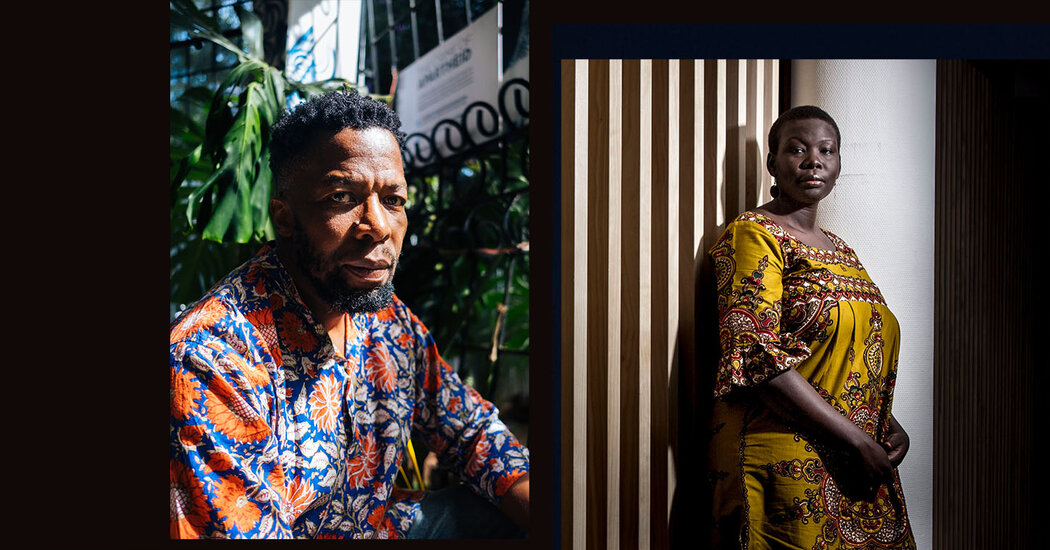

As a queer teenager growing up in northern Nigeria, Arinze Ifeakandu often found himself searching for books that reflected what he felt.
He combed through the books at home and imagined closer bonds between the same-sex characters. He scoured the book stands in Kano, the city where he lived, hoping to find stories that focused on L.G.B.T.Q. lives. Later, in furtive visits to internet cafes, he came across gay romance stories, but they often focused on lives far from his own, featuring closeted white jocks living in snowy towns.
Ifeakandu wanted more. After college, he began writing short stories in which gay men battled loneliness but also found lust and love in conservative, modern-day Nigeria.
“I have always taken my own desires, my own fears, my own joys seriously,” Ifeakandu, 29, said. “I knew I wanted to write characters who are queer. That’s the only way I am going to show up on the page.”
His stories gained traction with readers, and with critics. In 2017, he became a finalist for the Caine Prize for African Writing, and last year, his debut collection, “God’s Children Are Little Broken Things,” won the Dylan Thomas Prize for young writers.
Ifeakandu’s work is part of a boom in books by L.G.B.T.Q. writers across Africa. Long obscured in literature and public life, their stories are taking center stage in works that are pushing boundaries across the continent — and winning rave reviews.
Big publishing houses in Europe and the United States are getting in on the action, but so are new publishers cropping up across the continent with the goal of publishing African writers for a primarily African audience.
Thabiso Mahlape, who founded Blackbird Books in South Africa, has published Nakhane, a queer writer and artist, and “Exhale,” a queer anthology. “So much more can be done,” she said.
The gathering momentum dovetails with a broader cultural moment. More Africans are openly discussing sex and expressing their sexual and gender identities. Small Pride marches and film festivals are celebrating queer experiences, and some African religious leaders are speaking up in support of L.G.B.T.Q. people.
Young people, who make up the majority of the continent’s population, are turning to social media to discuss these books, and the big screen is bringing some of them to a wider readership: “Jambula Tree,” a short story by Uganda’s Monica Arac de Nyeko about the romance between two girls, inspired “Rafiki,” a film that was featured in Cannes.
The books — fiction, nonfiction and graphic novels — are also being published as a way to push back against virulent homophobia and anti-gay legislation across Africa.
By writing them, authors say they hope to engage readers and challenge pervasive notions that homosexuality is a Western import.
“These books are an invitation to change mindsets and to start a dialogue,” said Kevin Mwachiro, who coedited “We’ve Been Here,” a nonfiction anthology about queer Kenyans who are 50 or older.
“These books are saying, ‘I am not a victim anymore,’” he said. “It’s gay people saying, ‘We don’t want to be tolerated. We want respect.’”

The momentum is new, but books centering queer stories are not without precedent in Africa.
Mohamed Choukri’s 1972 novel “For Bread Alone” caused a furor in Morocco for its depiction of same-sex intimacy and drug consumption. The mesmerizing 2010 novel “In A Strange Room,” by the South African Booker Prize winner Damon Galgut, followed an itinerant gay protagonist. And the Kenyan author Binyavanga Wainaina made global headlines in 2014 when he published a “lost chapter” of his memoir titled “I am a homosexual, mum.”
But the books being published now, literary experts and publishers say, are expanding Africa’s literary canon. These stories — family sagas, thrillers, sci-fi and more — dive into the complexities of being queer in Africa and in the diaspora.
Their writers interrogate the silence surrounding queer culture in their own communities (“Love Offers No Safety,” edited by Jude Dibia and Olumide F Makanjuola) and the hope and heartache of being trans or gender fluid (Akwaeke Emezi’s “The Death of Vivek Oji”), intersex (Buki Papillon’s “An Ordinary Wonder”) or lesbian (Trifonia Melibea Obono’s “La Bastarda.”)
They look into the intersection of politics, religion and sex (“You Have to Be Gay to Know God” by Siya Khumalo) and the vicissitudes of the secretive gay scene in a bustling metropolis (“No One Dies Yet” by Kobby Ben Ben.)
The books also explore the awkward and difficult process of coming out to conservative parents (Uzodinma Iweala’s “Speak No Evil”) and imagine entire families whose members are on the L.G.B.T.Q. continuum (“The Butterfly Jungle” by Diriye Osman). “More Than Words,” a 2023 illustrated book from the Kenyan creative collective The Nest, looks at the everyday life of gay Africans through sci-fi and fan fiction.
The authors often use works of fiction to imagine bold new worlds.
The Nigerian American writer Chinelo Okparanta focuses on the coming-of-age story of a young woman during Nigeria’s Biafra Civil War in her 2015 novel “Under the Udala Trees.” The book’s protagonist, Ijeoma, meets Ndidi after finishing school. Together, they attend secret lesbian parties in a church, explore sexual pleasure and even talk about getting married.
Growing up, Okparanta said she read “So Long A Letter,” a 1979 epistolary novel by the Senegalese writer Mariama Bâ in which a widow writes to her longtime friend, and found herself imagining “a world where there might be more to the women’s relationship,” she said. “I must have been hungry for an African novel with a story like that.”
“Under the Udala Trees” ends on a hopeful note: Ijeoma’s mother accepts her and she and Ndidi end up together after her marriage to a man falls apart. Ndidi even imagines a Nigeria safe for gay people — a powerful statement, given that the book was published a year after Nigeria’s former leader signed a punitive anti-gay law.
“There needs to be room for people to have hope,” Okparanta said.
Nonfiction authors, too, are sharing their experiences of love and dating, of navigating hostile workplaces and of facing rejection from their own kin and finding what they call their “chosen” families. Even when they prioritize confession and catharsis, some of the books also aim to give a window into the lives of gay people on the continent.
“Sometimes people think we are just freaks having sex with each other and that there’s no love, there’s no desire, there’s no sensuality,” said Chiké Frankie Edozien, whose memoir “Lives of Great Men: Living and Loving as an African Gay Man” won a Lambda Award.
“I wanted truth and honesty and vulnerability,” he said.
Like Edozien, who lives in the Ghanaian capital, Accra, with frequent stays in New York, some queer African writers have relocated or established their careers in the West, and use their work to explore not only the communities they left behind but also those they live in.
These include Abdellah Taïa, the Paris-based writer originally from Morocco who is often considered the first openly gay Arab writer and filmmaker. Taïa has written nine novels that probe what it means to be Muslim, queer, Arab and African. He has also made two films: “Salvation Army,” which is adapted from his eponymous novel, and “Never Stop Shouting,” which addresses his gay nephew.
But Taïa’s work has also focused on France and Europe and the anti-migrant and anti-Muslim sentiments that have sprung there.
“If you are gay, and only thinking about gay liberation and only about that, it means you understand nothing about how the world is functioning,” Taïa said. “I am not totally free because other people are not free.”
For many of these authors, publishing has brought public recognition and even appreciation. But some have faced harassment or even death threats.
Edozien hopes the books will inspire younger generations to read a “dignified and balanced” portrayal of gay Africans.
“Books are really powerful, books are really intimate,” Edozien said. And having these queer-centered stories in “libraries for decades to come is great, because the needle has been moved even when it doesn’t feel like it.”
Ifeakandu dreams of a future where queer-centered African stories are no longer the exception to the rule.
“I didn’t choose the country I was born into, just as much as I didn’t choose my sexuality,” Ifeakandu said. “Grudgingly, hopefully, we’re going to stand up.”