
In the stock market, all is not quite as it seems.
A slowdown in inflation has boosted investor confidence in the economy this year and, combined with an intense fervor for artificial intelligence, provided the backdrop to a rally that has beaten all expectations.
The S&P 500 climbed about 15 percent in the first half of 2024, rising further into record territory.
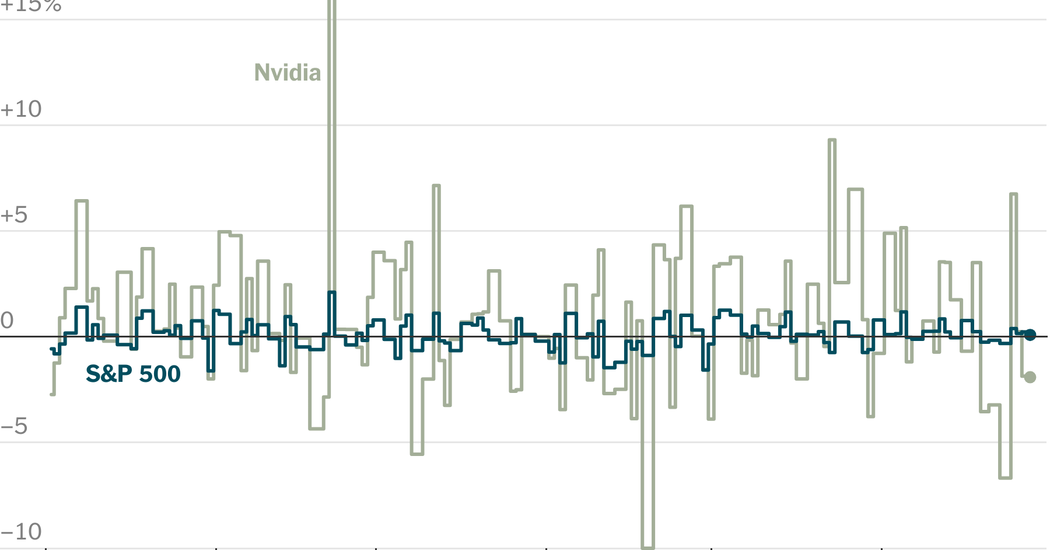
The gains have been remarkably steady, with the index only once rising or falling more than 2 percent in a single day. (It rose.) A widely tracked measure of bets on more volatility to come is close to its lowest-ever level.
But a look beneath the surface reveals much greater turbulence. Nvidia, for example, whose rising stock price helped it become the most valuable public company in America last week, is up more than 150 percent this year. The price has also repeatedly had deep plunges in the last six months, shaving billions of dollars of market value each time.
More than 200 companies, or roughly 40 percent of the stocks in the index, are at least 10 percent below their highest level of this year. Almost 300 companies, or roughly 60 percent of the index, are more than 10 percent above their low for the year. And each group includes 65 companies that have actually swung both ways.
Traders say this lack of correlated movement — known as dispersion — among individual stocks is at historic extremes, undermining the idea that markets have been blanketed by tranquillity.
One measure of this, an index from the exchange operator Cboe Global Markets, shows that dispersion rose after the coronavirus pandemic, as tech stocks soared while shares of other companies suffered. It has stayed high, in part because of the staggering appreciation of a select few stocks on A.I.’s cutting edge, analysts say.
This is presenting an opportunity for Wall Street, as investment funds and trading desks pile into dispersion trading, a strategy that typically uses derivatives to bet that index volatility will remain low while turbulence in individual stocks will stay high.
“It’s everywhere,” said Stephen Crewe, a longtime dispersion trader and partner at Fulcrum Asset Management. He believes these dynamics have surpassed even the most hotly anticipated economic data in terms of their importance to financial markets. “It almost doesn’t matter about G.D.P. or inflation data at the moment,” he added.
The risk to investors is that stocks will again begin to move in the same direction, all at once — most likely because of a spark that ignites widespread selling. When that happens, some fear, the role of complex volatility trades could reverse and, rather than dampen the appearance of turbulence, exacerbate it.
The dispersion trade.
Estimating the total size of this type of trading is challenging even for those embedded in the market, in part because there are multiple ways to make such a bet. Even in its most basic form, dispersion trading can include several different financial products that are bought and sold for multiple other reasons, too.
Just how big is it? “That’s a million-dollar question,” Mr. Crewe said.
But there are some clues. The options market has ballooned — the number of contracts traded is set to exceed 12 billion this year, according to Cboe, up from 7.5 billion in 2020 — and while there have always been specialists with wonky derivatives strategies, now more mainstream fund managers are said to be piling in.

Assets in mutual funds and exchange-traded funds that trade options, including trading dispersion, swelled to more than $80 billion this year, from around $20 billion at the end of 2019, according to Morningstar Direct. And bankers who are offering clients a way to replicate sophisticated trades, but without the specialist knowledge, say they’ve seen a groundswell of interest in dispersion trading.
But though its scope can’t be fully known, this perceived influx of funds has raised comparisons to the last time volatility trading became popular, in the years leading up to 2018.
Back then, investors had crowded into options and leveraged exchange-traded products that boasted big returns in muted markets but were highly susceptible to sharp sell-offs that increase volatility. These trades were explicitly “short volatility,” meaning they benefited when volatility fell but lost heavily when the market became turbulent.
So when calm markets suddenly erupted and the S&P 500 fell 4.1 percent in one day in February 2018, some funds were wiped out.
While that dynamic persists, analysts say that it is much less significant and that the advent of popular dispersion strategies is fundamentally different.
Because the trade seeks to profit from the difference between low index volatility and sizable swings in single stocks, even in a violent sell-off the result is usually more balanced, with one part likely to increase in value while the other decreases.
But even this generalization is dependent on how the trade was executed, and there are circumstances that could still run investors into trouble. That potential outcome is part of the reason dispersion trading is getting so much attention at the moment — all could be fine, but it is very hard to know for sure, and what if it isn’t?
“The firewood is very, very dry,” said Matt Smith, a fund manager at Ruffer, a London-based asset manager. “And there is a lot going on in the world, so the weather is hot.”
The unwind could be ugly.
Crucially, the very biggest companies in the market are also dispersed. Microsoft, a beneficiary of A.I. enthusiasm, has risen 20 percent this year. Tesla has fallen 20 percent. Nvidia remains the outlier, with staggering gains.
So even on a day like Monday, when Nvidia slumped 6.7 percent, the S&P 500 dropped only 0.3 percent. The broad index was buttressed by other stocks, especially other mammoth technology companies like Microsoft and Alphabet.
Calm seemed to prevail, despite the sharp drop in one of the index’s biggest components.
When the very large stocks all start to tumble in concert, as they did in 2022, the result could be painful. Dispersion trading could make it all worse.
If volatility of the S&P 500 is jolted higher because a stock like Nvidia tumbles, but the damage is contained to tech or A.I. specific sectors, an asymmetric outcome would punish many dispersion trades, according to industry specialists. The losses could spiral as traders looking to cut their losses make trades that exacerbate the volatility.
This possibility is hypothetical. Nvidia has yet to sate demand for its chips, and its earnings continue to skyrocket. Dispersion could continue for some time given these unusual market dynamics, said bankers and traders.
But for some specialist investors more experienced with the complexities of trading dispersion, the trade has lost its luster as it has been pushed to ever more extreme levels.
Naren Karanam, one of the largest dispersion traders in the market, who plies his trade at the hedge fund Millennium Management, has scaled back his activity, seeing less opportunity for profit, people with knowledge of his decision said. A rival hedge fund, Citadel, lost its head dispersion trader in January and opted not to replace the person.
Even some who remain in the market say the extreme current dynamic, with volatility at the index level so low and the dispersion of individual stocks so high, leaves them with little appetite to increase their trading. Others have begun taking the opposite side of the trade, hedging themselves against a tumultuous sell-off.
“Dispersion can’t go much higher, and volatility can’t go much lower,” said Henry Schwartz, global head of client engagement at Cboe. “There is a limit.”