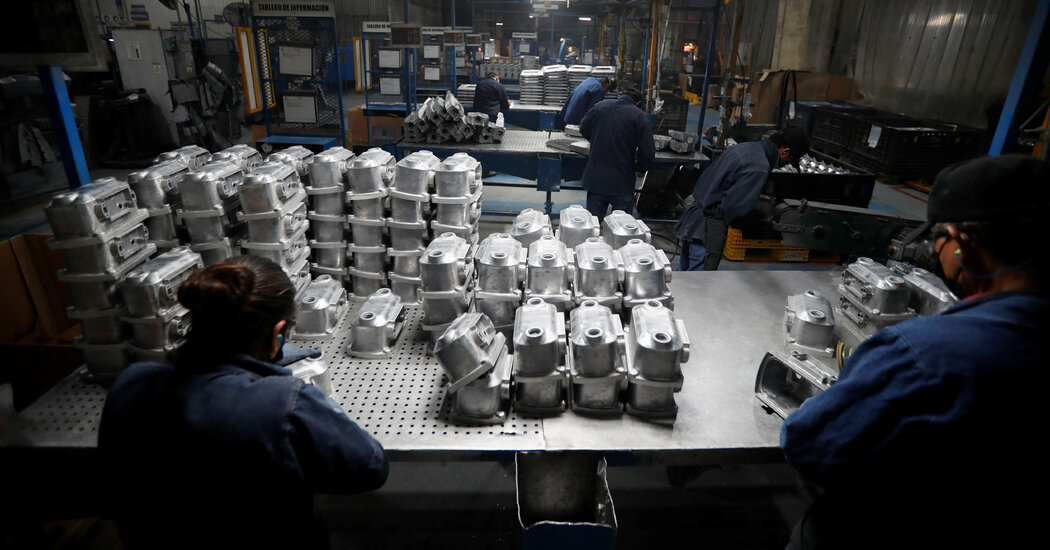

In the depths of the pandemic, as global supply chains buckled and the cost of shipping a container to China soared nearly twentyfold, Marco Villarreal spied an opportunity.
In 2021, Mr. Villarreal resigned as Caterpillar’s director general in Mexico and began nurturing ties with companies looking to shift manufacturing from China to Mexico. He found a client in Hisun, a Chinese producer of all-terrain vehicles, which hired Mr. Villarreal to establish a $152 million manufacturing site in Saltillo, an industrial hub in northern Mexico.
Mr. Villarreal said foreign companies, particularly those seeking to sell within North America, saw Mexico as a viable alternative to China for several reasons, including the simmering trade tensions between the United States and China.
“The stars are aligning for Mexico,” he said.
New data released on Wednesday showed that Mexico outpaced China to become America’s top source of official imports — a significant shift that highlights how increased tensions between Washington and Beijing are altering trade flows.
The United States’ trade deficit with China narrowed last year, with goods imports from the country dropping 20 percent to $427.2 billion, the data shows. American consumers and businesses turned to Mexico, Europe, South Korea, India, Canada and Vietnam for auto parts, shoes, toys and raw materials.
Mexican exports to the United States were roughly the same as last year, at $323.2 billion.
America’s total trade deficit, which consists of exports minus imports, narrowed 18.7 percent to $177.8 billion. Overall U.S. exports to the world increased slightly in 2023 from the previous year, despite a strong dollar and a soft global economy.
U.S. imports fell annually as Americans bought less crude oil and chemicals and fewer consumer goods, including cellphones, clothes, camping gear, toys and furniture.
The recent weakness in imports, and drop-off in trade with China, has partially been a reflection of the pandemic. American consumers stuck at home during the pandemic snapped up Chinese-made laptops, toys, Covid tests, athleisure, furniture and home exercise equipment.
Even as concerns about the coronavirus faded in 2022, the United States continued to import a lot of Chinese products, as bottlenecks at congested U.S. ports finally cleared and businesses restocked their warehouses.
“The world couldn’t get access to enough Chinese goods in ’21, and it gorged on Chinese goods in ’22,” said Brad Setser, an economist and senior fellow at the Council on Foreign Relations. “Everything has been normalizing since then.”
But beyond the unusual swings in annual patterns in the last few years, trade data is beginning to provide compelling evidence that years of heightened tensions have significantly chipped away at America’s trading relationship with China.
In 2023, U.S. quarterly imports from China were at roughly the same level as they were 10 years ago, despite a decade of growth in the American economy and rising U.S. imports from elsewhere in the world.

“We are decoupling, and that’s weighing heavily on trade flows,” Mark Zandi, the chief economist of Moody’s Analytics, said of the United States and China.
Economists say the relative decrease in trade with China is clearly linked to the tariffs imposed by the Trump administration and then maintained by the Biden administration.
Research by Caroline Freund, the dean of the University of California at San Diego’s School of Global Policy and Strategy, showed that trade with China fell for products that have high tariffs, like screwdrivers and smoke detectors, while trade in products that do not have tariffs, like hair dryers and microwave ovens, continued to grow.
Ralph Ossa, the chief economist for the World Trade Organization, said that trade between the United States and China had not collapsed, but that it had been growing about 30 percent more slowly than trade between those countries and the rest of the world.
There were two episodes in recent history where U.S. trade with China slowed notably, he said. The first was when trade tensions between the countries escalated in 2018. The second was when Russia invaded Ukraine, prompting the United States and its allies to impose strict sanctions and further reshuffling global trade relationships.
“There was a period where geopolitics didn’t really matter for trade much, but as uncertainty increases in the world, we do see that trade becomes more sensitive to these positions,” said Stela Rubinova, a research economist at the World Trade Organization.
Some economists caution that the U.S. reduction in trade with China might not be as sharp as bilateral data shows. That is because like Hisun, the Chinese vehicle producer, some multinationals have shifted portions of their manufacturing out of China and into other countries but continued sourcing some raw materials and parts from China.
In other cases, companies may simply be routing goods that are actually made in China through other countries to avoid U.S. tariffs.
U.S. trade statistics do not record such products as coming from China, even though a significant portion of their value would have been created there.
Ms. Freund, who wrote a recent paper on the subject, said the two countries’ trade relationship was “definitely being attenuated, but not as much as the official statistics suggest.”
Still, geopolitical risks are clearly pushing companies to look to other markets, particularly those with low costs and stable trading relationships with the United States, like Mexico.
Jesús Carmona, the president for Mexico and Central America at Schneider Electric, the French electrical equipment giant, said that the Biden administration’s 2022 climate law and geopolitical tensions stemming from the war in Ukraine were both factors pushing companies toward Mexico.
When China appeared to align with Russia in the conflict, “it triggered all sorts of alarms,” Mr. Carmona said. “People realized we cannot have such dependencies on China, which we built up over the last 40 years as we were making China the factory of the world.”
Schneider, which already had a substantial presence in Mexico with nine factories and nearly 12,000 employees, decided in 2021 that it needed to grow further in the country. Now, after opening new manufacturing sites and expanding existing plants, the company has about 16,000 employees in Mexico, with plans for that number to soon reach about 20,000.
Schneider sends about 75 percent to 80 percent of its production in Mexico to the United States, including an array of products like circuit breakers and panels used to distribute and regulate electrical power.
While foreign direct investment in developing countries fell 9 percent in 2023, the flow of such investment to Mexico surged 21 percent last year, according the United Nations Conference on Trade and Development.
Another economy caught in the shifting tides between the United States and China has been South Korea. Like Mexico, South Korea is subject to lower tariffs because it has a free trade deal with the United States.
South Korean firms have also particularly benefited from President Biden’s new climate legislation. The U.S. government is offering tax credits for consumers who buy electric vehicles, but it has set certain limits on sourcing parts of those cars from China.
As major manufacturers of electric vehicle batteries and components, South Korean firms have seized the opportunity to participate in newly expanding U.S. vehicle supply chains. One Korean battery manufacturer, SK On, has invested $2.6 billion in a factory in Georgia and is building new facilities in Georgia, Tennessee and Kentucky in partnership with Hyundai and Ford.
Min Sung, the chief commercial officer of SK On, said that China was getting more restrictive for Korean businesses. Meanwhile, the U.S. constraints on China benefiting from electric vehicle tax credits had given Korean businesses “more space to play.”
“In order for business to survive, you always find the market that’s got more potential,” Mr. Sung said.
As major Korean companies like SK, LG, Samsung and Hyundai build new facilities to make products in the United States, that also appears to be increasing U.S. trade with South Korea since companies are importing some materials, machinery and parts from their home countries to supply the new facilities.
In December, Korean exports to the United States surpassed Korean exports to China for the first time in 20 years, driven by shipments of vehicles, electric batteries and other parts.
Mr. Sung agreed that increasing American skepticism of China was pushing the United States and South Korea closer together.
“It’s never been stronger than the last couple of years between two allies,” he said.