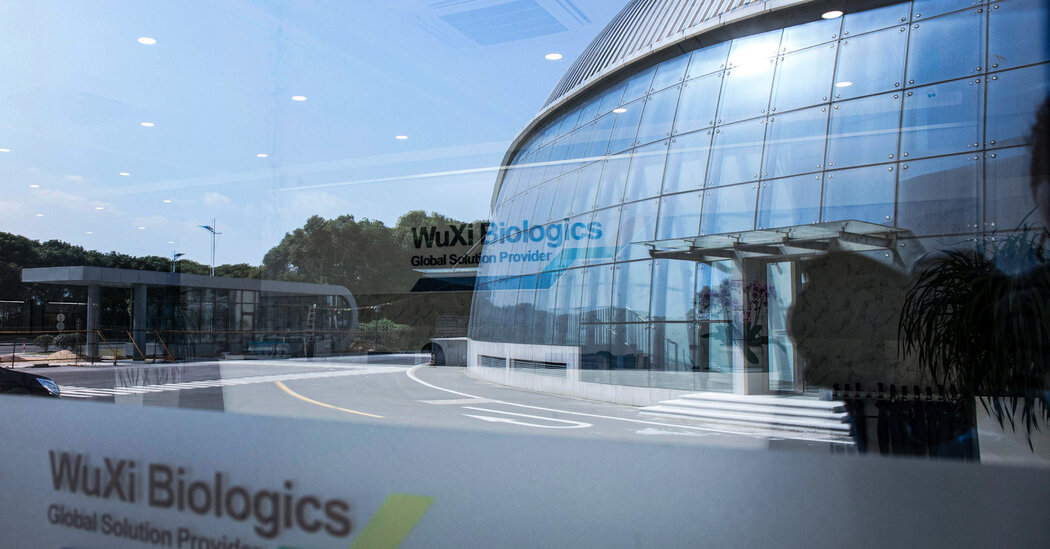

A Chinese company targeted by members of Congress over potential ties to the Chinese government makes blockbuster drugs for the American market that have been hailed as advances in the treatment of cancers, obesity and debilitating illnesses like cystic fibrosis.
WuXi AppTec is one of several companies that lawmakers have identified as potential threats to the security of individual Americans’ genetic information and U.S. intellectual property. A Senate committee approved a bill in March that aides say is intended to push U.S. companies away from doing business with them.
But lawmakers discussing the bill in the Senate and the House have said almost nothing in hearings about the vast scope work WuXi does for the U.S. biotech and pharmaceutical industries — and patients. A New York Times review of hundreds of pages of records worldwide shows that WuXi is heavily embedded in the U.S. medicine chest, making some or all of the main ingredients for multibillion-dollar therapies that are highly sought to treat cancers like some types of leukemia and lymphoma as well as obesity and H.I.V.
The Congressional spotlight on the company has rattled the pharmaceutical industry, which is already struggling with widespread drug shortages now at a 20-year high. Some biotech executives have pushed back, trying to impress on Congress that a sudden decoupling could take some drugs out of the pipeline for years.
WuXi AppTec and an affiliated company, WuXi Biologics grew rapidly, offering services to major U.S. drugmakers that were seeking to shed costs and had shifted most manufacturing overseas in the last several decades.
WuXi companies developed a reputation for low-cost and reliable work by thousands of chemists who could create new molecules and operate complex equipment to make them in bulk. By one estimate, WuXi has been involved in developing one-fourth of the drugs used in the United States. WuXi AppTec reported earning about $3.6 billion in revenue for its U.S. work.
“They have become a one-stop shop to a biotech,” said Kevin Lustig, founder of Scientist.com, a clearinghouse that matches drug companies seeking research help with contractors like WuXi.
WuXi AppTec and WuXi Biologics have also received millions of dollars in tax incentives to build sprawling research and manufacturing sites in Massachusetts and Delaware that local government officials have welcomed as job and revenue generators. One WuXi site in Philadelphia was working alongside a U.S. biotech firm to give patients a cutting-edge therapy that would turbocharge their immune cells to treat advanced skin cancers.
The tension has grown since February, when four lawmakers asked the Commerce, Defense and Treasury Departments to investigate WuXi AppTec and affiliated companies, calling WuXi a “giant that threatens U.S. intellectual property and national security.”
A House bill called the Biosecure Act linked the company to the People’s Liberation Army, the military arm of the Chinese Communist Party. The bill claims WuXi AppTec sponsored military-civil events and received military-civil fusion funding.
Richard Connell, the chief operating officer of WuXi AppTec in the United States and Europe, said the company participates in community events, which do not “imply any association with or endorsement of a government institution, political party or policy such as military-civil fusion.” He also said shareholders do not have control over the company or access to nonpublic information.
Last month, after a classified briefing with intelligence staff, the Senate homeland security committee advanced a bill by a vote of 11 to 1: It would bar the U.S. government from contracting with companies that work with WuXi. Government contracts with drugmakers are generally limited, though they were worth billions of dollars in revenue to companies that responded to the Covid-19 pandemic.
Mr. Connell defended the company’s record, saying the proposed legislation “relies on misleading allegations and inaccurate assertions against our company.”
WuXi operates in a highly regulated environment by “multiple U.S. federal agencies — none of which has placed our company on any sanctions list or designated it as posing a national security risk,” Mr. Connell said. WuXi Biologics did not respond to requests for comment.

Smaller biotech companies, which tend to rely on government grants and have fewer reserves, are among the most alarmed. Dr. Jonathan Kil, the chief executive of Seattle-based Sound Pharmaceuticals, said WuXi has worked alongside the company for 16 years to develop a treatment for hearing loss and tinnitus, or ringing in the ear. Finding another contractor to make the drug could set the company back two years, he said.
“What I don’t want to see is that we get very anti-Chinese to the point where we’re not thinking correctly,” Dr. Kil said.
It is unclear whether a bill targeting WuXi will advance at all this year. The Senate version has been amended to protect existing contracts and limit supply disruptions. Still, the scrutiny has prompted some drug and biotechnology companies to begin making backup plans.
Peter Kolchinsky, managing partner of RA Capital Management, estimated that half of the 200 biotech companies in his firm’s investment portfolio work with WuXi.
“Everyone is likely considering moving away from Wuxi and China more broadly,” he said in an email. “Even though the current versions of the bill don’t create that imperative clearly, no one wants to be caught flat-footed in China if the pullback from China accelerates.”
The chill toward China extends beyond drugmakers. U.S. companies are receiving billions of dollars in funding under the CHIPS Act, a federal law aimed at bringing semiconductor manufacturing stateside.
For the last several years, U.S. intelligence agencies have been warning about Chinese biotech companies in general and WuXi in particular. The National Counterintelligence and Security Center, the arm of the intelligence community charged with warning companies about national security issues, raised alarms about WuXi’s acquisition of NextCODE, an American genomic data company.
Though WuXi later spun off that company, a U.S. official said the government remains skeptical of WuXi’s corporate structure, noting that some independent entities have overlapping management and that there were other signs of the Chinese government’s continuing control or influence over WuXi.
Aides from the Senate homeland security committee said their core concerns are about the misuse of Americans’ genomic data, an issue that’s been more closely tied to other companies named in the bill.
Aides said the effort to discourage companies from working with WuXi and others was influenced by the U.S. government’s experience with Huawei, a Chinese telecommunications giant. By the time Congress acted on concerns about Huawei’s access to Americans’ private information, taxpayers had to pay billions of dollars to tear Huawei’s telecommunication equipment out of the ground.
Yet WuXi has far deeper involvement in American health care than has been discussed in Congress. Supply chain analytics firms QYOBO and Pharm3r, and some public records, show that WuXi and its affiliates have made the active ingredients for critical drugs.
They include Imbruvica, a leukemia treatment sold by Janssen Biotech and AbbVie that brought in $5.9 billion in worldwide revenue in 2023. WuXi subsidiary factories in Shanghai and Changzhou were listed in government records as makers of the drug’s core ingredient, ibrutinib.
Dr. Mikkael A. Sekeres, chief of hematology at the University of Miami Health System, called that treatment for chronic lymphocytic leukemia “truly revolutionary” for replacing highly toxic drugs and extending patients’ lives.
Janssen Biotech and AbbVie, partners in selling the drug, declined to comment.
WuXi Biologics also manufactures Jemperli, a GSK treatment approved by the Food and Drug Administration last year for some endometrial cancers. In combination with standard therapies, the drug improves survival in patients with advanced disease, said Dr. Amanda Nickles Fader, president of the Society of Gynecologic Oncology.
“This is particularly important because while most cancers are plateauing or decreasing in incidence and mortality, endometrial cancer is one of the only cancers globally” increasing in both, Dr. Fader said.
GSK declined to comment.
The drug that possibly captures WuXi’s most significant impact is Trikafta, manufactured by an affiliate in Shanghai and Changzhou to treat cystic fibrosis, a deadly disease that clogs the lungs with debilitating, thick mucus. The treatment is credited with clearing the lungs and extending by decades the life expectancy of about 40,000 U.S. residents. It also had manufacturers in Italy, Portugal and Spain.
The treatment has been so effective that the Make-A-Wish Foundation stopped uniformly granting wishes to children with cystic fibrosis. Trikafta costs about $320,000 a year per patient and has been a boon for Boston-based Vertex Pharmaceuticals and its shareholders, with worldwide revenue rising to $8.9 billion last year from $5.7 billion in 2021, according to a securities filing.
Trikafta “completely transformed cystic fibrosis and did it very quickly,” said Dr. Meghan McGarry, a University of California San Francisco pulmonologist who treats children with the condition. “People came off oxygen and from being hospitalized all the time to not being hospitalized and being able to get a job, go to school and start a family.”
Vertex declined to comment.
Two industry sources said WuXi plays a role in making Eli Lilly’s popular obesity drugs. Eli Lilly did not respond to requests for comment. WuXi companies also make an infusion for treatment-resistant H.I.V., a drug for advanced ovarian cancer and a therapy for adults with a rare disorder called Pompe disease.
WuXi is known for helping biotech firms from the idea stage to mass production, Dr. Kolchinsky said. For example, a start-up could hypothesize that a molecule that sticks to a certain protein might cure a disease. The company would then hire WuXi chemists to create or find the molecule and test it in petri dishes and animals to see whether the idea works — and whether it’s safe enough for humans.
“Your U.S. company has the idea and raises the money and owns the rights to the drug,” Dr. Kolchinsky said. “But they may count on WuXi or similar contractors for almost every step of the process.”
WuXi operates large bioreactors and manufactures complex peptide, immunotherapy and antibody drugs at sprawling plants in China.
WuXi AppTec said it has about 1,900 U.S. employees. Officials in Delaware gave the company $19 million in tax funds in 2021 to build a research and drug manufacturing site that is expected to employ about 1,000 people when fully operational next year, public records and company reports show.
Mayor Kenneth L. Branner Jr. of Middletown, Del., called it “one of those once-in-a-lifetime opportunities to land a company like this,” according to a news report when the deal was approved.
In 2022, the lieutenant governor of Massachusetts expressed a similar sentiment when workers placed the final steel beam on a WuXi Biologics research and manufacturing plant in Worcester. Government officials had approved roughly $11.5 million in tax breaks to support the project. The company announced this year that it would double the site’s planned manufacturing capacity in response to customer demand.
And in Philadelphia, a WuXi Advanced Therapies site next to Iovance Biotherapeutics was approved by regulators to help process individualized cell therapies for skin cancer patients. Iovance has said it is capable of meeting demand for the therapies independently.
By revenue, WuXi Biologics is one of the top five drug development and manufacturing companies worldwide, according to Statista, a data analytics company. A WuXi AppTec annual report showed that two-thirds of its revenue came from U.S. work.
Stepping away from WuXi could cause a “substantial slowdown” in drug development for a majority of the 105 biotech companies surveyed by BioCentury, a trade publication. Just over half said it would be “extremely difficult” to replace China-based drug manufacturers.
BIO, a trade group for the biotechnology industry, is also surveying its members about the impact of disconnecting from WuXi companies. John F. Crowley, BIO’s president, said the effects would be most difficult for companies that rely on WuXi to manufacture complex drugs at commercial scale. Moving such an operation could take five to seven years.
“We have to be very thoughtful about this so that we first do no harm to patients,” Mr. Crowley said. “And that we don’t slow or unnecessarily interfere with the advancement of biomedical research.”
Julian E. Barnes contributed reporting, and Susan C. Beachy contributed research.