
The United States economy is starting to show signs of strain as President Trump’s abrupt moves to shrink federal spending, lay off government workers and impose tariffs on America’s largest trading partners rattle businesses and reverberate across states and cities.
Funding freezes and firings of federal workers combined with the prospect of costly trade wars are souring consumer sentiment, raising inflation expectations and stalling business investment plans, according to recent economic surveys.
Local economies are also bracing for a sudden withdrawal of fiscal support, forcing officials to contemplate tax increases or municipal bond offerings to stabilize their budgets. While Mr. Trump has acknowledged that his policies could bring some initial pain, the early warning signs suggest that his blunt approach could come with more ominous risks to the economy.
“There’s more uncertainty than I think is widely appreciated,” said Michael Strain, an economist at the conservative American Enterprise Institute. “All the uncertainty around trade policy, uncertainty around some of the things that the Department of Government Efficiency is doing, I think will have a chilling effect on investment plans and expansion plans.”
Mr. Trump took office last month at a time of stable economic growth and easing inflation. The U.S. economy continues to be the strongest in the world.
But economists have warned that his plans to enact sweeping tariffs could cause prices to rise and trigger trade wars that would weigh on growth. There are early indications that those worries were valid.
The president’s moves to halt foreign aid and freeze some federal funding have already taken a toll on domestic farmers who export billions of dollars of products as part of American foreign aid programs. While some of Mr. Trump’s orders to halt funding have been paused by courts, they have still caused disruption to early-childhood programs such as Head Start. Billions of dollars of climate and infrastructure investments that were underway during the Biden administration are now in limbo.
A historically strong labor market, with a national unemployment rate of 4 percent, is also in jeopardy. The so-called Department of Government Efficiency, led by Elon Musk, has initiated thousands of job cuts across the federal government. The work force reductions are just beginning as the cost-cutting initiative scrutinizes how agencies align with Mr. Trump’s agenda.
The firings are reverberating beyond Washington, spurring protests at town hall meetings and backlash from some Republican lawmakers, who have expressed alarm about the economic fallout in their states.
“Dozens of Alaskans — potentially over 100 in total — are being fired as part of the Trump administration’s reduction-in-force order for the federal government,” Senator Lisa Murkowski, Republican from Alaska, wrote on X. “Many of these abrupt terminations will do more harm than good, stunting opportunities in Alaska and leaving holes in our communities.”
In Pennsylvania, Gov. Josh Shapiro sued the Trump administration over $2.1 billion in federal funding that was either frozen or placed under review. The money — which is dedicated to programs that ensure mine safety and plug abandoned wells that could leak toxic chemicals — was restored this week, but the freeze created uncertainty in the state.
“The federal government entered into agreements with state government agencies to get those dollars out into people’s communities,” Mr. Shapiro said this week. “Those agreements are binding. To put it simply: A deal is a deal.”
Emily S. Brock, the director of the Federal Liaison Center at the Government Finance Officers Association, said local officials had been scrambling to determine which of their projects could be halted by federal funding freezes. Local governments are worried that the sudden loss of federal money could lead to breached contracts if services suddenly have to stop.
To make up for the withdrawal of federal fiscal support, Ms. Brock said, municipalities are beginning to issue more bonds and look for other ways to raise revenue. She noted that it was a sharp reversal from the postpandemic era, when the Biden administration sent $350 billion of relief money to states and cities.

“To go from $350 billion to nothing, that’s a pretty impressive difference,” Ms. Brock said. “I think that state and local governments are going to have to think creatively about a lot of different things.”
Economists and analysts are also expressing growing concern about the toll on the economy.
Apollo Global Management, an investment firm, estimates that job cuts related to the Department of Government Efficiency could rise to 300,000 and, when government contractors are included, that the total number of layoffs could be closer to one million. That is a small share of the nation’s 160 million workers, but could still affect the job market and other areas of the economy.
“Any increase in layoffs will push jobless claims higher over the coming weeks, and such a rise in the unemployment rate is likely to have consequences for rates, equities and credit,” Torsten Slok, Apollo’s chief economist, wrote in a new report about intensifying risks to the economy.
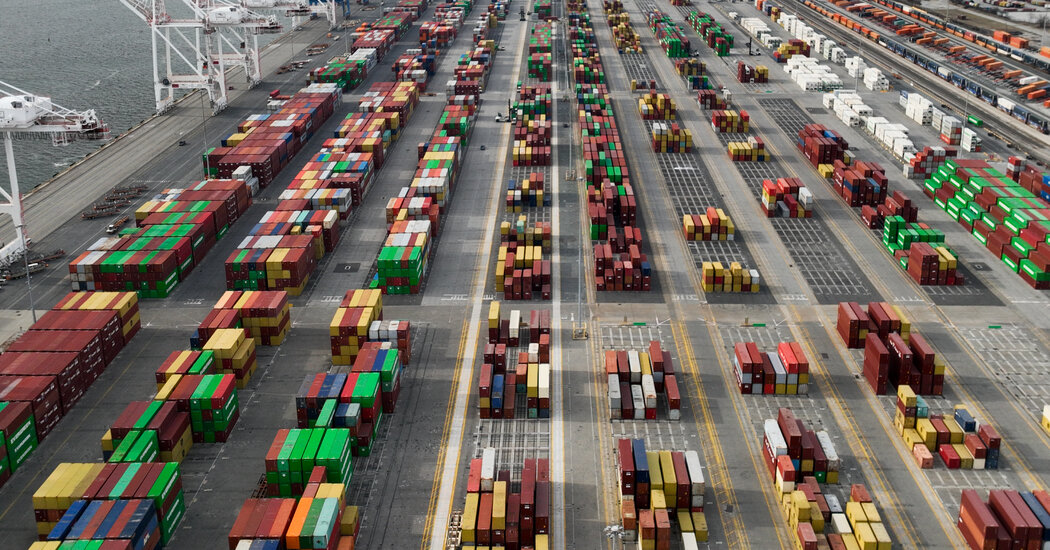
Economic indicators have been showing signs of mounting stress, with much of the anxiety focused on Mr. Trump’s tariffs. This month, he imposed 10 percent tariffs on Chinese imports and nearly imposed 25 percent tariffs on goods from Canada and Mexico, before offering a one-month reprieve. The Trump administration is also preparing to impose higher “reciprocal” tariffs on imports as well as levies on cars, semiconductors and steel and aluminum.
A survey of consumer sentiment published by the Conference Board on Tuesday recorded its largest monthly decline since 2021 in February. The drop was attributed to growing pessimism about employment prospects and future business conditions, with concerns about trade and tariffs reaching levels last seen during the 2019 trade wars in Mr. Trump’s first term.
A measure of corporate activity from S&P Global published last week showed business expansion slowing in the United States in February as a result of “uncertainty and instability surrounding new government policies” such as federal spending cuts and tariff-related developments.
The housing market is also feeling pressure. The National Association of Homebuilders said in its latest report that builder confidence had fallen to a five-month low because of concerns about tariffs, elevated mortgage rates and high housing costs.
During a cabinet meeting on Wednesday, Mr. Trump dismissed suggestions that his policies were creating economic anxiety.
“If you look at confidence in the nation, it had the biggest increase in the history of the chart,” he said of an uptick in confidence after he won the election, without specifying what chart he was referring to.
Morgan Stanley economists estimate that tariffs will raise inflation, as measured by the Personal Consumption Expenditures index, by as much as 0.6 percentage points and depress real consumer spending by as much as two percentage points. The overall hit to inflation-adjusted economic growth could be as high as 1.1 percentage point.
For the Federal Reserve, concerns about the outlook for inflation appear to be outweighing those related to economic growth, minutes from the central bank’s latest meeting showed. That suggests that businesses and consumers hoping for some relief in terms of lower borrowing costs may be waiting for some time. So far, the Fed has suggested that further interest rate cuts are on hold for the foreseeable future.
Mr. Trump’s top economic advisers argue that any economic impact from the tariffs will be offset by the range of other policies the president is pursuing, which include increasing domestic energy production, cutting taxes and government spending, and reducing regulatory red tape.
In an interview on Fox News on Sunday, Treasury Secretary Scott Bessent defended the Trump administration’s actions to shrink the size of the federal government and argued that they were intended to stop the private sector from being crowded out by federal spending.
“We have seen what I would call this orgiastic government spending with the past administration,” Mr. Bessent said. “And we’re going to bring that down.”
But even some of Mr. Trump’s most ardent supporters are viewing the economy with some trepidation. After stock markets plunged last Friday, Larry Kudlow, the Fox Business host who was the National Economic Council director during Mr. Trump’s first term, said investors were not happy that tax cuts appeared to be delayed in Congress and acknowledged that tariffs could temporarily lead to higher prices.
“At least for now, the economic signals are flashing slower growth and higher inflation,” Mr. Kudlow said. “Not good.”
Colby Smith contributed reporting from New York.