
Even when India was staring down the barrel of a 27 percent tariff on most of its exports to the United States, business executives and government officials saw an upside. India’s biggest economic rival, China, and its smaller competitors like Vietnam were facing even worse.
India has been pushing hard in recent years to become a manufacturing alternative to China, and it looked as if it had suddenly gained an advantage.
Then India and its smaller rivals got 90-day reprieves, and President Trump doubled down on China, boosting its tariff to 145 percent.
The sky-high tax on Chinese imports to America presented “a significant opportunity for India’s trade and industry,” said Praveen Khandelwal, a member of Parliament from the ruling party of Prime Minister Narendra Modi and a top figure in the country’s business lobby.
India, with its enormous work force, has been trying to elbow into China’s manufacturing business for a long time, yet its factories are not ready. For the past 10 years Mr. Modi has pursued a goal he named “Make in India.”
The government has paid incentives to companies producing goods in strategic sectors, budgeting over $26 billion, and tried to attract foreign investments in the name of reducing India’s dependence on Chinese imports. One of its goals was to create 100 million new manufacturing jobs by 2022.
There have been successes. The most eye-catching one is that Foxconn, the Taiwanese contract manufacturer, has started making iPhones for Apple in India, moving some work from China.
Yet the role of manufacturing in India over a decade has shrunk, relative to services and agriculture, from 15 percent of the economy to less than 13.
Manufacturing and the jobs it can bring are thought to be crucial to India’s rise as a global power. China, with an economy five times the size of India’s, is the biggest of the Asian countries to have sped toward prosperity by making and selling stuff the rest of the world wants to buy. But manufacturing accounts for a 25 percent share of most East Asian economies — twice as much as in India.
Public infrastructure has come a long way under Mr. Modi’s direction. But 10 years has not been enough time to train the country’s growing work force to match businesses’ needs. And the route remains bumpy when it comes to connecting India’s pockets of economic strength to one another.
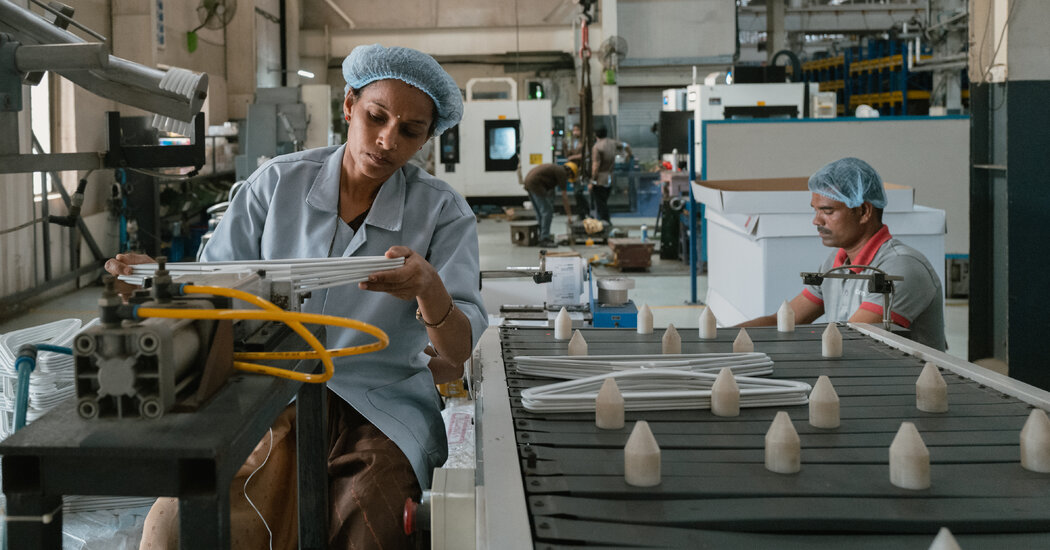
Barely an hour from New Delhi on a new eight-lane elevated highway, the Rai Industrial Estate in Haryana occupies land that grew wheat and mustard crops earlier this century. Some of the factories on the dusty grid inside have been grinding out auto parts and processed foods for 20 years. Others are just starting, hoping for an imminent breakthrough.
Vikram Bathla, who in 2019 founded LiKraft, which manufactures lithium-ion batteries for vehicles, said access to technology was the most frustrating obstacle to his business. He depends heavily on imports, which need to be bought in bulk and take time to ship, and finds it difficult to hire the people he needs to do highly technical work.
“We can buy the equipment, and we do” — and most of it comes from China. “What we don’t have,” he said, “is the skilled workers to use it.” For five years, he said, he has been trying to catch up with competitors that started 15 years before him.
Mr. Bathla, tall, mild-mannered and English-speaking, paces among LiKraft’s 300 workers, most of them migrants from poorer Indian states, quietly bent over brightly lit benches, assembling batteries. They start with cells imported from China, some of them turquoise cylinders labeled “Made in Inner Mongolia.”

Other workers operate larger machines, also imported from China, to weld cells and electronic components into batteries. The finished products will be marked “Made in India.” But the supply chain is foreign.
It is not just a high-tech phenomenon. Another factory, half a mile away in the same industrial park, depends on foreign inputs, too.
AutoKame designs, cuts and sews car-seat covers for the Indian market. Its high-precision fabric cutters, with whirring, robotic arms, are imported from Germany and Italy. The synthetic fiber also has to be imported.
Expensive raw materials are only the tip of the iceberg, said Anil Bhardwaj, the secretary general of a trade organization for manufacturing businesses. Also contributing to the problem, he said, are the high cost of land, a shortage of the right kinds of engineers and a lack of good financing from banks. Many difficulties that he and other owners face are about inconsistent government policy and red tape, problems that have dogged Indian industry for many decades.
Mr. Bhardwaj also cited a less obvious need faced by manufacturers: a well-functioning justice system. India’s courts are slow and their rulings arbitrary, he said, putting small businesses like his colleagues’ at the mercy of larger firms that can afford better lawyers and political influence.
“That’s why people really fear the big companies in India,” he said.
Smaller companies can’t afford to confront them, or the politicians and regulators who accommodate them. India’s court system is so disastrously backed up — with more than 50 million cases pending — that any entanglement can turn deadly for a smaller player. So they avoid growing, and miss out on efficiencies of scale.
He and other experts acknowledge significant improvements in recent years. For instance, power, which was in short supply 10 years ago, has become plentiful in places like Haryana’s industrial parks, though it is not as reliable as the small factories there would like. Many government processes have been streamlined during Mr. Modi’s time in office.
And states have managed to replicate some parts of the production system that made China’s factories the world’s envy. A cluster of Apple suppliers in the state of Tamil Nadu is by some estimates producing 20 percent of the world’s iPhones. Until the past few years, nearly all were made in China.
Records from Tamil Nadu’s main airport show that in the weeks before Mr. Trump announced his 27 percent tariff, outbound shipments of electronics doubled, to more than 2,000 tons a month, as Apple and other companies stocked up. A decision on Friday by Mr. Trump to exclude smartphones and other electronics could tamp down the rush to ship iPhones to America.
Still, long-term changes are afoot. A person who works closely with Apple’s suppliers, who was not authorized to discuss their plans publicly, said the suppliers were hoping to ramp up production so India could make 30 percent of the world’s iPhones.
Mr. Khandelwal, the politician, said India was ready to seize the overnight advantage created by the 145 percent tariff against China across many industries, including electronics, auto parts, textiles and chemicals.
Smaller factory owners are eager for the same things. But they see big old Indian obstacles in their way, the very kind that have resisted reform for decades.