
Follow live updates on Trump’s cabinet picks and other administration news.
America has seen this movie before: President Trump, who imposed stiff tariffs on Monday on imported steel and aluminum, did so once before, in 2018. So domestic industries have a pretty good idea of how the story ends.
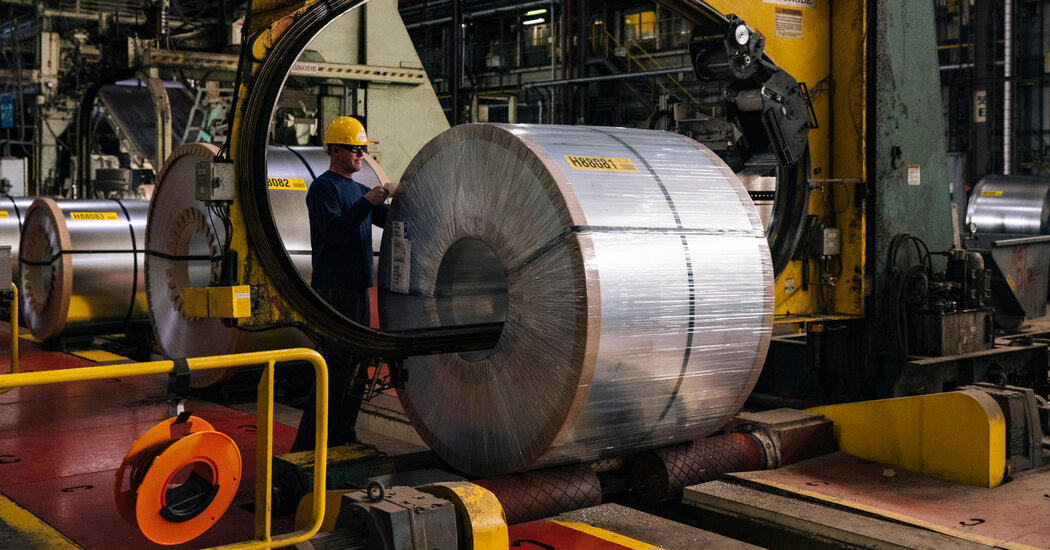
Manufacturers of trucks, appliances and construction equipment scramble to find U.S. sources of metal inputs, keeping steel and aluminum producers busier than they were before. Companies that need specific alloys that aren’t made domestically are forced to pay more. Prices rise, making end products more expensive.
But there may be plot twists along the way. Will Mr. Trump cut deals with some countries, allowing large shipments in without the new duties? Will he set up a process to give companies a reprieve if they can demonstrate a hardship? (On Monday, a White House official said there would be no exclusions.)
All of those could affect the outcome, which is why steel users are proceeding with caution before the metal tariffs take effect on March 12. Angela Holt, who runs a precision machining company and heads the board of the Indiana Manufacturers Association, says the potential impacts on businesses are “complex.”
“It could affect not only the cost but the availability, depending on their situation,” Ms. Holt said. “It’s highly varied, even among industries — I think it’s going to depend on an individual basis where they source their materials, what the competition looks like.”
Lessons From Last Time
Although the American steel and aluminum industries are far weaker than they were in their heyday in the 1970s, U.S. companies import only about 26 percent of the steel they use, according to the International Trade Administration, and that number has been falling.
At the same time, end users seeking alternatives to foreign suppliers may have options. U.S. iron and steel producers are operating at only about 70 percent capacity. The first Trump administration aimed to get to 80 percent, and did so briefly. But underpriced Chinese exports have taken a toll on domestic producers in recent years, forcing older, less efficient mills to close and leaving others with fewer orders than they can handle.
Also, primary metal tariffs don’t appear to be completely passed on to consumers. According to a 2020 study by economists at Columbia University, Princeton University and the Federal Reserve Bank of New York, foreign exporters absorbed about half of the 2018 steel tariffs, dropping their prices to maintain access to the U.S. market.
Still, that doesn’t mean prices won’t increase. In 2023, the U.S. International Trade Commission found that those tariffs increased steel and aluminum prices on average by 2.4 percent and 1.6 percent. Perhaps accordingly, the stocks of U.S. metals processors like Nucor, Steel Dynamics and Cleveland-Cliffs rose on Monday, in anticipation of Mr. Trump’s tariff announcement.
“I think the big takeaway is there were a lot of downstream industries that were impacted,” said Alex Durante, a senior economist at the Tax Foundation who has written about the economic impact of tariffs. “The main effects outweighed whatever positive effect on the steel and aluminum producers, the smelters and refineries.”
There are also reasons to think the impact might be worse for metal users this time.
U.S. manufacturing is in a delicate state, muffled by high interest rates and a strong dollar that makes exports less competitive. Unemployment remains low, and as the Trump administration cracks down on immigration, labor may get more expensive. Steel and aluminum prices spiked during the Covid-19 pandemic and haven’t yet fallen to their previous levels.
That’s why additional tariffs could have a greater impact — especially if they end up stacked on top of across-the-board tariffs on Canadian imports, which Mr. Trump has said could take effect on March 1.

“It contributes to a number of things that are already putting stress on a tight macroeconomic situation,” said Chad Bown, a senior fellow at the Peterson Institute for International Economics.
Cans, Houses, Cars
For an idea of which industries could be most affected by new tariffs, it’s helpful to look at how important steel and aluminum are to their production.
As part of its report on the impact of the 2018 Trump tariffs, the International Trade Commission ranked industries by their dependence on the two metals. A type of business that uses the most steel is motor vehicle metal stamping, at 58 percent, with other components of auto manufacturing also using quite a bit.
While much of the steel that auto manufacturers use is produced in the United States, those companies and their suppliers also depend on specialized alloys that are available only from overseas producers. Virtually all automakers would be affected, including Tesla, which in 2023 petitioned for an exemption to tariffs. The company told officials it needed steel available only from abroad, reportedly for the Cybertruck, which has a stainless steel body. (Tesla’s stock price dropped 3 percent on Monday.)
Many automakers are already struggling to remain profitable in the face of increased competition from Chinese automakers and the cost of developing electric models. Tariffs on goods from Mexico and Canada could damage the creditworthiness of some manufacturers — particularly Nissan and Stellantis — said Fitch Ratings, which grades company finances.
Next up for reliance on steel: buildings. Commercial construction and large apartment buildings require a lot of rebar — a steel reinforcement in concrete — which could add quite a bit to the bill for developers. Carl Harris, the chairman of the National Association of Home Builders, noted on Monday that Mr. Trump had said he wanted to make housing more affordable.
“His move to impose 25 percent tariffs on all steel and aluminum products imports into the U.S. runs totally counter to this goal by raising home building costs, deterring new development and frustrating efforts to rebuild in the wake of natural disasters,” Mr. Harris said in a statement. “Ultimately, consumers will pay for these tariffs in the form of higher home prices.”
One sector that uses no steel but a lot of aluminum is brewing and soft drink bottling. In 2018, when aluminum tariffs were set at 10 percent, they added half a billion dollars to production costs, according to the American Beverage Association.
Planes and Bridges?
The impact on other industries is unclear.
Higher aluminum prices could affect Boeing, for example. The company is already behind schedule on jet deliveries after a quality crisis and extended worker strike last year. In a recent securities filing, it said tariffs, particularly on aluminum and titanium, could mean that the company would be “unable to deliver one or more of our products in a timely fashion or at budgeted costs.”
But when Mr. Trump imposed similar restrictions on aluminum and steel in 2018, Boeing and its top supplier, Spirit AeroSystems, said the effects were limited.
Boeing’s chief executive at the time, Dennis Muilenburg, said at an investor conference that the company sourced about 90 percent of its aluminum within the United States, adding that Boeing was “not significantly exposed.” The company and its suppliers also use consortia and long-term contracts to securely source and stabilize prices of raw materials.
Another big user of metal is the federal government, through construction and repair of railroads, bridges, submarines and aircraft carriers. Most of those are already required to use domestically produced steel and aluminum, but tariffs can push up those prices, too.
Tariffs could also feed into the price of energy, both fossil-fuel-based and renewable. Drilling equipment and pipelines for oil and gas are made of steel and aluminum, as are racks for solar arrays and towers for wind turbines. And building new transmission lines, which is necessary for both types of energy, would get more expensive.
Energy companies could sidestep tariffs by buying those finished goods from overseas. But that would undermine the goal of the Biden administration’s subsidies for renewable energy development that used domestically produced parts and equipment, which had fueled a small boom in U.S. factory construction.
Jack Ewing, Niraj Chokshi and Rebecca Elliott contributed reporting. Susan C. Beachy contributed research.